McLennan County Courthouse
Text
Built in 1901, the McLennan County Courthouse holds pride of place within Waco as not only a functioning center of justice but also the city’s most impressive civic building.
Designed by James Riley Gordon, the renowned architect responsible for the Ellis County Courthouse in Waxahachie and the Arizona State Capital building, the McLennan County Courthouse has a neoclassical exterior. The courthouse’s pilasters and columns are Corinthian. The courthouse features three justice-themed statues. On top of the central dome stands Themis, the Greek goddess of divine order. In her right hand, Themis holds a double-edged sword that represents the law as the chief instrument of justice. Her left hand holds aloft a pair of scales intended to symbolize the weighing of facts in the balance by the courts. The other two statues are located on the upper roof below the dome. One is Justitia, the Roman goddess of justice, and the other appears to be a classical version of Lady Liberty.
The interior of the courthouse is also ornate. The Tenth Court of Civil Appeals features columns made of Kenesaw marble. Stained-glass art pieces with brilliant blue hues and star designs grace the inside ceiling of the dome.
In addition to its courtrooms, the structure is also the seat of the McLennan County government. As a result, the building is charged with the task of storing the legal records of the entire county. At first there was more than enough room to house paper copies of the records. However, as the population of McLennan County increased in the mid-twentieth century, the existing office space and cabinetry proved insufficient. To create more space, McLennan County renovated much of the courthouse’s interior.
Many notable legal cases have taken place in the courthouse. Clyde Barrow, of Bonnie and Clyde fame, stood trial there in 1930 for numerous criminal charges including burglary and theft. Judge Richard I. Munroe sentenced Barrow to a two-year prison sentence for the above offenses, but Barrow broke out of the McLennan County Jail before he could be transferred to the state jail at Huntsville. Furthermore, the first live televised murder trial took place in the building in December of 1955, when Judge D. W. Bartlett allowed local station KWTX-TV to film the proceedings of the Harry L. Washburn trial in the 54th State District Court.
Files
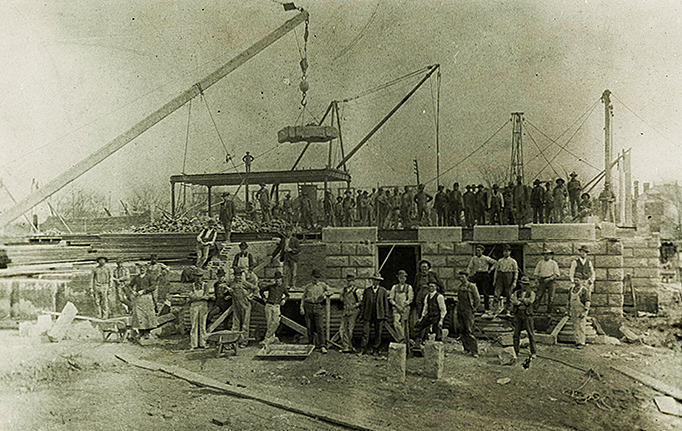
Construction Begins (1900)
The lot for the courthouse cost $15,000. McLennan County voters approved $250,000 in bonds for its construction. Note how the disorderly display of building materials is contrasted by the clear social divide between the well-dressed foremen at the front of the image and builders located towards the back. | Source: Image courtesy of the Texas Collection, Baylor University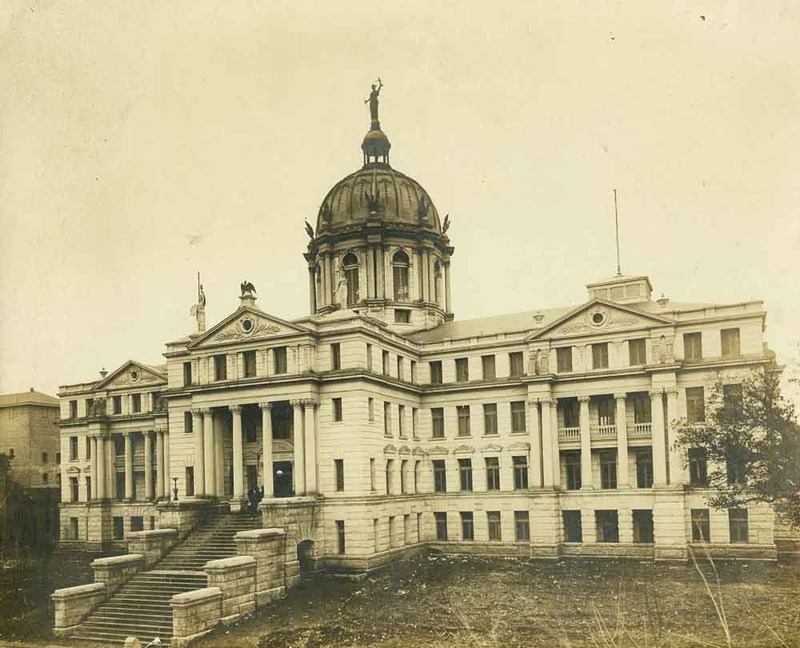
Courthouse Exterior (early 1900s)
The lack of landscaping in this image of the newly built courthouse makes the impressive classical detailing on the exterior all the more apparent. These architectural embellishments include urns with torches, ribands tied in bowknots, wreaths, leaves, and fluted columns. | Source: Image courtesy of the Texas Collection, Baylor University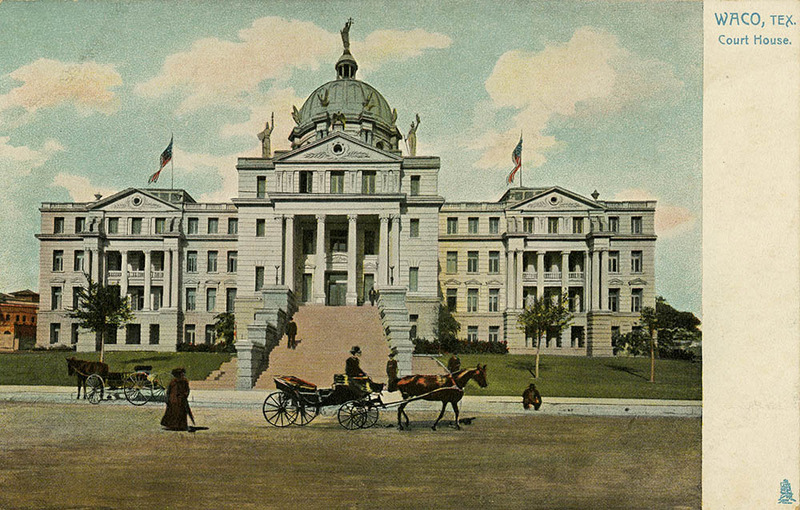
Souvenir Postcard
By constructing such a large and elegant courthouse, McLennan County sent a message to visitors and residents alike that the rule of law would not only be respected there but enshrined. | Source: Image courtesy of the Texas Collection, Baylor University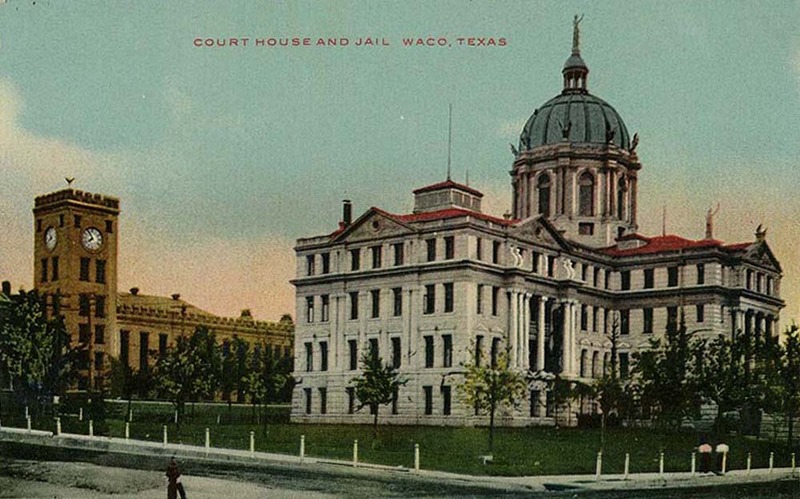
Souvenir Postcard
A Victorian-style jail used to be located just behind the McLennan County Courthouse. While beautiful in appearance, its design rendered it impractical as inmate populations increased during the early twentieth century.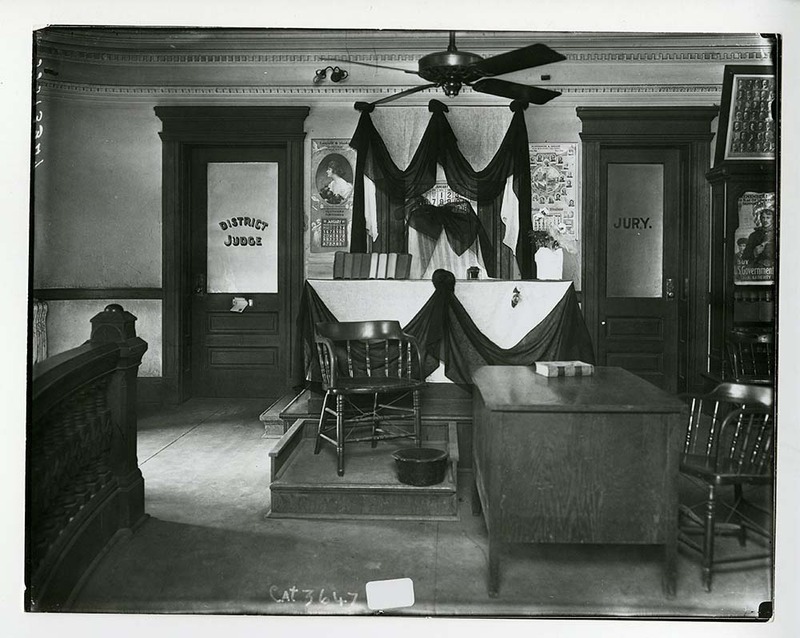
Courtroom circa January 1919
This image is striking for its rich period detail. The courtroom is decorated with black bunting that generally signifies a period of mourning. The bunting could be to commemorate the passing of a county lawyer/judge or the lives lost to the 1918 influenza pandemic. Note the spittoon, or cuspidor, located to the right of the witness stand. In the early twentieth century, every room of the courthouse contained a cuspidor. | Source: Image courtesy of the Texas Collection, Baylor University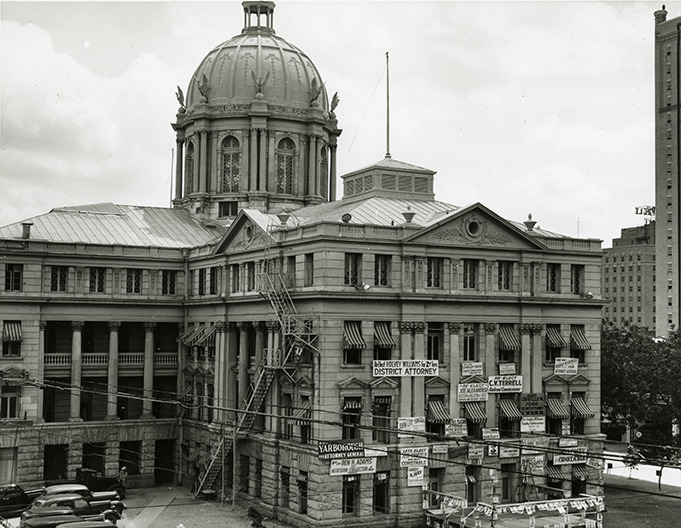
Where the Rubber Meets the Road
This image reveals that the courthouse served as a center of political life as well as a center of justice. The platform on the right is where candidates would make their appeals to members of the public who came to spectate from a lawn on Sixth Street. While the exact date of the photograph is unknown, the campaign banner promoting Raplph Yarborough for state Attorney General, likely places it within the 1938 Democratic primary. | Source: Image courtesy of the Texas Collection, Baylor University
Two Marriages in One Day
Bill C. Logue tells the story of a gentleman buying and changing a marriage license at the courthouse in the 1930s. | Source: Logue, Bill C., interviewed by M. Rebecca Sharpless, February 23, 1994, in Waco, Texas. Baylor University Institute for Oral History, Waco, TX. View the full interviewMurder Trials as a Thing of Interest
Bill C. Logue explains how people would go to the courthouse to listen to the trials in the 1930s. | Source: Logue, Bill C., interviewed by M. Rebecca Sharpless, February 23, 1994, in Waco, Texas. Baylor University Institute for Oral History, Waco, TX. View the full interview.