R. T. Dennis and Co., Inc.
Text
R. T. Dennis and Co. helped furnish the homes of Central Texas for nearly seventy years. Known for its exceptional quality furnishings, R. T. Dennis thrived in downtown Waco and served as the premier home décor destination. Unfortunately, the R. T. Dennis building, as well as the company, met their end when an F5 tornado leveled the building in May 1953.
R. T. Dennis and Co. was born out of the dream of two brothers, Robert T. Dennis and James K. Dennis, in 1886. The two brothers first moved to Central Texas in 1874 and worked as rail-splitters in Hillsboro for a short time. Robert then tried his hand in the grocery and dry-goods businesses, but his passion existed elsewhere. Robert joined the furniture business, taking a job in 1875 with W. P. Martin and Bro., Furniture as a delivery wagon driver. He saw promotions to salesperson and bookkeeper in the coming years. After twelve years of learning the trade, Robert felt confident to step out on his own, and he started R. T. Dennis and Brother with James in Gatesville. In 1889, they decided to move their operations to Waco, as the city was growing rapidly and taking off as a market center. In 1892, the Dennis brothers rented a building on the corner of Fifth Street and Austin Avenue constructed by Richard Coke, which they later purchased in 1904, and the scene was set for the expansion of their business.
What began largely as a coffin and funeral service business soon exploded into a vibrant retail and wholesale enterprise for all types of furniture and carpets. In the first six months of operations in Waco, the company’s net worth skyrocketed from $8,000 to $50,000. R. T. Dennis and Co. also opened stores in Hillsboro (run by James Dennis), Bryan, and Temple. This sudden rise to success made Robert Dennis an important man in the Waco community, and he soon became the director of the Farmers and Merchants National Bank of Waco and eventually invested in a number of business ventures in town, including the ALICO building. He also kick-started Dennis Manufacturing, which produced some of the furniture for his store. Robert even used a bit of pageantry to advertise his business and attract attention, sometimes putting the costumes from the local opera in his shop windows and always having an impressive display at the Texas Cotton Palace each year. By 1915, the Dennis brothers were able to buy out rival furniture store Stratton Furniture and further expand their reach in the Waco economy. Following World War I, R. T. Dennis and Co. purchased the Tom Padgitt Company building that abutted the store to use as a warehouse, making the entire block of Fifth Street from Austin Avenue to Franklin Avenue under R. T. Dennis’s ownership.
The 1920s brought further growth for the company but also the loss of its founder. In 1920, Dennis decided to incorporate for an impressive sum of $500,000, and the company became R. T. Dennis and Co., Inc. The same year, Dennis sold Dennis Manufacturing and dedicated the business entirely to retail and wholesale furniture. By 1924 the company had started a mattress factory and employed four traveling salesmen covering three states: Texas, Oklahoma, and New Mexico. These men traveled with photographs and catalogs and allowed people to place orders for R. T. Dennis furniture from afar. This required the company to keep a large stock on hand, and as a result it purchased real estate around Waco to use as warehouses. One such purchase came in 1926 when R. T. Dennis bought Waco Dry Goods on Sixth Street and Jackson Avenue. The Hilton then tapped R. T. Dennis to furnish its new hotel in downtown Waco in 1928 (which later became the Roosevelt Hotel). This turned out to be Dennis’s last major business deal, as he died in June of 1928 of a prolonged illness. Treasurer Willard Robert Wigley, whose father, W. J. Wigley, had helped found R. T. Dennis and Co. and R. T. Dennis and Wigley Co. (Dallas), took over as president upon Dennis’s death and remained in that position until the dissolution of the company.
R. T. Dennis and Co. went on to weather the Depression of the 1930s quite well, marketing their products as necessary and practical. Robert Dennis’s nephew-in-law, Rush H. Berry, enjoyed a promotion in the mid-1930s from secretary to vice president, a position he held until his death. In the 1940s his own son, Labon E. Berry, filled the secretary position and become general manager, with business continuing steadily throughout World War II. In 1950 the company was named to the Grand Rapids Furniture Makers Guild, a guild reserved for only the highest-quality furniture companies.
Despite all its success, the end of R. T. Dennis and Co. came swiftly and suddenly. On May 11, 1953, a massive Category 5 tornado ripped through downtown Waco. The site of the R. T. Dennis building was classified as the “impact area,” receiving the full force of the twister. Both the R. T. Dennis and Tom Padgitt buildings were reduced to rubble. Of the thirty-one employees in the building, twenty-two were killed. Some employees sought shelter in the basement, only for the basement to flood when the debris punctured a water pipe. Rescue volunteers worked for three days straight trying to clear the rubble and recover the bodies of those inside.
Included in the deceased were Rush H. Berry, vice president and treasurer, and Labon E. Berry, secretary and general manager. President Willard Wigley stood as the only surviving executive of the company, and he was soon hospitalized in Dallas for leukemia. With all its leadership deceased or incapacitated, the R. T. Dennis Board of Directors decided to close the company for good and to liquidate the remaining stock in Hillsboro, Temple, and Bryan. In a somber address, the granddaughter of R. T. Dennis and chairwoman of the board, Mrs. William Sloane, broke the news to the public in October 1953 that R. T. Dennis and Co., Inc., would not reopen. The historical marker of the tornado is located near the former R. T. Dennis building location.
Though the memory of R. T. Dennis and Co. will forever be linked to the 1953 tornado, the company was a source of light and prosperity in Waco for decades through its dedication to the community and quality service.
Files
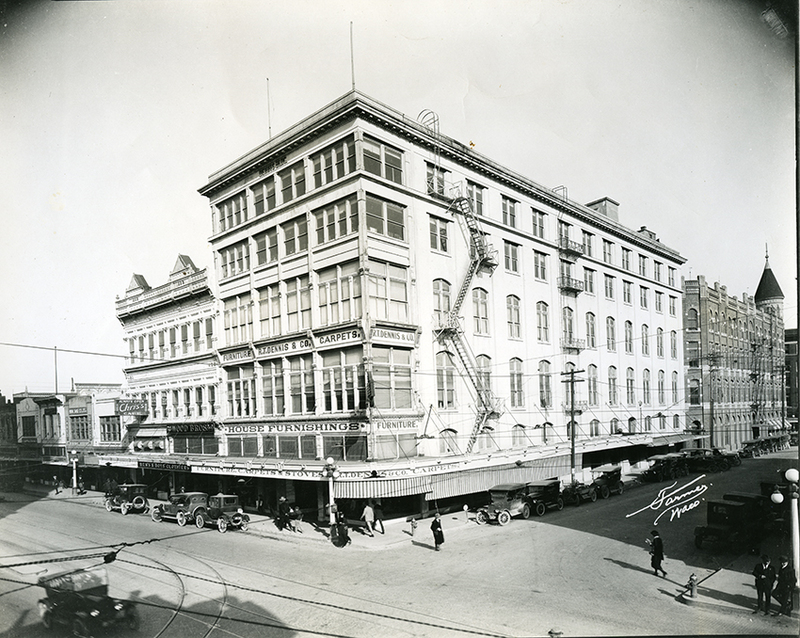
R.T. Dennis Building in 1920s
The R. T. Dennis building originally had only three stories, but it grew before its destruction by the 1953 tornado. It stood at three stories until 1909, when two additional stories were added, and then the inside was redone to have eight floors including a basement. Though floors were added, no further reinforcements were made, making the building susceptible when the tornado hit. | Source: "RT Dennis & Co. and Tom Padgitt Inc. Buildings, Waco, Texas," The Texas Collection, Baylor University photo stream, Flickr, https://www.flickr.com/photos/texascollectionbaylor/8674146212/in/photostream/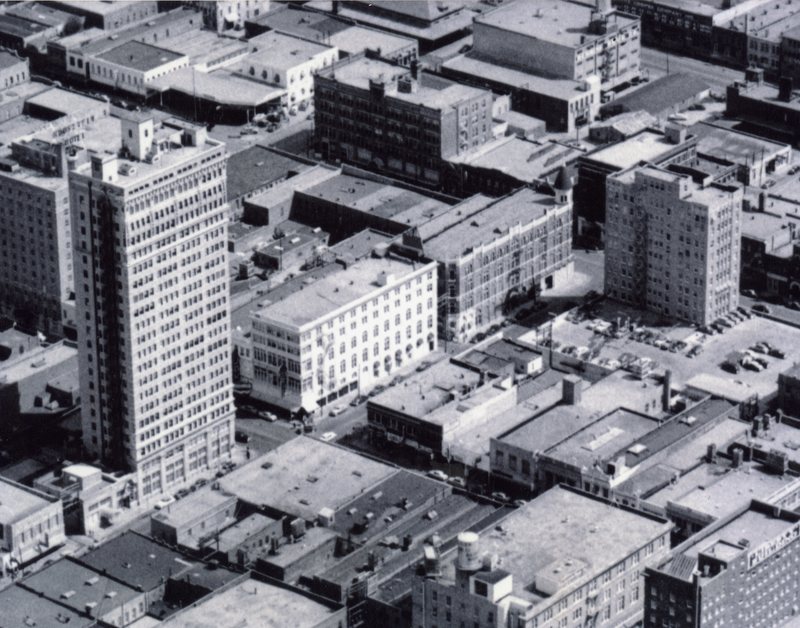
Aerial View
The R. T. Dennis building sat at the corner of Austin Avenue and Fifth Street. Austin Avenue ran between R. T. Dennis and the ALICO buildings. | Source: Wilton Lanning Papers, Series 2 Waco Tornado, Box 9, The Texas Collection, Baylor University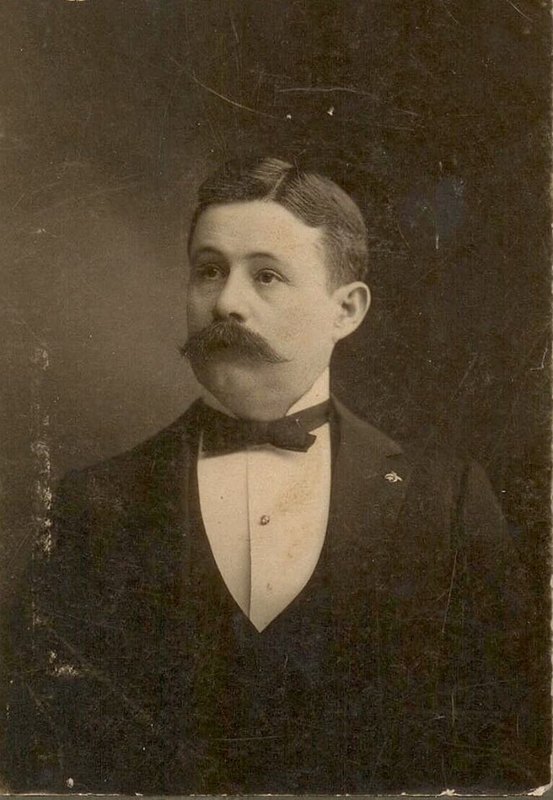
Robert Thornton Dennis
Robert Thornton Dennis was born in Alabama in 1859, and he lived in New Orleans and Virginia before finally making it to Texas at the age of fifteen. In 1888 he joined the Freemasons and became a member of Waco Lodge 92 in 1889. He lived at 1923 Austin Avenue with his wife Annie Kirkpatrick Dennis and their children. | Source: “Robert Dennis.” Waco Masonic Lodge #92, www.wacomasonic.org/robert-dennis/.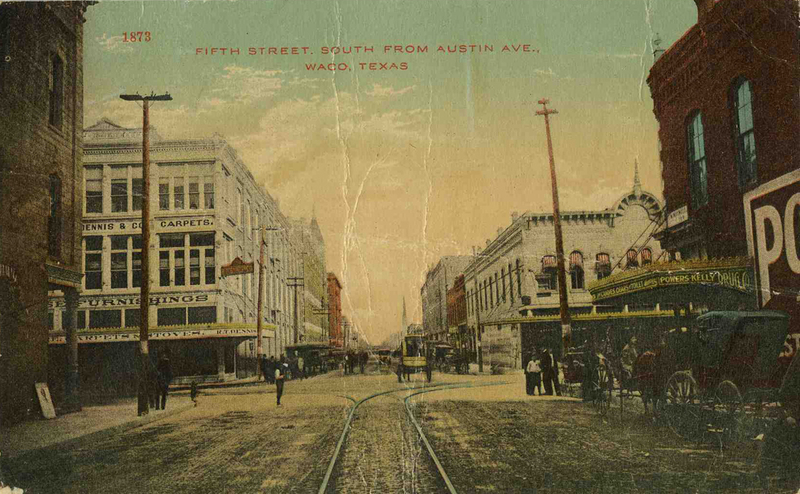
Fifth Street
This image shows the R. T. Dennis building on the left as one traveled down what later became Fifth Street. The image shows a great representation of the roads through Waco in the late nineteenth century, though the date at the top left-hand corner is incorrect, as R. T. Dennis and Co. was not founded until 1888. | Source: "Fifth Street South from Austin Ave., Waco, Texas," The Texas Collection, Baylor University photo stream, Flickr, https://www.flickr.com/photos/texascollectionbaylor/6169483607/in/album-72157624609439808/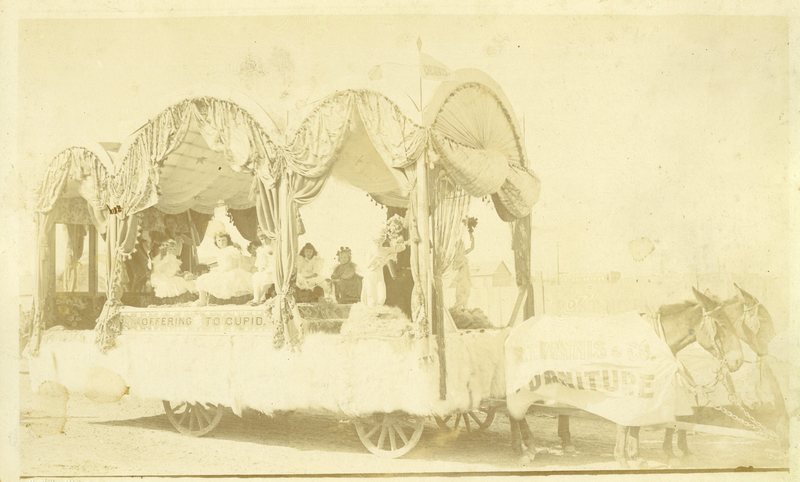
Parade Float
This R. T. Dennis parade float was likely part of the Cotton Palace Expo during the early twentieth century in Waco. Dennis prided himself on his elaborate displays at the expo, such as this beautiful float ridden by young girls titled “An Offering to Cupid.” | Source: Wilton Lanning Papers, Series 2 Waco Tornado, Box 9, The Texas Collection, Baylor University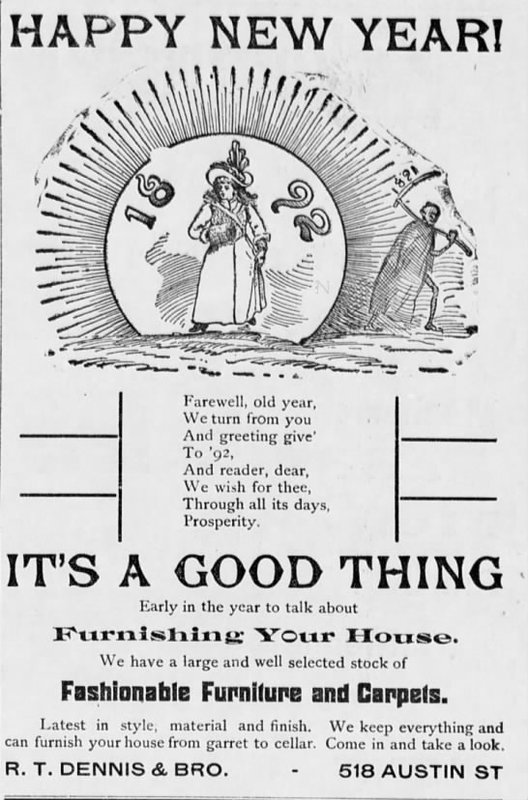
1892 Advertisement
R. T. Dennis and Co. housed the biggest drapery department in the entire state of Texas. | Source: “Robert Dennis.” Waco Masonic Lodge #92, www.wacomasonic.org/robert-dennis/.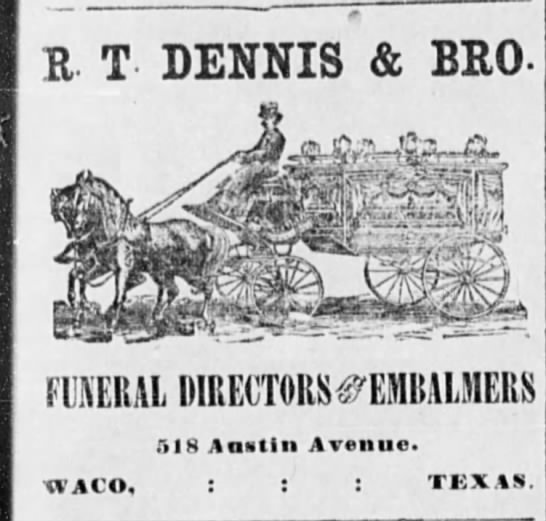
1892 Advertisement
The Martin Brothers sent R. T. Dennis to St. Louis to study embalming when he was under their employ. When he returned, he performed the first embalming in Waco’s history. Since furniture stores often sold funeral furniture and performed undertaker services, this proved to be a new competitive edge for the Martin Brothers, and Dennis continued his embalming services when he started his own company. | Source: “Robert Dennis.” Waco Masonic Lodge #92, www.wacomasonic.org/robert-dennis/.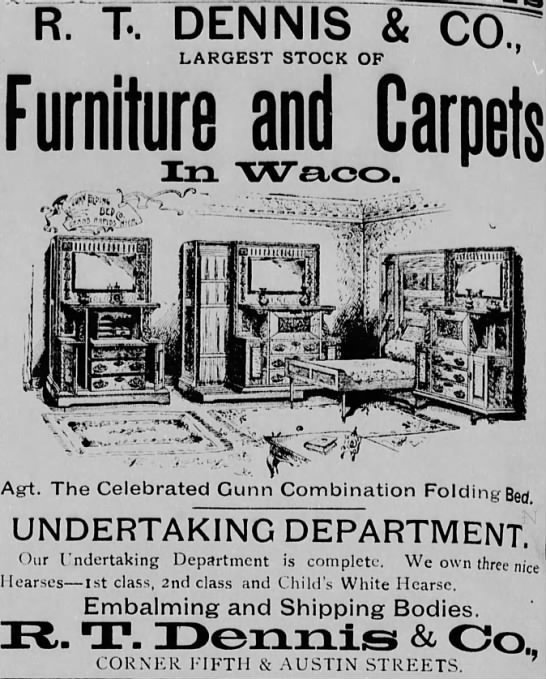
1893 Advertisement
Folding beds were extremely popular in the United States until around 1894. R. T. Dennis carried the most well-known folding bed, produced by Gunn Folding Bed Co. of Grand Rapids, Michigan, until the product’s decline in popularity. | Source: “Robert Dennis.” Waco Masonic Lodge #92, www.wacomasonic.org/robert-dennis/.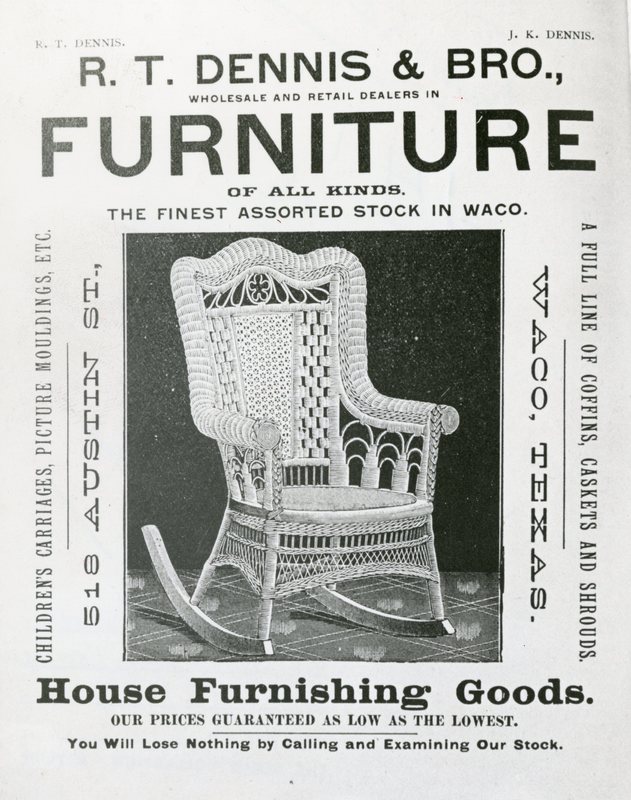
1896s Advertisement
R. T. Dennis carried one of the largest retail stocks in the state of Texas and delivered to almost anywhere in the state. Dennis traveled around the country buying stock for his store, from Grand Rapids to Chicago and New York, so the selection was also one of the best in the state. In the late nineteenth and early twentieth centuries, such travel was no easy task. | Source: Wilton Lanning Papers, Series 2 Waco Tornado, Box 9, The Texas Collection, Baylor University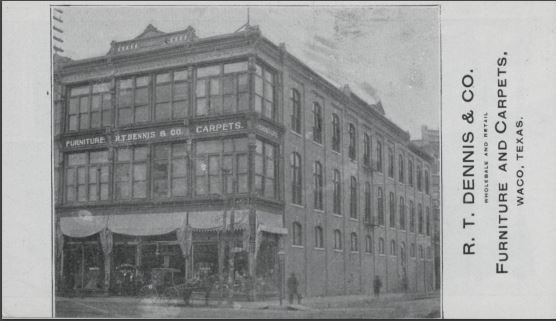
R. T. Dennis circa 1901
The R. T. Dennis building as pictured here is close to the building originally purchased from Sen. Richard Coke in 1892. At the time it was three stories, with only a small awning at the front windows. The company later expanded the awning around the side of the building and added more stories. | Source: Knight, W.B., "Waco, Texas: The Central City of the Lone Star State," Knight Printing Company, Waco, Texas, 1901. The Texas Collection, Baylor University, http://digitalcollections.baylor.edu/cdm/ref/collection/07texas-pro/id/1073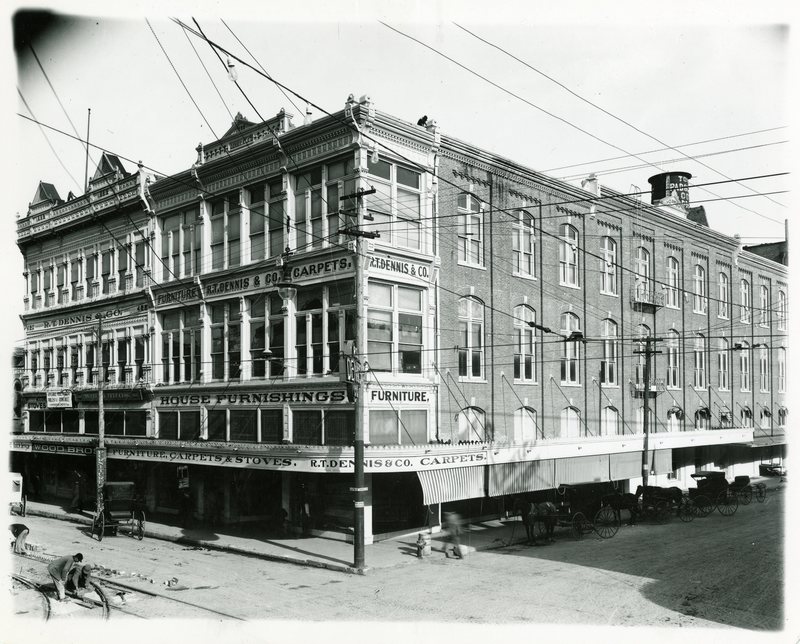
R. T. Dennis circa 1907
In 1915, R. T. Dennis redid the entire inside of the store in preparation for the visitors coming for the Cotton Palace expo. | Source: Wilton Lanning Papers, Series 2 Waco Tornado, Box 9, the Texas Collection, Baylor University.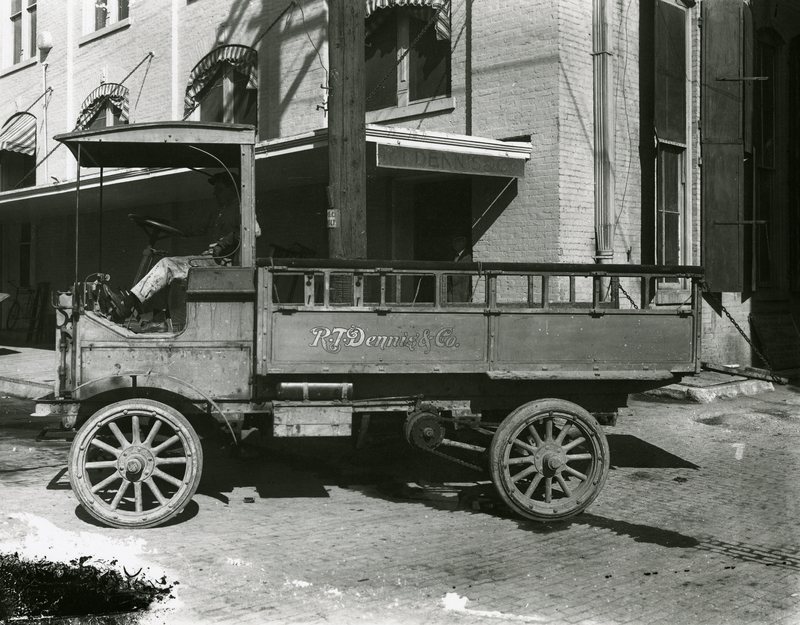
Delivery Truck
R. T. Dennis changed with the times, originally delivering furniture and conducting undertaker services using horse-drawn carts. As technology improved and cars came on the scene, R. T. Dennis upgraded its delivery methods. | Source: Wilton Lanning Papers, Series 2 Waco Tornado, Box 9, The Texas Collection, Baylor University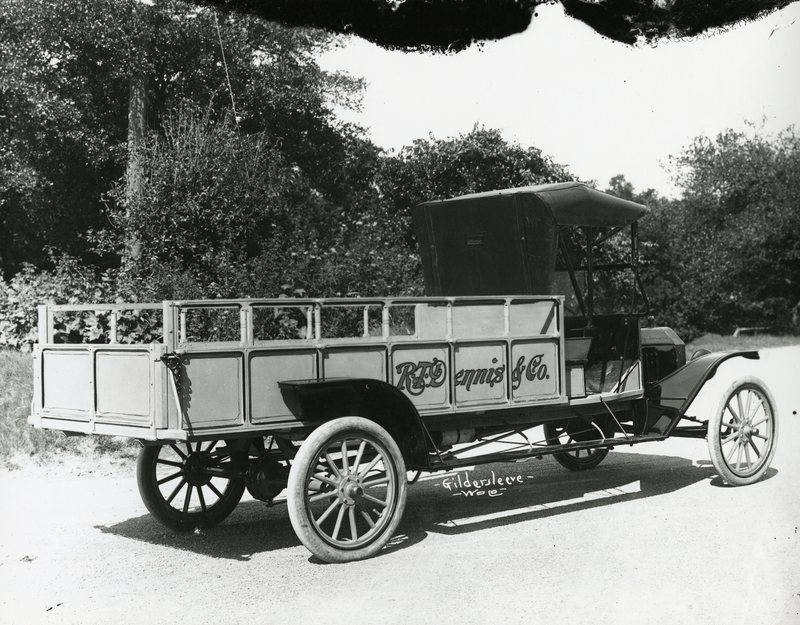
Dedicated Drivers
R. T. Dennis had an impressive delivery range, driving furniture as far as Houston and Dallas. | Source: Wilton Lanning Papers, Series 2 Waco Tornado, Box 9, The Texas Collection, Baylor University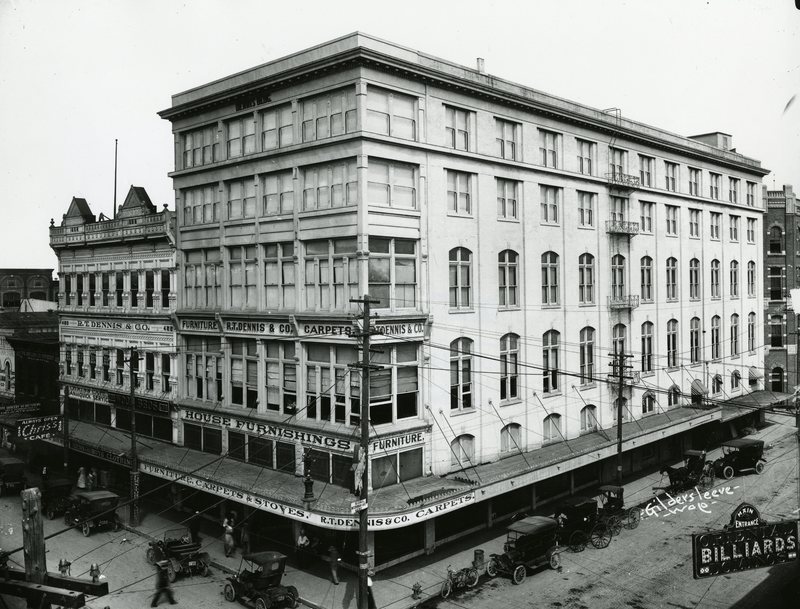
R. T. Dennis circa 1920
In the 1920s, R. T. Dennis’s top-selling products were radios and phonographs. | Source: Wilton Lanning Papers, Series 2 Waco Tornado, Box 9, The Texas Collection, Baylor University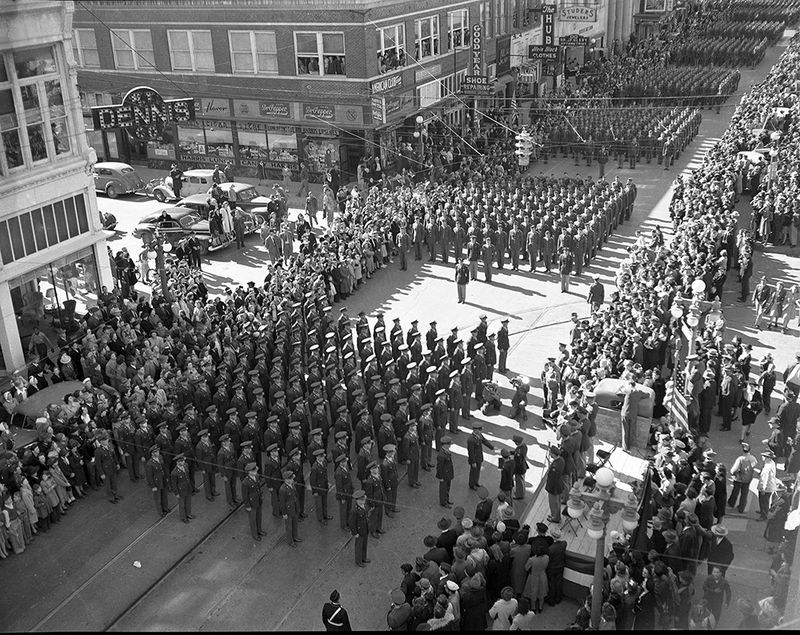
1940s Parade
A military parade down Austin Avenue in 1945 marched right past the R. T. Dennis building, whose sign can be seen at the top left-hand corner of the image. The building was at the center of much of Waco’s activity. | Source: "R.T. Dennis & Co. Furniture Building and Military Event on Austin Avenue, c.1940s," The Texas Collection, Baylor University photo stream, Flickr, https://www.flickr.com/photos/texascollectionbaylor/8665979055/in/album-72157633288188565/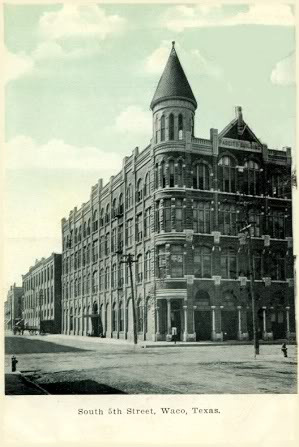
Tom Padgitt Building
The Tom Padgitt Company was an internationally acclaimed saddle manufacturer. With the rise of the automobile after World War I, the company suffered, resulting in R. T. Dennis and Co. purchasing their building. The R. T. Dennis building was located directly behind the Padgitt building, seen in the background of this picture. | Source: “Tom Padgitt Company History.” Vintage Gun Leather, www.vintagegunleather.com/company-marks/padgitt_history.html.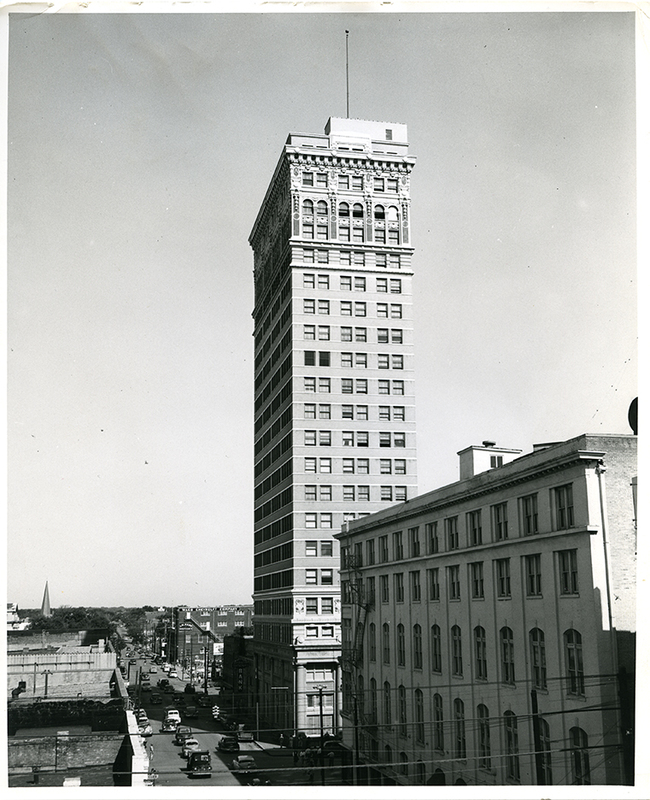
Last Photograph
This is one of the last images of the R. T. Dennis building before the tornado in 1953. | Source: "Austin Avenue, Waco, TX, March 1953," The Texas Collection, Baylor University photo stream, Flickr, https://www.flickr.com/photos/texascollectionbaylor/32369258345/in/album-72157675525927934/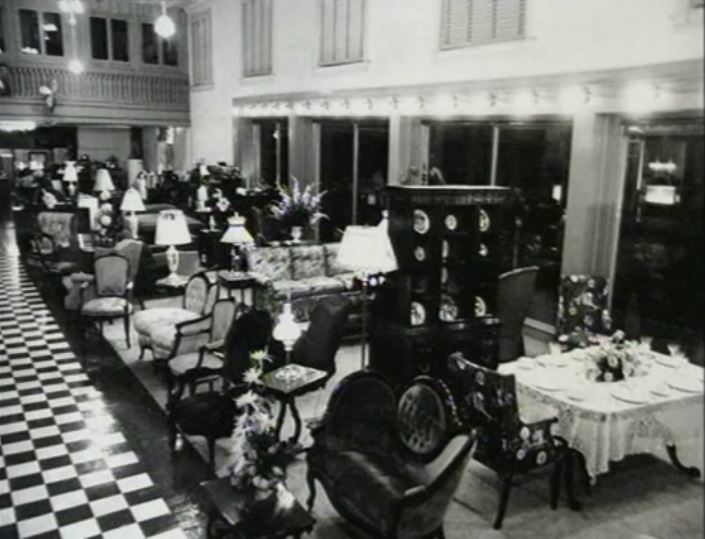
Interior Displays
Upon entering the R. T. Dennis store in the early 1950s, patrons saw furniture lining either side of a black-and-white checkered aisle. This image shows the aisle on the Fifth Street side of the store. The windows in the upper left-hand corner of the image were the office of Ed Berry, the general manager killed in the tornado. | Source: “Remember the 1953 Waco Tornado - Ed Berry.” Vimeo, City of Waco, 1 Jan. 2013, vimeo.com/49476669.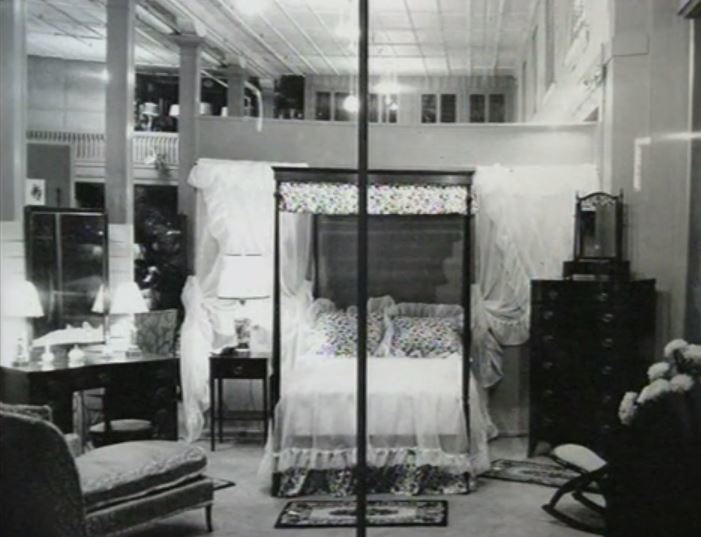
Interior Displays
Vignettes on either side of the aisle of the R. T. Dennis store showed the latest furniture, set up like a room in a home, much like furniture stores today. | Source: “Remember the 1953 Waco Tornado - Ed Berry.” Vimeo, City of Waco, 1 Jan. 2013, vimeo.com/49476669.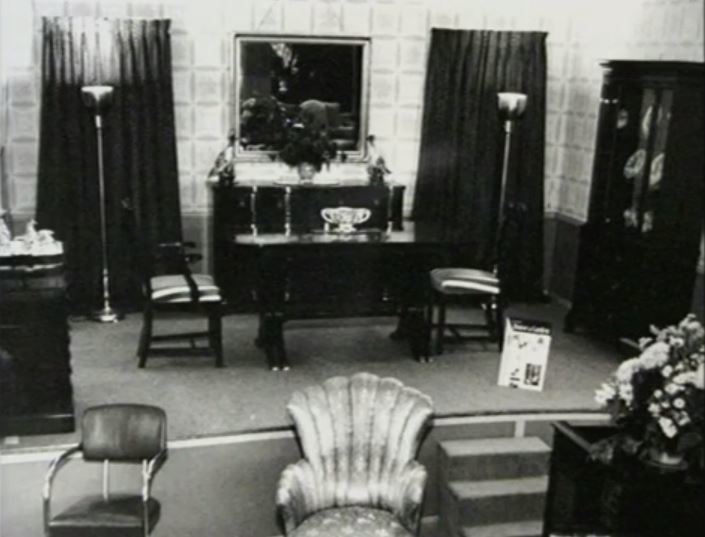
Interior Displays
In the 1950s, R. T. Dennis provided local schools with bedroom and dining room furniture through the Better Home Institute. This program taught children home economics, and they would have bed-making contests and demonstrations of proper dining etiquette on the provided furniture. | Source: “Remember the 1953 Waco Tornado - Ed Berry.” Vimeo, City of Waco, 1 Jan. 2013, vimeo.com/49476669.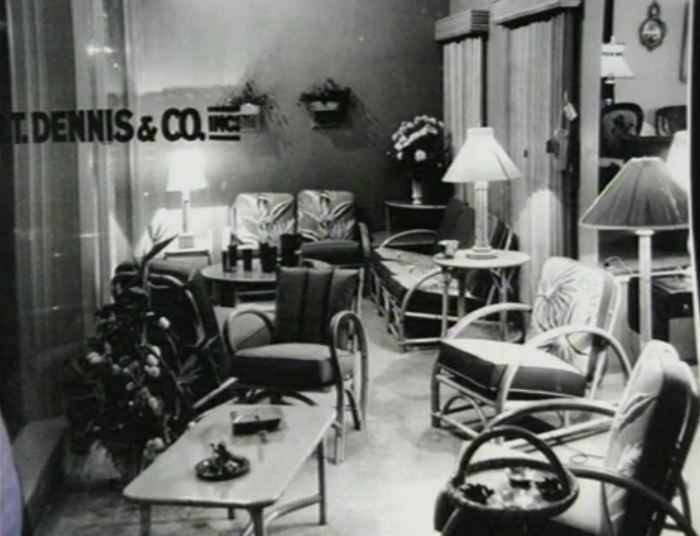
Window Display
R. T. Dennis was known for its fabulous window displays, working hard to draw in customers off the busy Austin Avenue and Fifth Street. | Source: “Remember the 1953 Waco Tornado - Ed Berry.” Vimeo, City of Waco, 1 Jan. 2013, vimeo.com/49476669.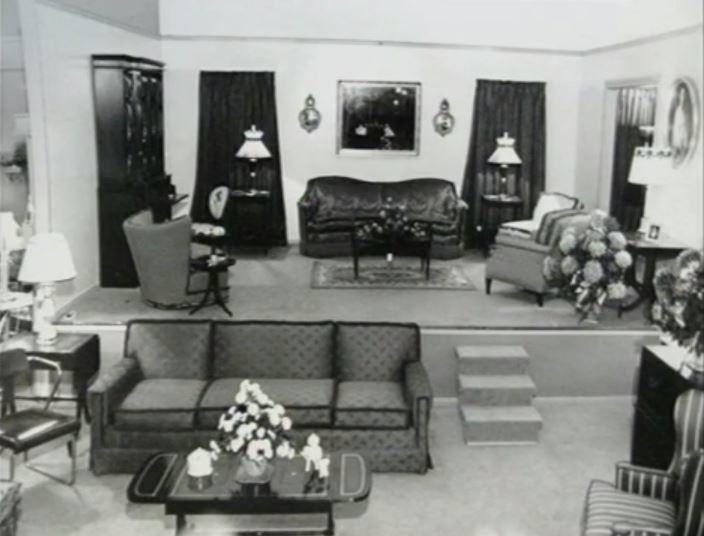
Interior Displays
R. T. Dennis catered to the community in many ways. The company allowed Waco High School students to come to the store and learn about salesmanship and homemaking during the annual vocational clinic in the 1950s. Other businesses around town catered to students interested in radio, teaching, architecture, athletics, and more. | Source: “Remember the 1953 Waco Tornado - Ed Berry.” Vimeo, City of Waco, 1 Jan. 2013, vimeo.com/49476669.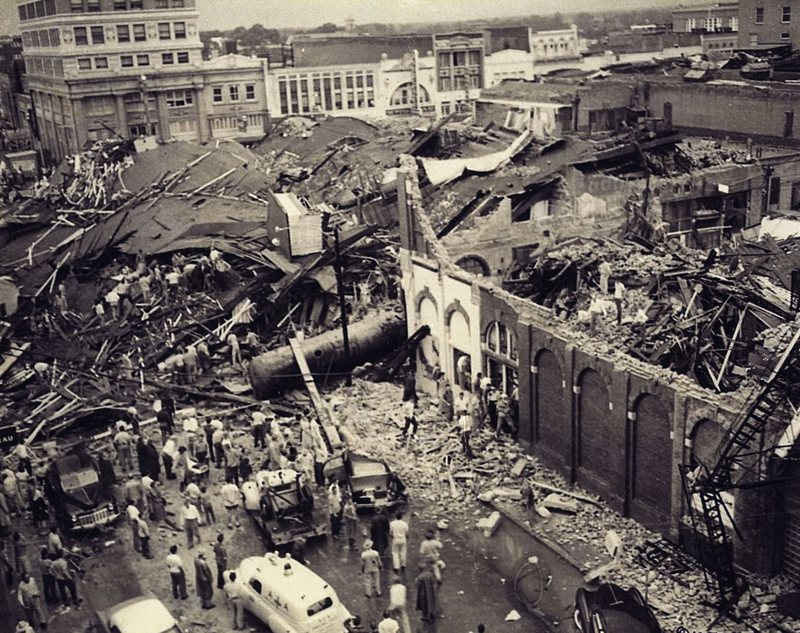
Rubble
The pile of rubble in the background of the image was all that remained of the R. T. Dennis building after the tornado. The building was constructed entirely of timber with no steel reinforcements, as that was new construction technology at the time. The steel-reinforced ALICO building next door withstood the storm. | Source: Wilton Lanning Papers, Series 2 Waco Tornado, Box 9, The Texas Collection, Baylor University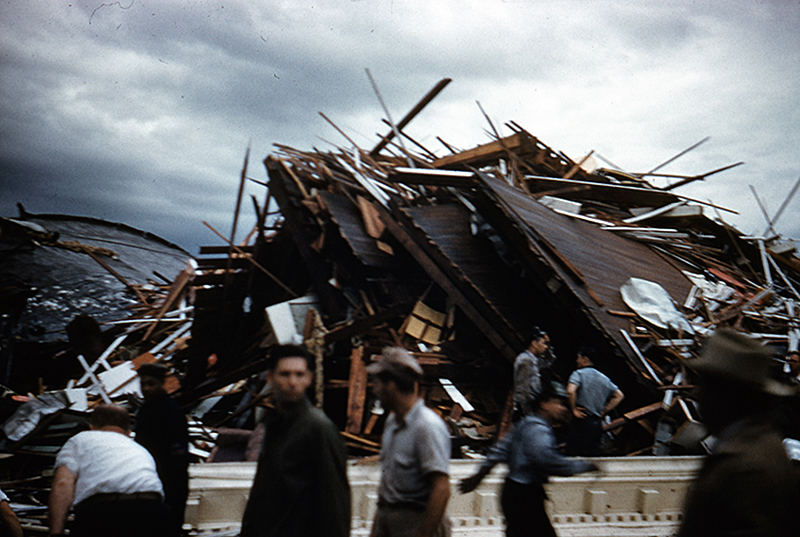
Total Destruction
One victim of the storm was R. T. Dennis advertising manager Mabel Thaxton, found still clutching her calling cards in her hand. President of the company Willard Wigley was not in the building at the time of the storm and survived, though he suffered from leukemia and died just over a year later in May 1954. | Source: "Collapse of 5-Story R.T. Dennis & Co. Building, Austin Avenue, 1953 Waco Tornado," The Texas Collection, Baylor University photo stream, Flickr, https://www.flickr.com/photos/texascollectionbaylor/8666010107/in/album-72157633288188565/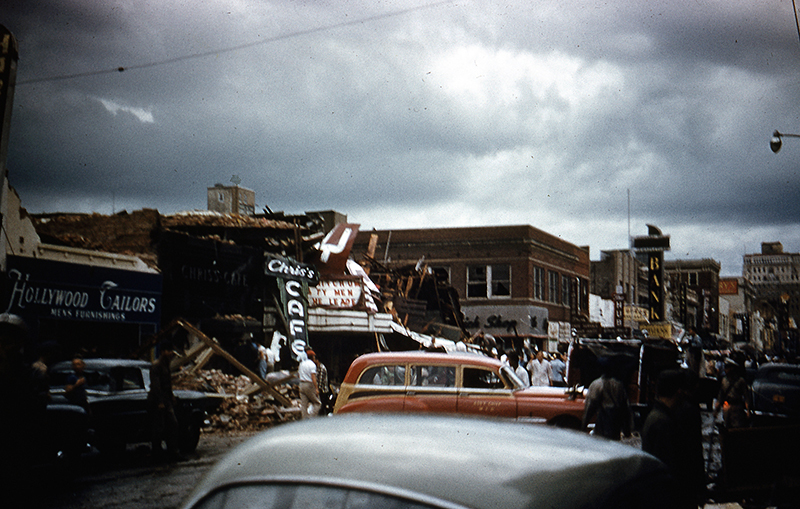
Into the Street
The wreckage of the R. T. Dennis building also collapsed onto the Joy Theater and Chris’s Café next door. One lucky survivor in the R. T. Dennis building, Lillie Matkin, was trapped under a divan that inadvertently shielded her from the rest of the debris. | Source: "Hollywood Tailors, Chris's Café, Joy Theatre, and the R.T. Dennis & Co. Furniture Building, 1953 Waco Tornado," The Texas Collection, Baylor University photo stream, Flickr, https://www.flickr.com/photos/texascollectionbaylor/8667107906/in/album-72157633288188565/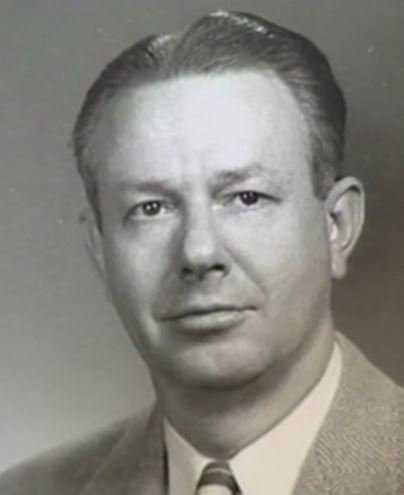
Ed Berry
R. T. Dennis was family-run throughout its history. Rush Halbert Berry, vice president of the company after Dennis’s death, married Dennis’s niece Maude Dennis. Their son, Labon Edward “Ed” Berry, pictured here, served as R. T. Dennis’s general manager and secretary. He also served on many boards and committees around town, including as chairman of the Columbus Avenue Baptist Church deacons. Both Rush and Ed were killed in the tornado, and they had a joint funeral at Columbus Avenue Baptist. This is the last image taken of Ed before his death. | Source: “Remember the 1953 Waco Tornado - Ed Berry.” Vimeo, City of Waco, 1 Jan. 2013, vimeo.com/49476669.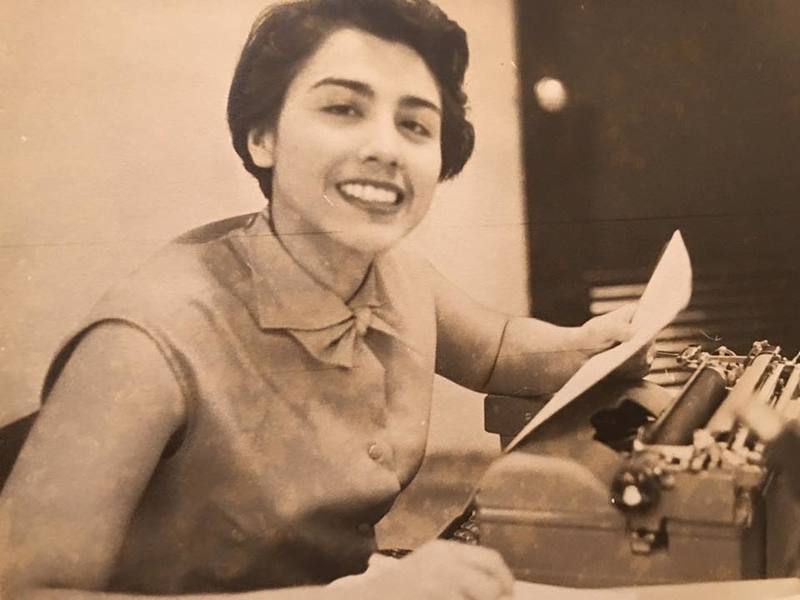
Beatrice Ramirez
Nineteen-year-old Beatrice Ramirez survived the collapse of the R. T. Dennis building. She went on to give her firsthand account to the Waco Times-Herald, saying, “The only way of seeing anything was by the lightening. [Mrs. Carrie Patton and I] stood there while the lightening flashed, and we could see the last window in the front break. We saw Mr. Rush Berry run toward the back to the side entrance leading to Fifth Street. That was the last thing I saw. The building caved in.” She was conscious after the collapse and did her best to free Mrs. Patton and another woman from the rubble before going for help. She escaped the rubble through the elevator shaft and enlisted men to help her try and save those still buried inside. | Source: Image courtesy of Ashley Thornton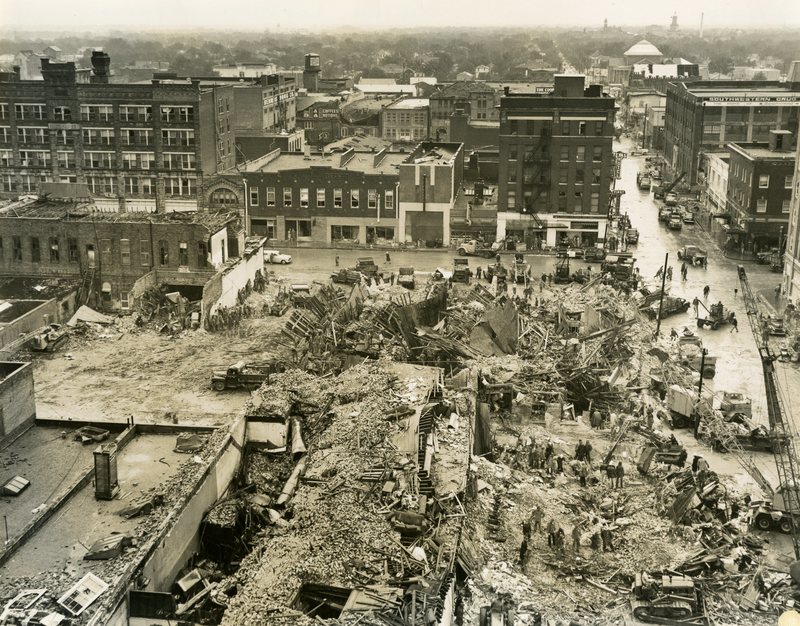
Escaping the Wreckage
Beatrice Ramirez described her escape from the collapsed building: “I did not know how I was going to get out until I saw a small hole of light. And I said, ‘With the help of God, I’ll get out of here.’ I crawled in and out of small holes. I crawled until I hung my arms down the freight elevator shaft. I fell and climbed up a cable. . . . I swung the width of the shaft and knocked brick off with one hand and held to the cable with the other. I did this twice when the cable carried me down all the way. I had to climb up again. . . . So I climbed all the way up and yelled and yelled until two or three men came. I showed them where the people were.” The detail of her account impressed newspaper staff and she was given a job writing for the Waco Times-Herald. | Source: Wilton Lanning Papers, Series 2 Waco Tornado, Box 9, The Texas Collection, Baylor University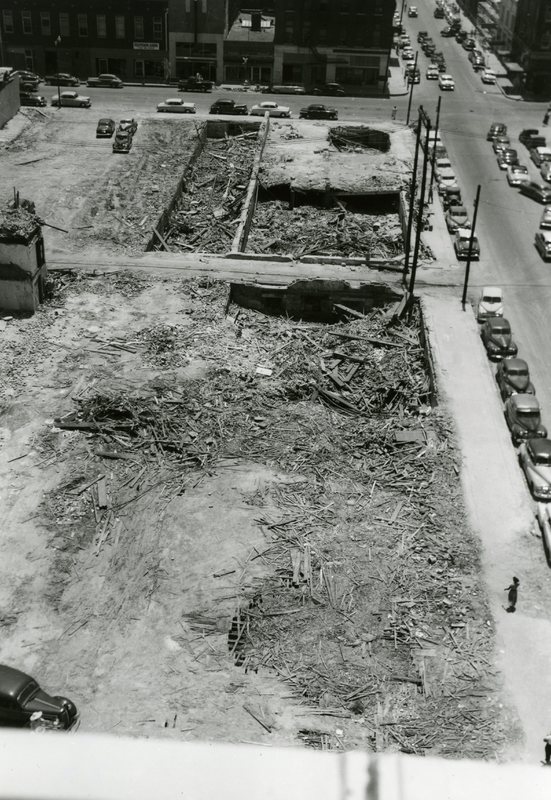
Clear the Debris
After initial rescue efforts ceased and all bodies were accounted for, volunteers began the long process of clearing the rubble of the R. T. Dennis and Tom Padgett buildings. An entire week after the tornado was designated as “cleanup week,” allowing people to take time off their regular jobs and help with Waco’s recovery. | Source: Wilton Lanning Papers, Series 2 Waco Tornado, Box 9, The Texas Collection, Baylor University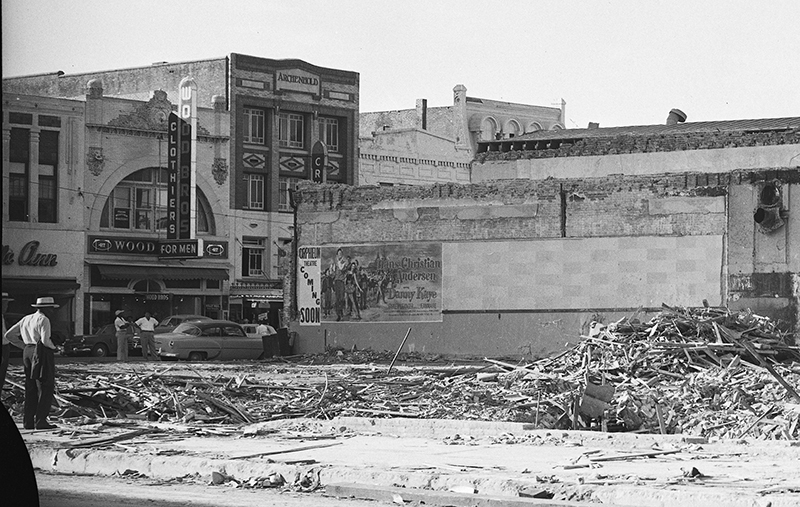
Like a War Zone
According to the Corsicana Daily Sun, “Downtown Waco looked like a city gutted by war. The block surrounding the five-story [R. T. Dennis] building that was smashed was akin to war-scarred Manila after the bitter siege there in World War II.” | Source: "RT Dennis & Co. Site after the 1953 Waco Tornado," The Texas Collection, Baylor University photo stream, Flickr, https://www.flickr.com/photos/texascollectionbaylor/8667153614/in/album-72157633288188565/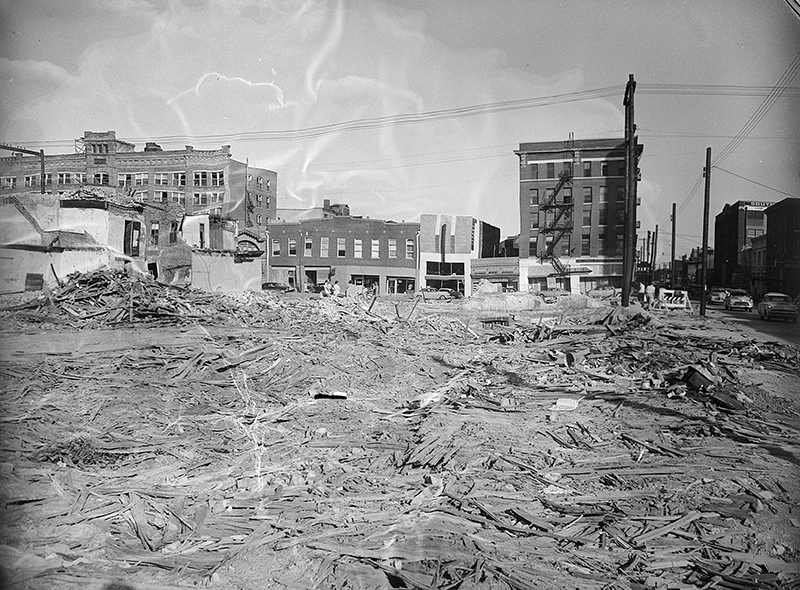
"An Act of God"
Though some lawsuits were filed for personal damages after the collapse of the R. T. Dennis building, the judge ruled that the tornado was a fierce natural force and R. T. Dennis and Co. was in no way negligent in its safety measures. | Source: "RT Dennis & Co. Site after the 1953 Waco Tornado (2)," The Texas Collection, Baylor University photo stream, Flickr, https://www.flickr.com/photos/texascollectionbaylor/8666053039/in/album-72157633288188565/
Buying on Credit
Ollie Mae Moen remembers buying furniture on credit with R. T. Dennis and Co. during the late 1920s, and she was able to afford the payments with her salary of $30 per month. | Source: Moen, Ollie Mae, interviewed by Jaclyn Jeffrey, July 2, 1986, in Waco, Texas, Baylor Institute for Oral History. View Full Interview (Interview 4)Combination Stove from R. T. Dennis
Mary Sendon remembers when her father purchased a combination gas and wood-burning stove from R. T. Dennis in the early 1910s and how it benefited the family. | Source: Sendon, Mary Kemendo, interviewed by Lois Myers, January 11, 1994, in Waco, Texas, Baylor Institute for Oral History. View Full Interview (Interview 3)R. T. Dennis Accepted Scrip
Mary Sendon describes how Baylor professors were payed during the Depression, with "scrip" or pieces of paper worth a certain amount, and the only only stores in Waco that would accept them. | Source: Sendon, Mary Kemendo, interviewed by Lois Myers, February 17, 1994, in Waco, Texas, Baylor Institute for Oral History. View Full Interview (Interview 12)Seeing R. T. Dennis Collapse
Victor Newman recalls watching the R. T. Dennis building collapse. | Source: Newman, Victor T., interviewed by Lois Myers, October 1, 1997, in Waco, Texas, Baylor Institute for Oral History. View Full Interview (Interview 6)Arrival Downtown
Miriam Baldwin describes the destruction of the R. T. Dennis building during the 1953 tornado and why the ALICO building next door survived. | Source: Baldwin, Miriam Helen Pool, interviewed by Blakie LeCrone, September 30, 1976, in Waco, Texas, Baylor Institute for Oral History. View Full Interview (Interview 3)Saving People from the Basement
Fireman Johnny Rauch describes his experience retrieving a water pump from the fire station and saving the people on the verge of drowning in the R. T. Dennis basement. | Source: Rauch, Johnny, interviewed by Sean Sutcliffe, June 9, 2006, in Temple, Texas, Baylor Institute for Oral History. View Full Interview (Interview 2)Not Insured
Carl Barrett discusses the R. T. Dennis building's insurance situation and how businesses used to carry insurance in the 1950s. | Source: Barrett, Carl M., interviewed by Virginia Collins, February 15, 1981, in Waco, Texas, Baylor Institute for Oral History. View Full InterviewDr. Aubrey Goodman
Lawrence Collins describes the experience of his colleague Aubrey Goodman as the only physician in the downtown area after the tornado. | Source: Collins, Lawrence, interviewed by Virginia Collins, January 14, 1981, in Waco, Texas, Baylor Institute for Oral History. View Full InterviewOn the Phone When the Building Collapsed
Donald Hansard remembers his P.E. teacher being on the phone with her husband the moment the R. T. Dennis building collapsed and he was killed. | Source: Hansard, Donald, interviewed by Carl Snodgrass, August 15, 1980, in Waco, Texas, Baylor Institute for Oral History. View Full InterviewBravery in the Wreckage
George Hutson describes the courage and the fear surrounding the rescue efforts around the R. T. Dennis building. | Source: Hutson, George, interviewed by Carl Snodgrass, August 6, 1980, in Waco, Texas, Baylor Institute for Oral History. View Full InterviewStealing from the R. T. Dennis Rubble
Wiley Stem Jr. talks about the problem the city had with contractors stealing merchandise during the clean-up of the R. T. Dennis building and how they had to post a guard at the dump. | Source: Stem, Wiley W. Jr., interviewed by Thomas Charlton, March 12, 1981, in Waco, Texas, Baylor Institute for Oral History. View Full InterviewMrs. Matkin Trapped in the Elevator Shaft
Thomas Turner Sr. describes the days-long effort to remove R. T. Dennis employee Mrs. Matkin, alive and conscious, from the wreckage of the elevator shaft. | Source: Turner, Thomas E. Sr., interviewed by Virginia Collins, March 25, 1981, in Waco, Texas, Baylor Institute for Oral History. View Full InterviewBeatrice Ramirez Climbing to Safety
George Graves Jr. recounts Beatrice Ramirez's amazing escape from the R. T. Dennis rubble. | Source: Graves, George Berry Jr., interviewed by George Graves, April 14, 2014, in Waco, Texas, Baylor Institute for Oral History. View Full InterviewFalling Silverware
F. M. Young describes an unexpected obstacle when trying to find people buried in the R. T. Dennis rubble--falling silverware. | Source: Young, F. M., interviewed by Lois Myers, September 14, 2009, in Waco, Texas, Baylor Institute for Oral History. View Full Interview