Monnig's Department Store
Text
For many immigrants throughout the 1800s, the United States seemed to be a land filled with promise. Texas, in particular, appeared to be a place where dreams could be fulfilled. Otto Monnig, a Prussian immigrant to Missouri, believed this to be true. In 1870, Monnig opened a Family General Store in Gasconade County, Missouri, where he sold clothing, toys, and groceries, while also running a drugstore and post office. This business venture served as a precursor for what was to come for the Monnig family. In April 1889, after sending his son William Monnig to assess business prospects in Texas, he decided to open Monnig’s Dry Goods and Hardware Store in Fort Worth, the fifth largest city in Texas.
For the Monnigs, the promise of a better life held true. Business boomed. In fact, on opening day, Monnig’s department store brought in $44—over $1,000 today. The enterprise continued to expand its inventory and remained in competition against other notable Texas businesses like Cox’s. In 1900, after investing in bulk merchandise, their business model expanded, and they also entered the wholesale dry goods business. The retail and wholesale divisions continued successfully, and the business opened locations across the state, including one in an up-and-coming Texas city: Waco.
Otto Edward Monnig supervised the expansion project, following in his father’s and uncle’s footsteps. Though he had lived in Waco and since moved to California, his wife convinced him to return. That advice proved sound as he became the operator of Monnig’s in Waco, growing the business and its inventory.
The first Waco location opened in 1932 on Fifth and Washington, continuing the retail and wholesale model. Monnig’s, branded as “the Friendly Store,” now offered more than dry goods and hardware. The store sold clothes, groceries, toys, beauty products, candy, and flowers, and still maintained their wholesale business. Customers who could not make it to the store had the option to call a “Miss Shopper,” an employee who could shop for needed items and ensure their delivery. With an abundance of merchandise and a growing retail division, the Monnigs decided to open an additional location in town.
The new Monnig’s opened at 604 Austin Avenue on August 27, 1936. While the Waco department store branched out into the downtown area, the grocery division remained at the old location, 120 North Fifth Street. This new location offered an extensive variety of clothing, furniture, and other retail items. After leasing the Horne Building, the business dedicated the 60-by-165-feet ground level to merchandise alone. The second floor remained utilized as storage space for wholesale materials.
Thrilled at the department store’s expansion, Wacoans rushed out to opening day. Multiple local businesses endorsed Monnig’s, including The First National Bank of Waco and Mailander & Company, who aided in the three-month remodeling process. The store expected such an influx of people that they opened at nine o’clock in the morning, rather than eight thirty, to ensure that employees could prepare for the rush.
Though Monnig’s survived the historic 1953 Waco tornado and nationally vexing financial periods, the business eventually filed for bankruptcy in 1988. Monnig’s department stores across Texas closed their doors, and in 1989, Chrysler Technologies Airborne Systems (CTAS) occupied the old Monnig’s building at Seventh and Austin. By 1990, bankruptcy resulted in the closing of all seven Monnig’s locations across Texas. Still, many Wacoans reflected fondly on the local store during its decades of success. While Monnig’s opened business because of the opportunities Texas offered, the Waco department store promised a new future for the downtown area and the city more broadly.
Files
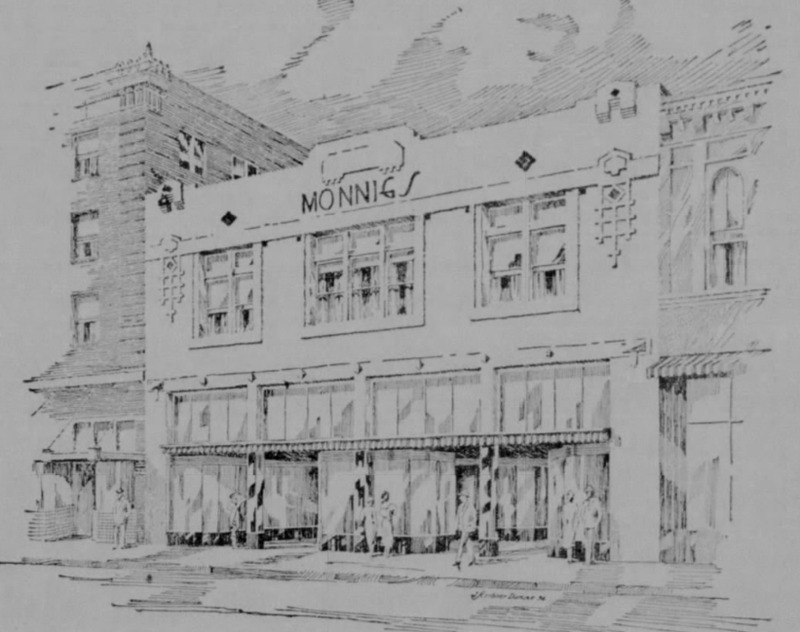
Way down to Waco:
As Monnig’s expanded its stores across Texas, it endeavored to provide retail for everyday clientele. George Monnig ensured customers that company growth did not mean that the store was headed in a new direction. “‘If there is any thing that Monnig’s is not…’” he stated, “‘it’s ritzy.’” | Source: "Monnig's 606 Austin Avenue, 1936," photograph on “Otto Edward Monnig.” Waco Masonic Lodge No. 92. 2022. https://www.wacomasonic.org/otto-monnig/.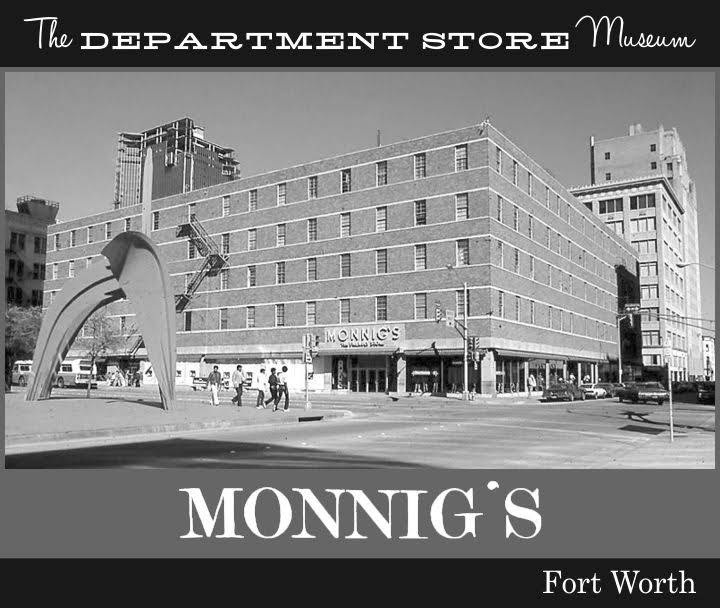
Booming Business:
Monnig’s department store reaped success in Fort Worth, Texas. Though the store faced many competitors, it outlasted them. In fact, Monnig’s acquired the Fair department store in 1963, closing the downtown branch of the Fair and absorbing 300 Fair employees. | Source: "The Friendly Store," photograph. The Department Store Museum. Accessed March 8, 2022. http://www.thedepartmentstoremuseum.org/2011/05/monnig-dry-goods-company-fort-worth.html.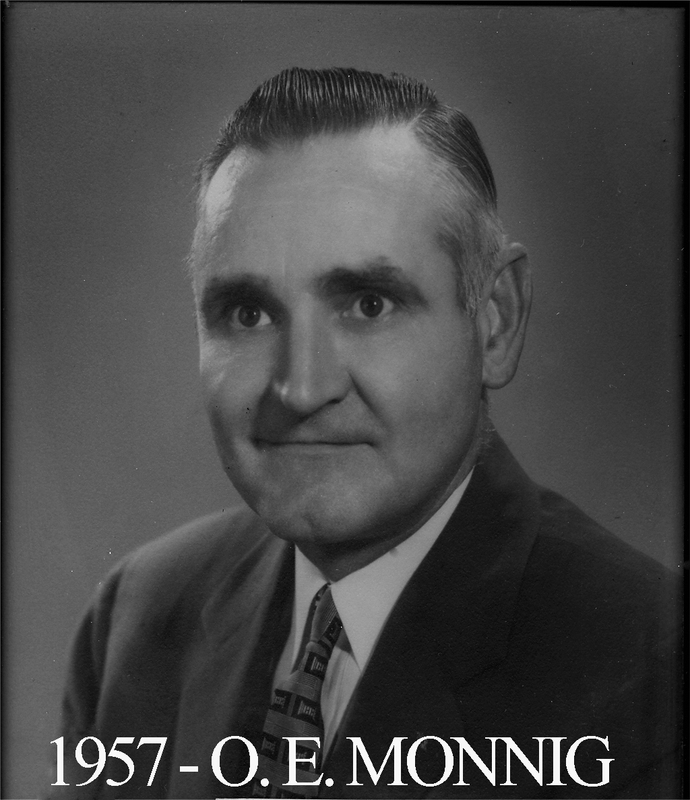
Managing Monnig’s:
O.E. Monnig opened the Waco branch of Monnig’s in 1932. While O.E. Monnig certainly remained important to the department store, he also became involved in the Waco community. He attended St. Alban’s Episcopal Church and was a member of the Waco Masonic Lodge. | Source: "Otto Edward Monnig," photograph. Waco Masonic Lodge No. 92. 2022. https://www.wacomasonic.org/otto-monnig/.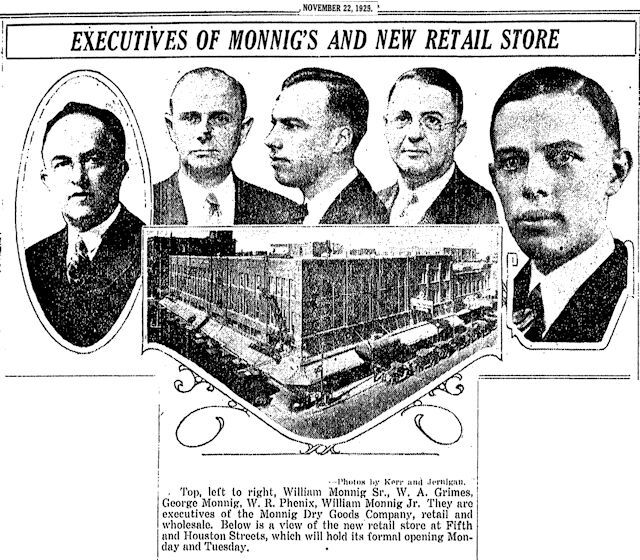
Early Executives:
At the department store’s height, Monnig’s employed over 1,000 people. Pictured here are the executives, mostly from the Monnig family, who oversaw the company’s growth and strategically expanded the business across Texas. | Source: Executive Photograph. “Monnig’s (1889-1988): The ‘Friendly Store.’” Hometown by Handlebar. October 20, 2021. https://hometownbyhandlebar.com/?p=30178.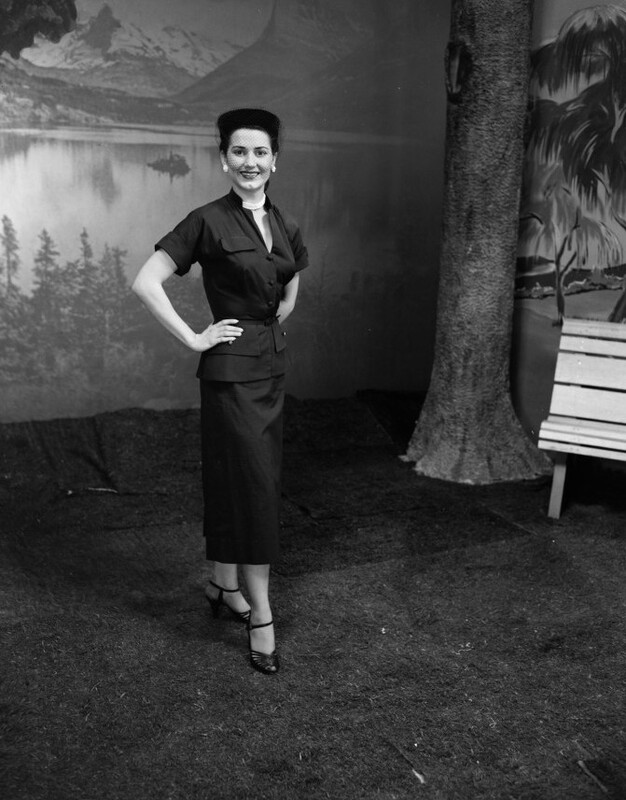
Modeling Merchandise:
Monnig’s department store prided themselves on their offerings of women’s clothes and accessories. In the women’s departments, they advertised that “women [could] find up-to-the minute styles.” | Source: WBAP-TV. [Clothes from Monnig's Department Store], photograph, May 23, 1951. University of North Texas Libraries, The Portal to Texas History. https://texashistory.unt.edu/ark:/67531/metadc1555551/.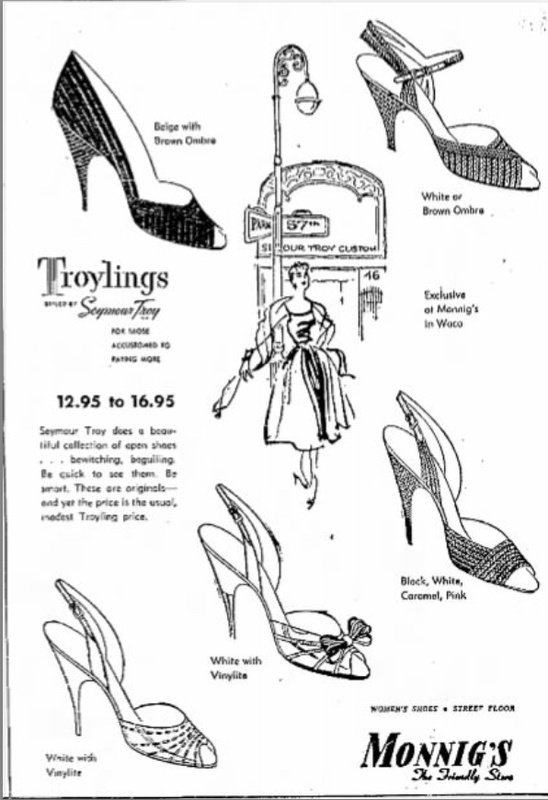
Surplus of Shoes:
When the Monnig’s department store opened on Austin Avenue, George W. Monnig noted that new customers could explore the shoe department—where there were at least 100 pairs of shoes available for purchase. | Source: Monnig's Advertisement. The Waco News-Tribune. May 3, 1956. www.newspapers.com.
Thursday Thrills:
When Rodney G. Kroll’s father left for work on Thursday’s, he and his mom would often walk to Dutton Street, take the bus downtown and spend the day shopping at different stores, including Monnig’s. Only on that night of the week did local shops stay open until nine o’ clock at night. | Source: Kroll, Rodney G. Interviewed by Rudy Solano, April 30, 2014, in Waco, TX. Baylor University Instiute for Oral History. Waco, TX. Access full interview here.Segregated Shopping:
Though some Waco stores maintained segregation policies, like refusing to allow Black customers to try items on, for example, Pauline Adams contends that she shopped at Monnig’s Department Store without difficulty. She also elaborates on the utilization of their layaway purchasing option when shopping for children’s clothes. | Source: Adams, Pauline. Interviewed by Aaron Ward, April 16, 2002, in Waco, TX. Baylor University Institute for Oral History, Waco, TX. Access full interview here.Discounted Décor:
As she reminisces on planning the interior design of her home, Ollie Mae Allison Moen remembers gift vouchers available at Monnig’s Department Stores that allowed customers to save money after a number of purchases, which she used when furnishing her home. | Source: Moen, Ollie Mae Allison. Interviewed by Jaclyn Lee Jeffrey, 1986, in Waco, TX. Baylor University Institute for Oral History, Waco, TX. Access full interview here.Customer Communication:
Margie Lopez Cintron recounts shopping at Monnig’s Department Store with her grandmother, a native-Spanish speaker. Though they enjoyed shopping on Austin Avenue, the store lacked bilingual workers, and her grandmother struggled to communicate with employees. | Source: Cintron, Margie Lopez. Interviewed by Elinor Mazé, November 11, 2006, in Waco, TX. Baylor University Institute for Oral History, Waco, TX. Access full interview here.Local Competition:
In search of a suit, most people might turn to prominent department stores, like Monnig’s, but Santos “Tito” Martinez found it cheaper and more reliable to have a suit made by a local Waco tailor shop run by two Mexican brothers. | Source: Martinez, Santos "Tito." Interviewed by Michael Woodward, April 11, 2014, in Waco, TX. Baylor University Institute for Oral History, Waco, TX. Access full interview here.