La Pila
Text
At a fountain named La Pila, children frequently splashed and played while others took a drink or filled jars and buckets with water. La Pila, meaning “the basin,” was the centerpiece and social hub of the historic Calle Dos neighborhood from the 1920s to the 1960s. Fed by an artesian well close by, the fountain produced warm, drinkable water to a neighborhood in which few had access to running water in their homes.
The origin of La Pila is unknown, although Waco newspapers suggest that the city authorized the construction of an artesian well near the area in 1915, and it was reported in 1933 that a fountain in the area was fed by a nearby well with warm water. Children would play and bathe in its waters, and families would bring containers to fill from its four faucets, taking the water home to use for cooking, drinking, and cleaning. Often day laborers gathered at La Pila, waiting to be picked up for work. The fountain’s artesian waters even drew Waco residents who did not live in Calle Dos. Rudy Solano, who lived in Calle Dos as a child, recalled that “people would pull up in their fancy cars and load up their fancy glass containers.” While La Pila held a communal significance for the residents of Calle Dos, it served the broader Waco area as well.
In 1950, the waters of La Pila dried up. Although its practical use had faded, it still served as a gathering place for the community until Urban Renewal destroyed both Calle Dos and La Pila in 1958. Urban Renewal was an effort to clear “slums” from the downtown area, and it happened in cities across the nation. Low-income neighborhoods and minority communities were those most impacted, displaced from homes and businesses. La Pila was buried, and its concrete edges were damaged even further with the later expansion of University Parks Drive.
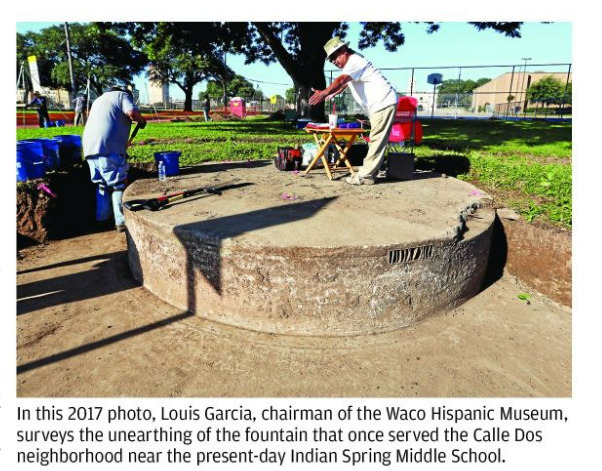
In 2016 Alice Rodriguez, founder of the Waco Hispanic Museum, and Louis Gayton-Garcia decided that unearthing La Pila would be an excellent way to commemorate an important aspect of Waco Hispanic heritage. Partnering with archaeologist Katherine Turner-Pearson, the work to excavate the historic fountain began the following year with a grant for the project from Baylor Philanthropy and Public Service. The money was quickly exhausted, and Turner-Pearson used donations from the community and an army of volunteers, including students from the nearby Indian Spring Middle School, to contribute to the project and to educate the community about the process of excavation.
In 2020, Pearson-Turner and the Waco Hispanic Museum wanted to take the project in very different directions. The Waco Hispanic Museum had wanted to completely unearth La Pila and create a small park or monument out of it, perhaps with benches and art surrounding it. Pearson-Turner, however, believed it would be best to rebury La Pila because of the complications in getting volunteers during the COVID-19 pandemic. She explained that it was a common archaeological practice to uncover an artifact enough to make a report about it and then backfill and rebury the item to protect it. With loss of funding and volunteers, the recommendation of the Texas Historical Commission to backfill, and the lack of a detailed plan with Waco ISD to turn the fountain into a monument on their property, La Pila became once again a buried memory.
La Pila’s future is uncertain. It might be uncovered again and reconstructed, or it might remain as it is. Regardless of what happens, La Pila still stands in the memories of those who lived in Calle Dos as a symbol of their community, and the excavation project ensured that the legacy of La Pila was shared with a new generation of Wacoans.
Files
Uncovering La Pila
Louis Garcia, who provided much of the vision behind excavating La Pila, was personally involved in the unearthing. This photo shows the amount of excavation that had already taken place by 2017, three years before the project ended. | Source: Brooke Crum, “La Pila Reburied after Years of Excavation,” Waco Tribune-Herald, October 3, 2020.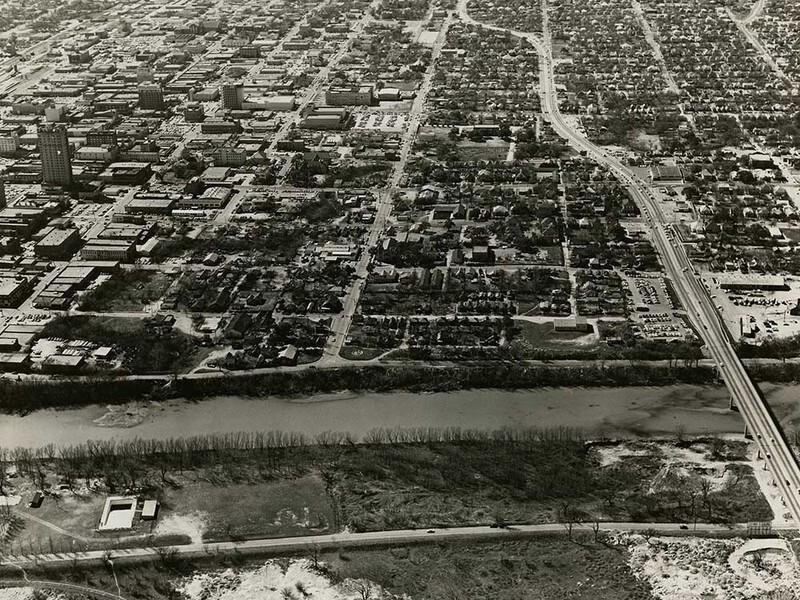
La Pila from Above
Few images remain of the original La Pila, but the historic fountain can be seen in the center of this photo of Calle Dos, next to the banks of the Brazos. The entire residential area pictured in this photo was destroyed with Urban Renewal and now holds a school and multiple businesses. | Source: Image courtesy of the Texas Collection.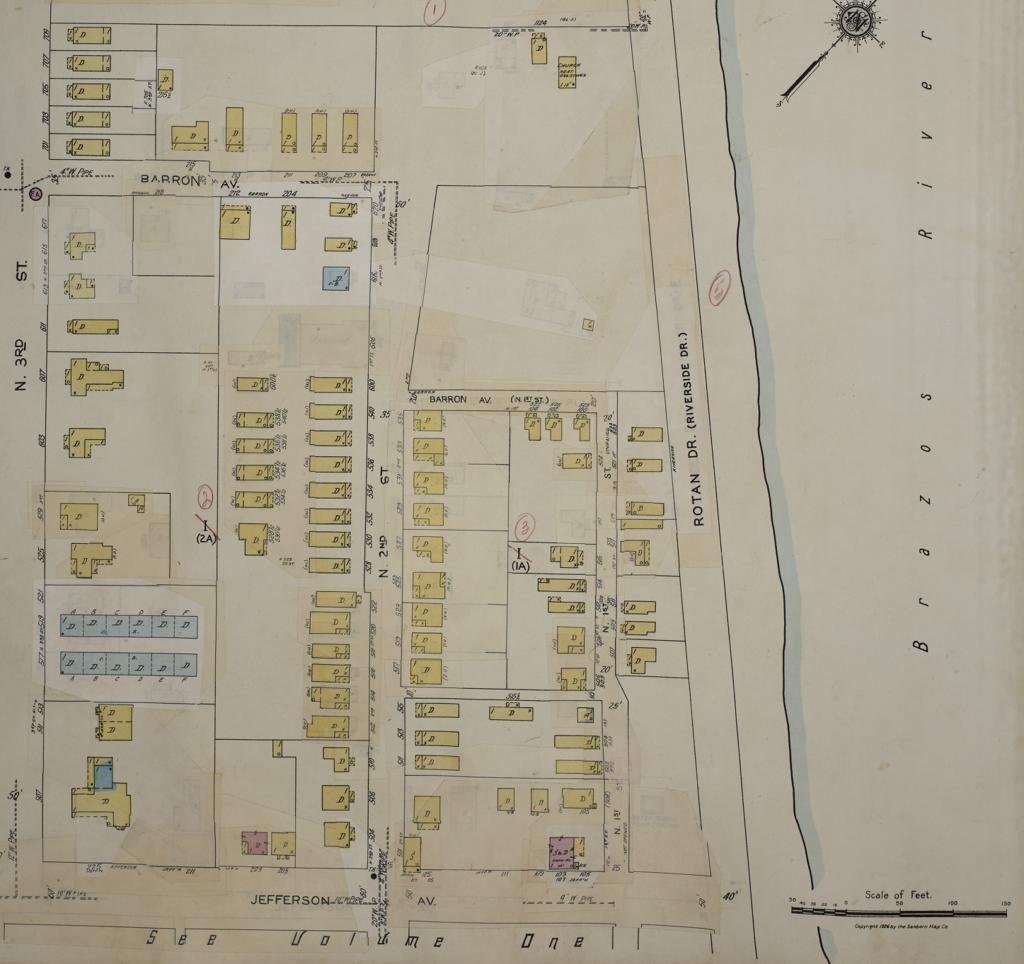
1950 Map
This map is from the Sanborn Fire Insurance Company and was created in 1950. La Pila is not directly represented, but it would have been located just above Jefferson Ave. to the left of the Brazos. The map shows the shotgun houses typical of Calle Dos which surrounded La Pila. | Source: Sanborn Fire Insurance Map from Waco, McLennan County, Texas. Sanborn Map Company, Vol. 2, 1950. Map. https://www.loc.gov/item/sanborn08803_008/.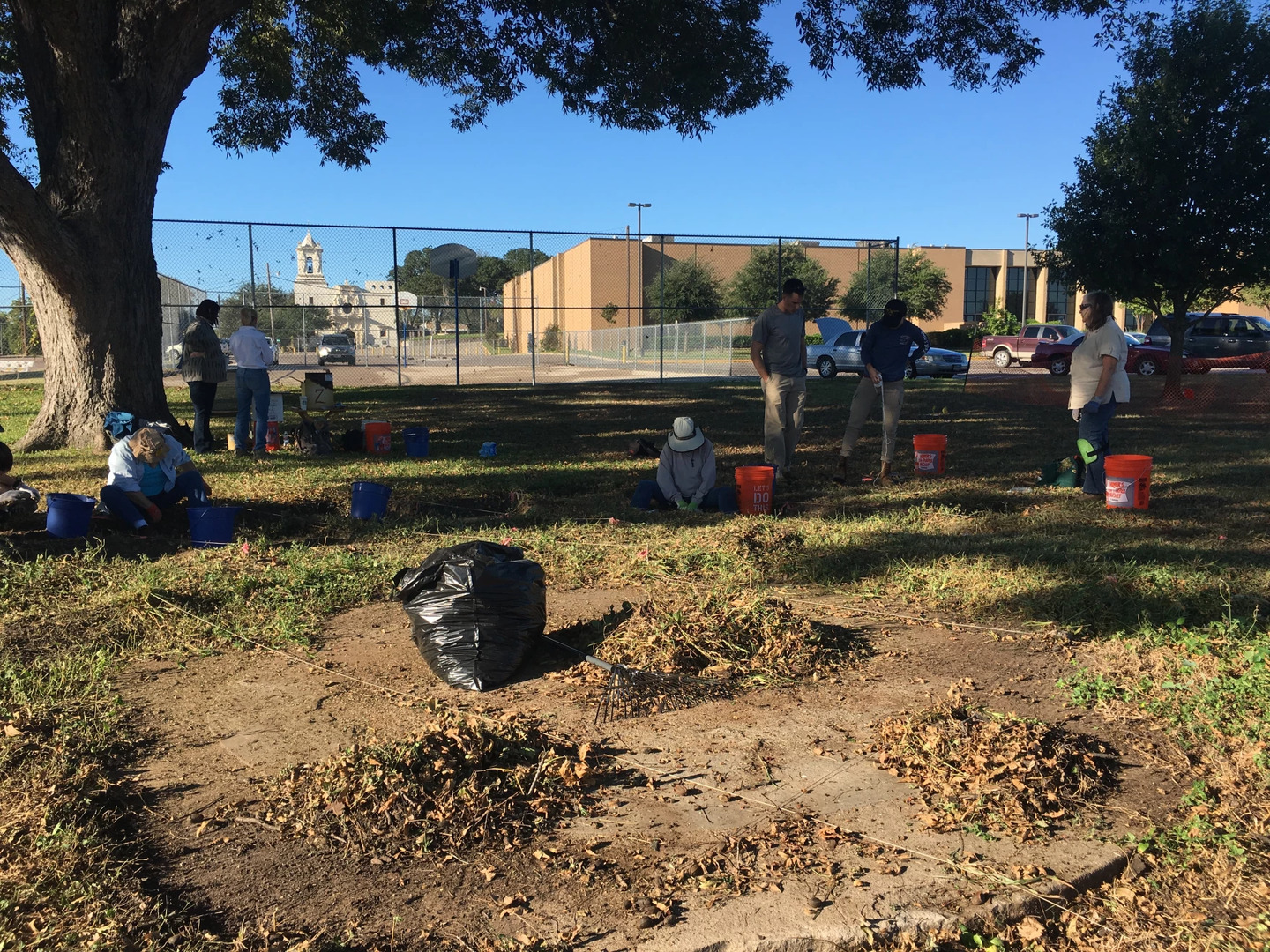
Army of Volunteers
The excavation of La Pila relied heavily on volunteers to contribute to the project. Some volunteers even were students at the Indian Springs Middle School seen in the background. This group of volunteers worked to clear the top surface of La Pila. | Source: “Unearthing ‘La Pila’, a Remnant of a Bygone Hispanic Neighborhood.” KWBU, November 16, 2016. https://www.kwbu.org/texas-news/2016-11-11/unearthing-la-pila-a-remnant-of-a-bygone-hispanic-neighborhood.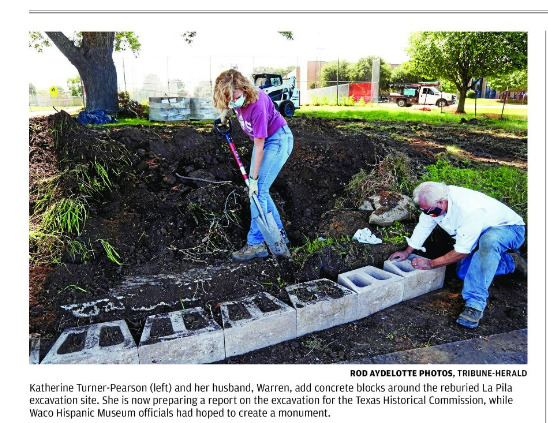
Reburying La Pila
Sadly, the excavation of La Pila ended in 2020 when the pandemic made it too difficult to continue. Turner-Pearson and her husband reburied the fountain, ending the vision of a park and monument proposed by Garcia. | Source: Brooke Crum, “La Pila Reburied after Years of Excavation,” Waco Tribune-Herald, October 3, 2020.
Neighborhood Necessity
Benny Herrera lived in Calle Dos, and he recalled having more privileges, like running water, than most of his neighbors. His neighbors depended on La Pila for almost all of their needs, relying on its water for drinking, cooking, bathing, and more. | Source: Herrera, Benny. Interviewed by Sarah Swint, March 4, 2006, in Waco, TX. Baylor University Institute for Oral History. Access full interview here.