Memorial Hall: Woman's Memorial Dormitory
Text
Baylor University was the first coeducational university in the South, and only the second in the country. Even so, the education women received at Baylor for many years was fundamentally different than the men’s. Women stayed within the bounds of the more “feminine” degrees such as education or music, and access to on-campus organizations was severely limited. Female students were held to high standards and kept under close supervision by the Dean of Women. They had to adhere to a strict dress code (superintendents could remove undesirable clothing from student’s closets), attend Sunday school and church services every Sunday, sign out any time they left campus, observe a strict curfew, and keep good grades in order to be allowed to date, ride in a car, or leave campus.
As women’s rights activists made headway in the early twentieth century, coed institutions received more and more female applicants. Baylor was no exception. In the 1920s, Baylor received so many applications from women that they had to turn them away due to a lack of space. At the time, Georgia Burleson Hall and a few small annexes were the only women’s residential spaces on campus, and women who were not from Waco were not allowed to live off campus due to university administration’s desire to keep them protected and out of trouble. The male students, by comparison, were not subject to the same levels of supervision as the women and were trusted to live off campus. The ones that did live on campus were housed in then-brand-new Brooks Hall.
Despite being advertised as better than the accommodations at other universities, Burleson Hall was cramped, leaky, outdated, and only housed around 200 women, and the annexes could hold around 200 altogether. In the mid-1920s, the number of women enrolled at Baylor was around one thousand. In light of this space issue, President Samuel Palmer Brooks began planning the addition of a new women’s dormitory. The Woman’s Missionary Union of Texas, having observed the piety and Christian attitudes of Baylor students, took an interest and pledged to help the university raise funds for this new building. They advertised in Waco newspapers to secure donations from the community, and sororities on campus aided them with fundraisers.
In 1928, a groundbreaking ceremony took place at the site of the new dormitory on the corner of Seventh and Speight. Baylor alumna, renowned author, and Columbia University professor Dorothy Scarborough addressed the spectators at this event. Scarborough emphasized the importance of remembering the exceptional women in Baylor’s history and made a commitment to be present at similar events in the future. Baylor administrators overseeing the project hoped that the groundbreaking might serve as a reminder to the community that the project was still underway, and hopefully inspire them to resume their donations, which had decreased significantly.
Woman’s Memorial Dormitory, named in honor of the Woman’s Missionary Union, was finished in 1930 and cost approximately $350,000. Securing funding for this project was no small feat, as at this time the country was suffering in the early days of the Great Depression. At this time, the building could house 245 women, and boasted a dining hall, a chapel, a study hall, and two banquet rooms. On October 15, 1930, the university suspended classes for two hours so that faculty, staff, and students could attend the ribbon-cutting ceremony of the new dormitory. President Brooks, speaking at this ceremony, thanked the Woman’s Missionary Union for making the idea for the new dormitory into a reality, and further thanked all the women of Texas for their contributions to the project. Mrs. F. S. Davis, president of the Woman’s Missionary Union, also addressed the attendees, speaking of her hopes that the women of the dormitory would grow in their faith and be strong, Christian leaders in their community. “The fervent prayer,” she said, “that wells up from the heart of the Women’s Missionary Union today is that ‘our daughters may be as polished cornerstones after the similitude of a palace.’ For truly you, our daughters, are our glory and our crown.”
In 2005, Memorial and neighboring hall Alexander became home to the university’s Honors College Living and Learning Community, or HC-LLC (often called the Hick-Lick), with Memorial housing the women and Alexander housing the men. Four years later the university upgraded the community to the status of residential college. The Honors Residential College is known across campus for its tight-knit community, goofy traditions, and, in the words of one former Baylor professor,its “common love of uncommon things.” In 2023, the university renovated both Memorial and Alexander, updating facilities, rooms, and common spaces, as well as adding the new Carona Family Commons, a two-floor shared common area connecting the two buildings.
Woman’s Memorial Dormitory, now simply called Memorial Hall, has been a welcoming home away from home to Baylor women for almost 100 years. Memorial was instrumental in improving women’s access to education at Baylor when it was built, and the impact it and its founders had on the university is still visible.
Files
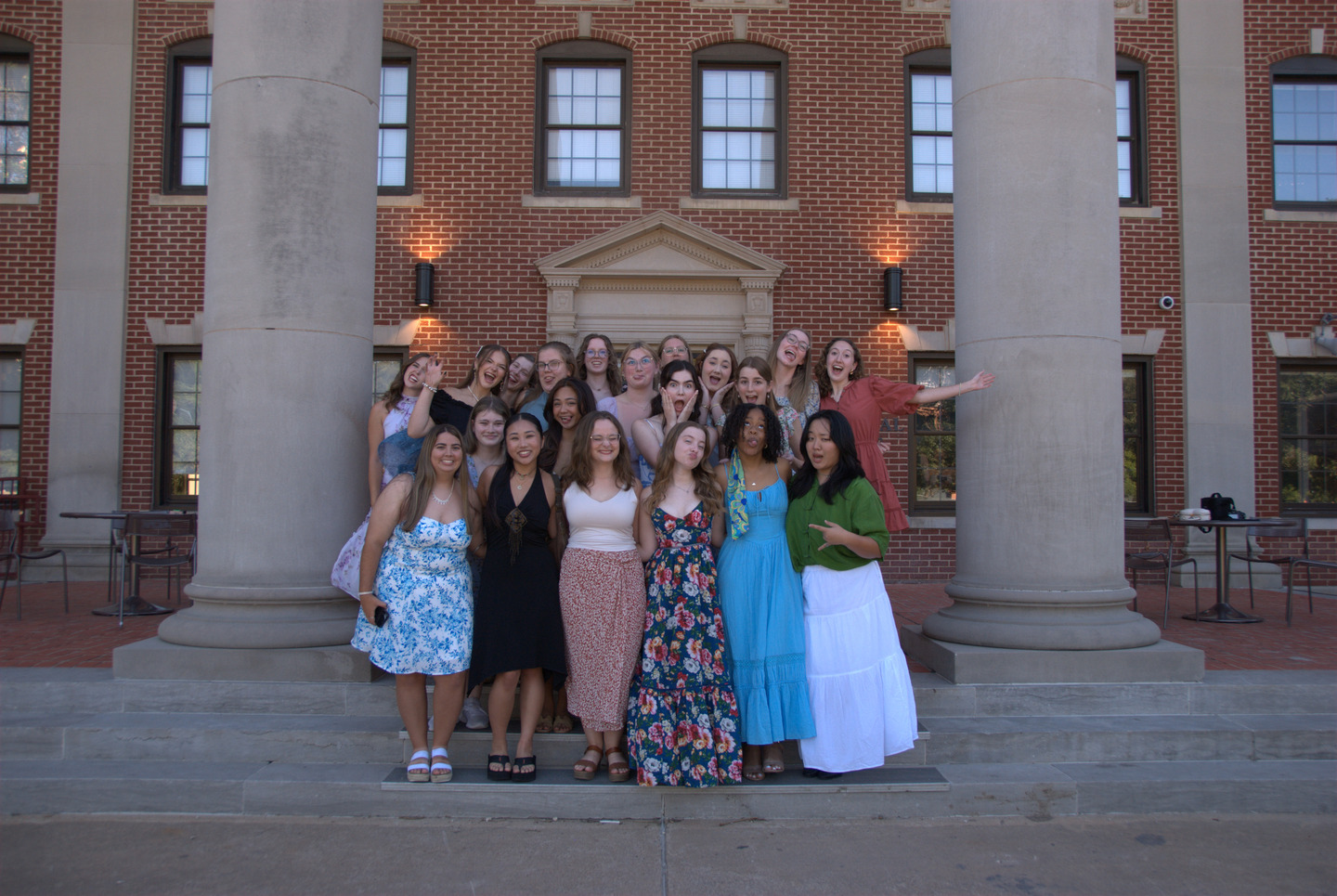
Fides Quaerens Intellectum
Memorial Residence Hall is now home to the women of the Honors Residential College. A community of scholars in the Honors College, the HRC prioritizes love of God, love of neighbor, and love of learning. | Source: Image courtesy of the Baylor University Honors Residential College Public Relations Committee.
Sisters in Service
To raise money for building expenses, Baylor sorority Alpha Omega (now Pi Beta Phi) organized fundraisers such as candy sales, fashion shows, rummage sales, and toothbrush sales. Memorial would become the meeting space for several sororities in the coming years. | Source: Baylor University Archive - The Round Up - Student Annual, Texas Collection, Baylor University, Digital ID: bu-roundup-ann_1943.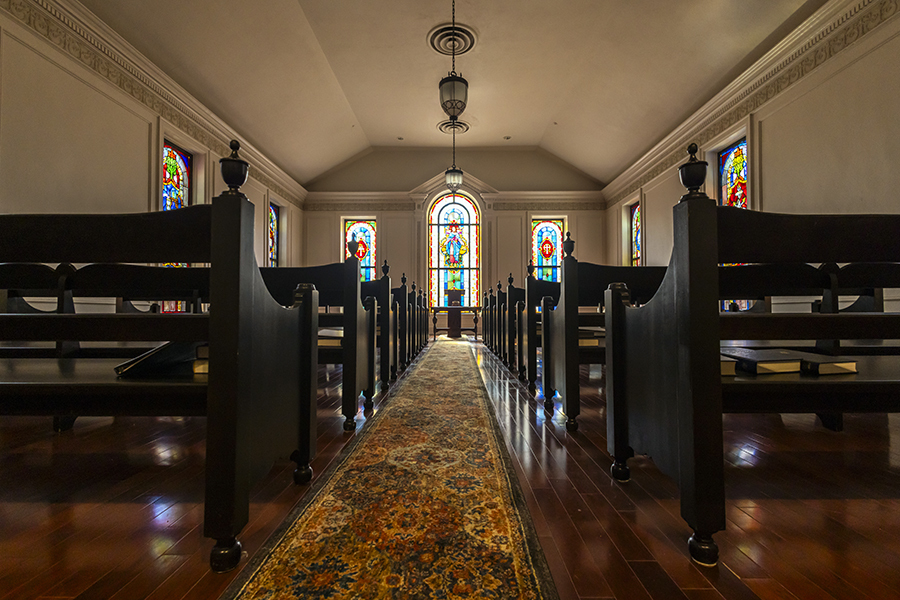
Restoration of Faith
Originally called the Lou F. White Memorial Chapel, the Memorial chapel was initially used by sororities such as Delta Alpha Pi and Kappa Alpha Theta. After falling into disrepair and out of use for about 50 years, the chapel was restored in 2008 for the use of the new Honors Residential College. | Source: Image courtesy of the Baylor University Honors Residential College, https://hrc.honors.baylor.edu/living-hrc/community-spaces.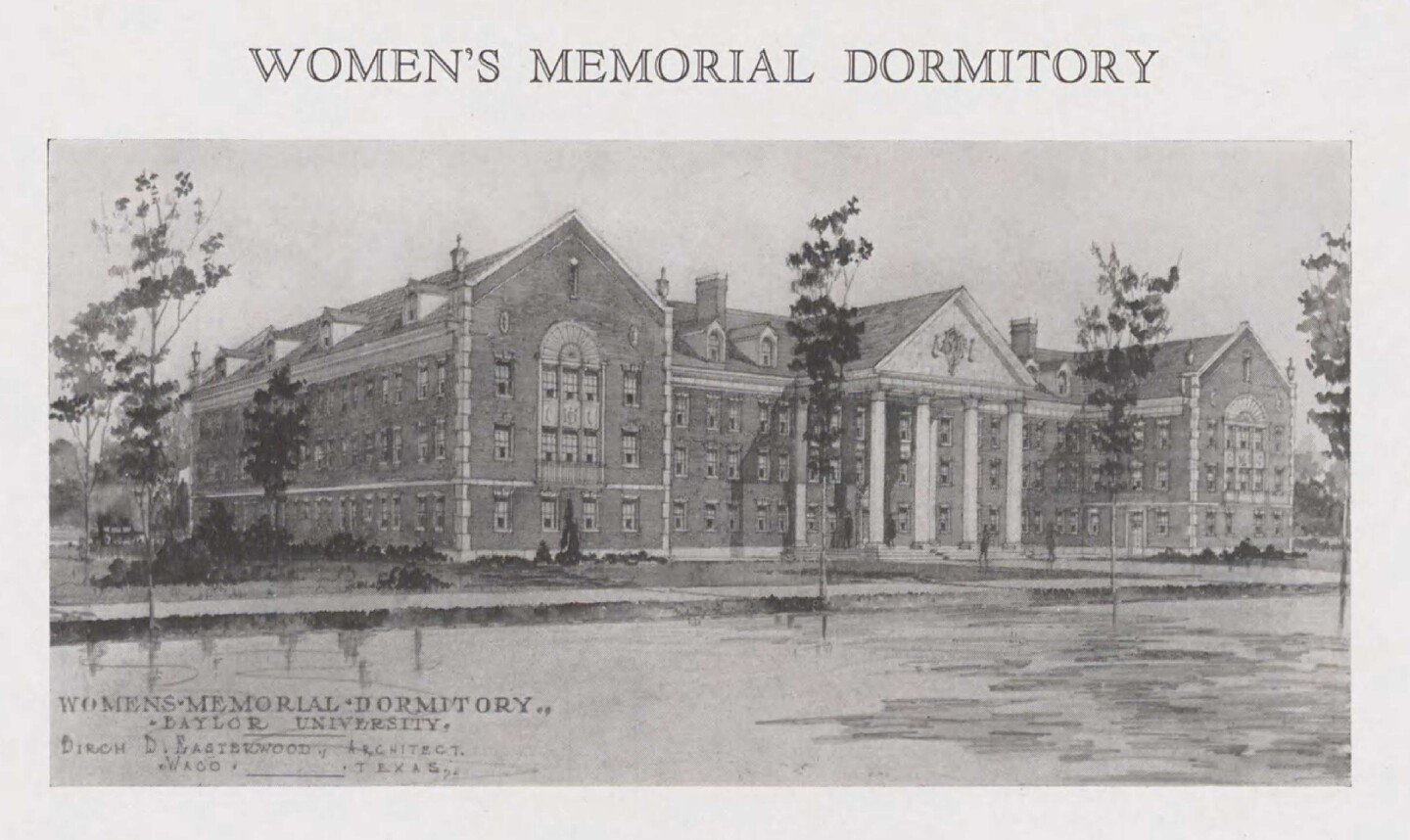
Mind Your P’s and Q’s
Unlike male students on campus, the women of Baylor lived under the direct supervision of a faculty member, the Dean of Women. She made sure the girls met the high behavior standards for the university’s female students—going to church on Sundays, being in by curfew, and following the dress code, to name a few. | Source: Baylor University Archive - The Round Up - Student Annual, Texas Collection, Baylor University, Digital ID: bu-roundup-ann_1930.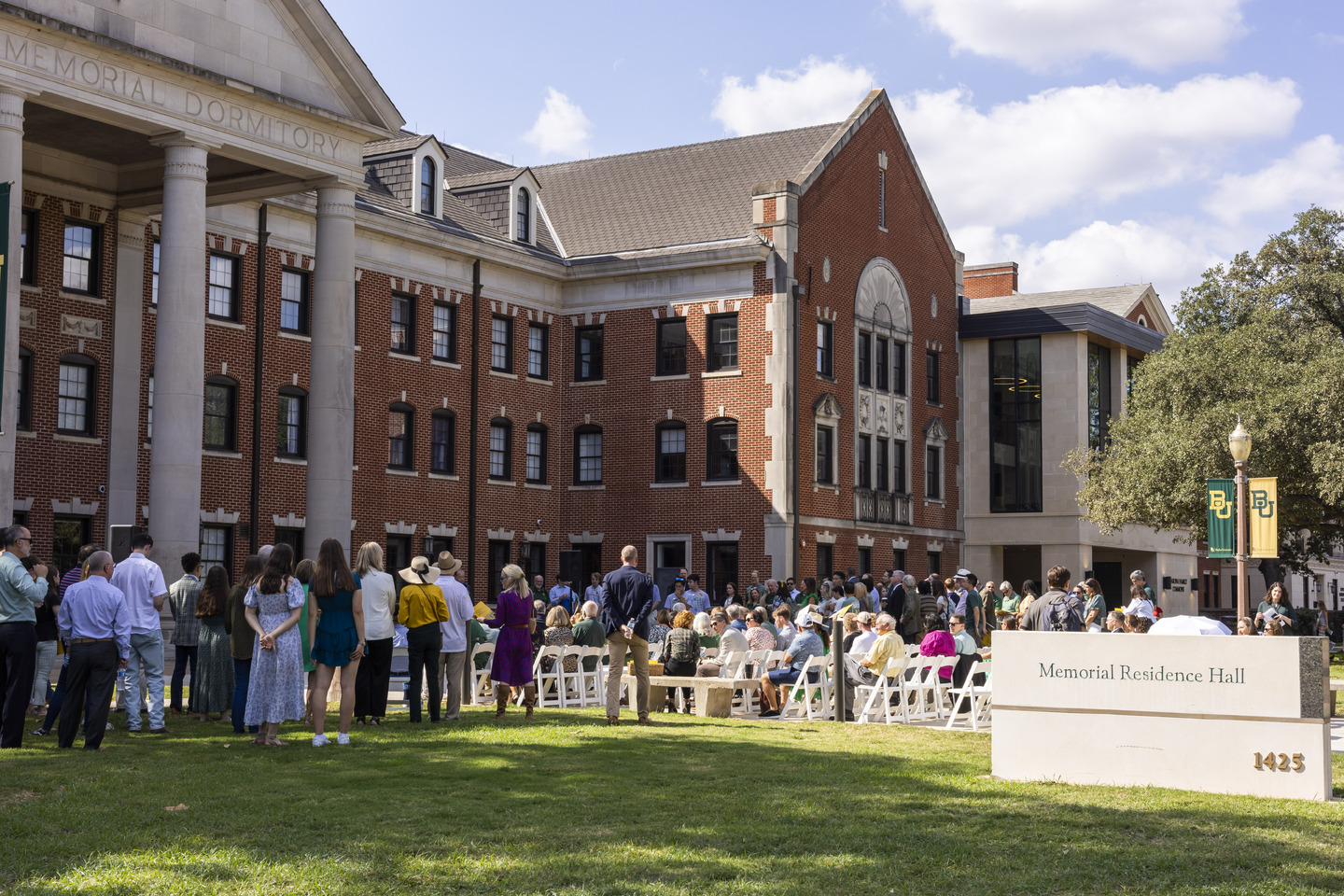
Renovation Orations
The grand re-opening of Memorial and neighboring hall Alexander drew alumni, donors, students, and faculty to hear opening remarks by President Linda Livingstone, Honors College Dean Doug Henry, and others. After the ceremony, guests were invited to tour the new spaces and view the original Book of Remembrance. | Source: Image courtesy of the Baylor University Honors College.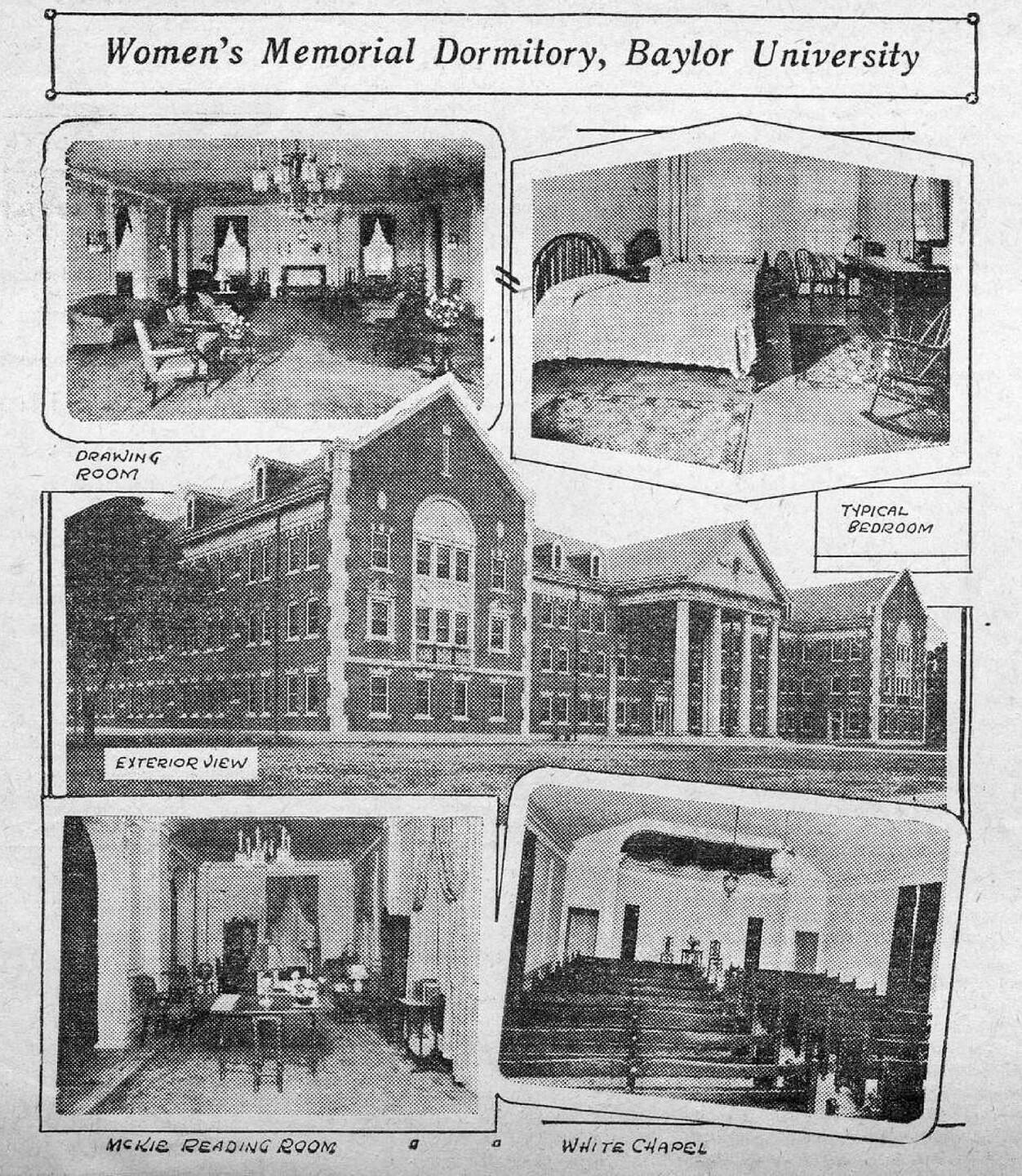
Inferior Interior
The interior of Memorial has been renovated and changed throughout the years, updating student room layouts, restoring the chapel, and refurbishing the drawing room. The exterior, however, remains almost entirely as it was in 1930. | Source: Baptist and Religious – ‘The Baptist Standard,’ Texas Collection, Baylor University, Digital ID: ml-standard-nwp_v042-n43_1930-10-23.
Bear Fare
Memorial Dining Hall, located on the first floor of Woman’s Memorial Dormitory, was the fourth dining hall to open on campus. Prior to this, dining options included Georgia Burleson Dining Hall, Brooks Dining Hall, and the Baylor Cafeteria. | Source: Image courtesy of the Baylor Lariat, September 4, 2015, https://baylorlariat.com/2015/09/04/video-get-the-memo-new-1845-dining-hall-at-memorial-becomes-campus-favorite/.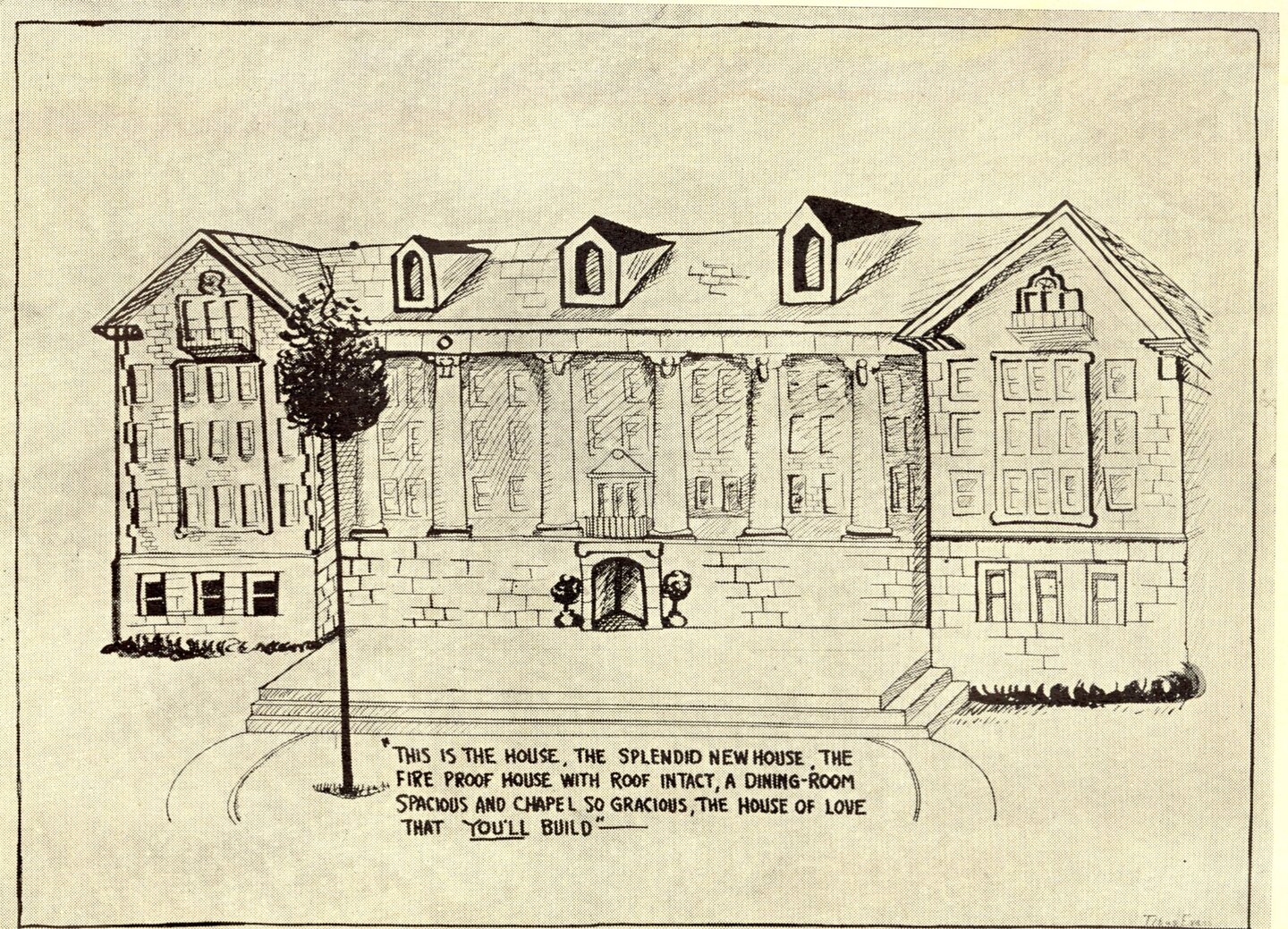
The House That You’ll Build
To raise money for their new hall, female Baylor students organized a dinner party for potential donors. At the party, the students regaled attendees with songs about dormitories and presented them with an illustrated poem about the struggles of life at Burleson Hall and their hopes for life at Memorial. | Source: Image Courtesy of the Texas Collection, At a Baylor University Dinner Party. Baylor University, 1928.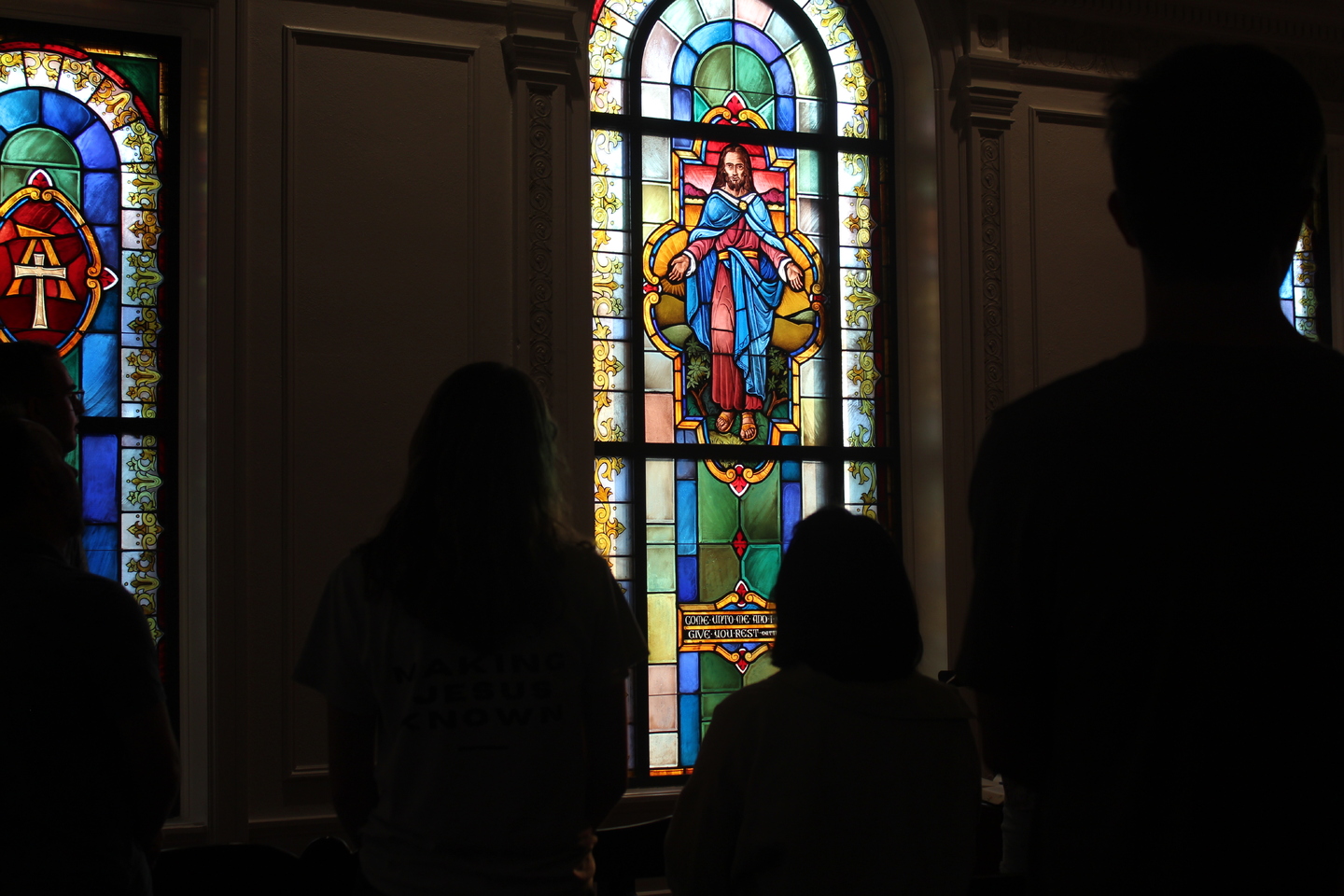
Through a Glass Darkly
The stained-glass windows in Memorial Chapel feature virtues and symbols of Christ, and a central window portrays the risen Christ. The windows were designed by former provost Dr. David Lyle Jeffrey and include Bible verses chosen by donor Mary Jo Robbins. | Source: Image courtesy of the Baylor University Honors Residential College Public Relations Committee.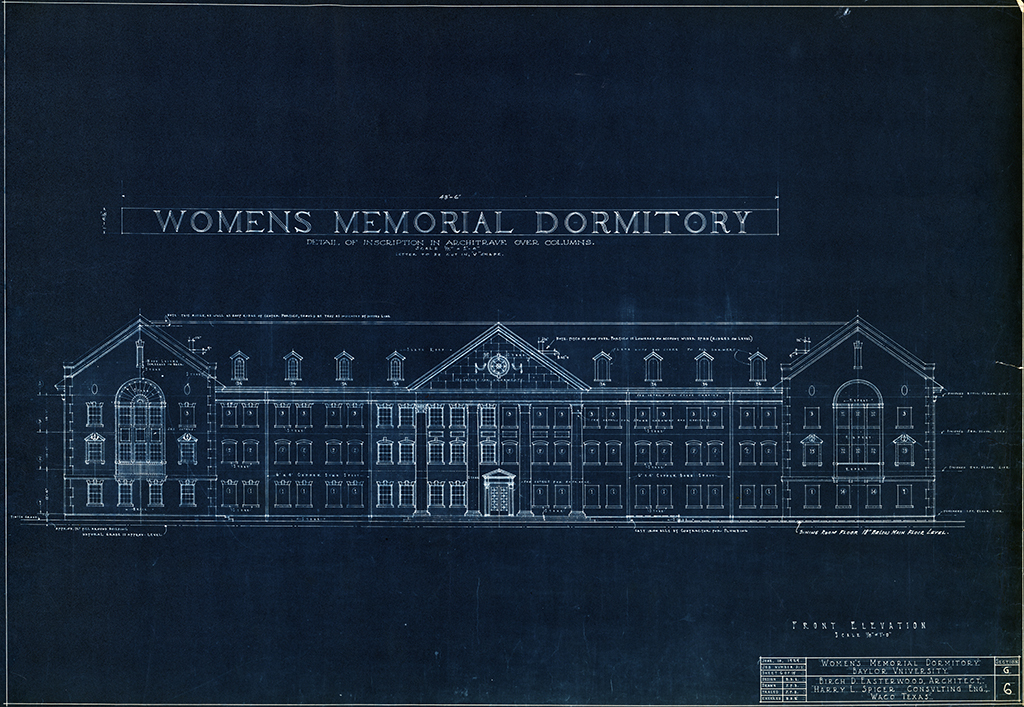
By Any Other Name
Above the entrance to Memorial Hall, the words “Woman’s Memorial Dormitory” are engraved. However, when architect Birch D. Easterwood made the blueprints for the building, he labeled them “Women’s Memorial Dormitory” instead, beginning a long tradition of using “woman’s” and “women’s” interchangeably in the name. | Source: Digital Library - Architecture Collection, Texas Collection, Baylor University, Digital ID: dl-archblu-bpt_memorial_01-g02_first-floor-plan_1929-06-10.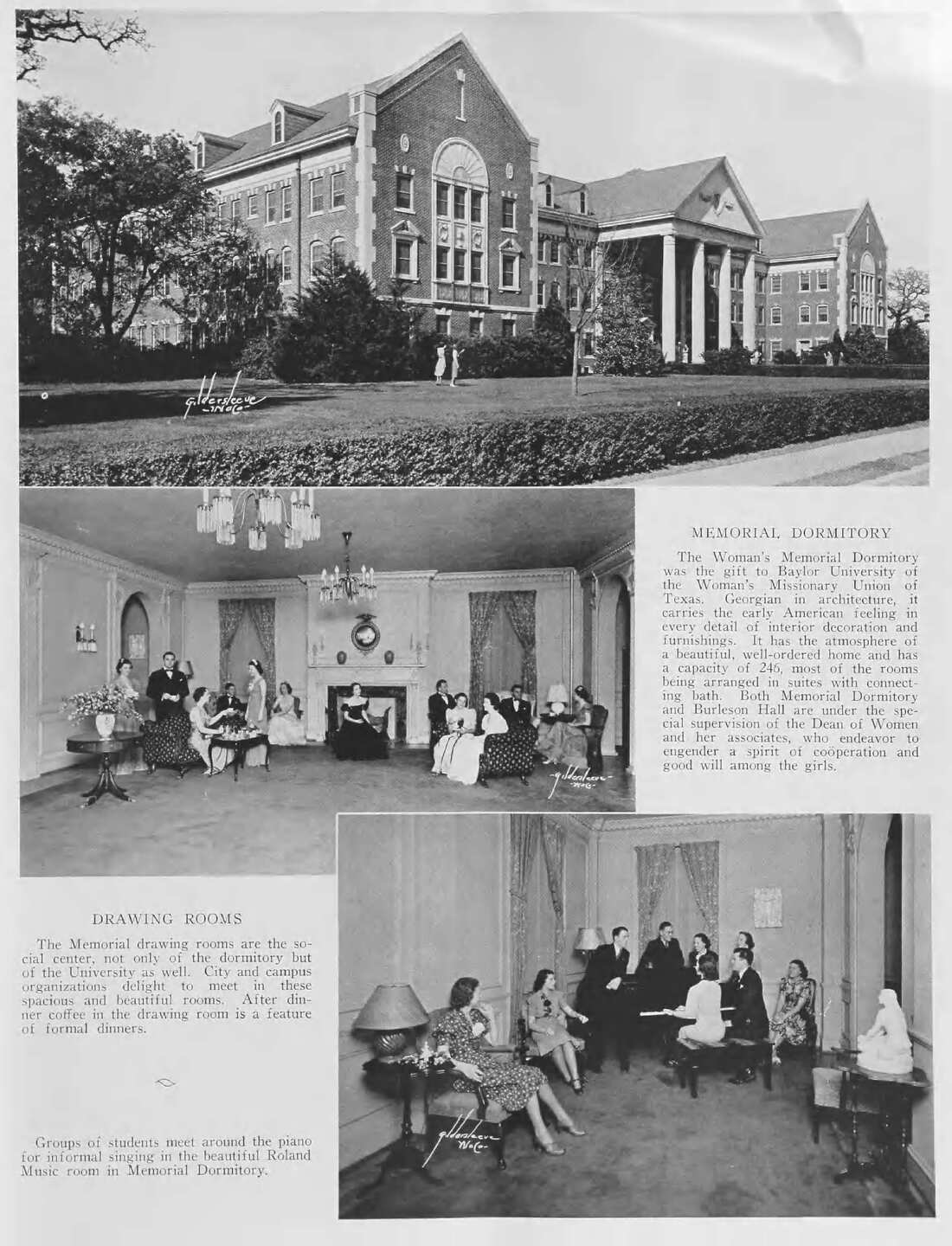
Clubs for Coeds
In the 1920s, it became socially acceptable for women to take part in college organizations, and several women’s societies popped up at Baylor. When Memorial opened, it was only natural that the women’s organizations chose to conduct their business in their new space. | Source: Baylor University Archives – Selections, Texas Collection, Baylor University, Digital ID: bu-archive-cat_promotional-catalog_1940.
Bear in Mind
The Book of Remembrance is a large volume inscribed with the names of everyone who contributed to the fundraising, planning, and building of Woman’s Memorial Dormitory. Created by the Woman’s Missionary Union, the book features beautiful hand-drawn illumination and calligraphy. | Source: Image courtesy of the Baylor University Honors College.
A Howling Success
Former provost Dr. David Lyle Jeffrey recalls the founding of the Honors Residential College. The HRC continues to be beloved by both residents and faculty. | Source: Jeffrey, David Lyle, interviewed by Stephen M. Sloan, April 4 to December 11, 2013, in Waco, Texas. Baylor University Institute for Oral History, Waco, Texas. Access full interview here.Baylor Belles
Baylor alumna Maxine Hart recalls the strict rule of life Baylor women led even as late as the 1950s. Baylor administration made it their priority to produce well-behaved and ladylike women. | Source: Hart, Maxine, interviewed by Brenda H. Morris on July 16, 1997, in Waco, Texas. Baylor University Institute for Oral History, Waco, Texas. Access full interview here.Members to Remember
Aurelia Brooks Harlan, daughter of Baylor President Samuel Palmer Brooks, recalls going to London to commission the Book of Remembrance, which listed the names of the individuals who made the building of Memorial possible. On display in Memorial until 2025, the book is now digitized and available for viewing through the Texas Collection. | Source: Brooks, Sims Palmer and Harlan, Aurelia Emma Brooks, interviewed by Kent Keeth and Tab W. Lewis, October 13, 1981 to October 4, 1984, in Corpus Christi, Texas. Baylor University Institute for Oral History, Waco, Texas. Access full interview here.