Bettie Mae Scott
Text
During World War II, Elizabeth “Bettie” Mae Scott joined a small group of women who took to the skies in support of the United States war effort. Scott served as a member of the Women Airforce Service Pilots (WASP), a program that trained female aviators to perform critical flying duties within the United States while male pilots fought overseas.
Bettie Mae Scott spent her early life in Monrovia, California, a city in the greater Los Angeles area. She was born on July 26, 1921, to Frank L. Scott and Virgel (Cochran) Scott. Although relatively little documentation survives about her early years, the 1940 U.S. Census indicates that she grew up in a household with three siblings (two brothers and one sister) and her father served as the Police Chief in Monrovia. Scott remained in the community where she was raised until leaving California for Texas to begin training with the Women Airforce Service Pilots, marking the first time she had relocated away from home.
Bettie’s story emerged during a period of dramatic change in the American workforce. As masses of men departed for military service, an estimated 6.6 million women entered the labor force, taking on occupations that had previously been closed to them. Aviation proved no exception to these national trends, and the U.S. Army Air Forces soon faced a shortage of domestic male pilots.
Operating from August 1943 to December 1944, the Women Airforce Service Pilots (WASP) program represented a significant development in the professional advancement of female aviators in the United States. However, its creation did not mark the beginning of women’s participation in aviation. Rather, WASP emerged from decades of effort by women seeking greater access to flight training and professional aviation opportunities. Applicants were required to already hold pilot licenses; many having trained through the federal Civilian Pilot Training Program established in 1938. Bettie Scott herself had earned a civilian pilot’s license before applying to the program. Administratively, WASP consolidated two earlier organizations, the Women’s Flying Training Detachment (WFTD) and the Women’s Auxiliary Ferrying Squadron (WAFS), into a single program. Its formation also reflected broader global developments, as both Great Britain and the Soviet Union had already incorporated women into wartime aviation roles, placing pressure on the United States to expand women’s participation in military aviation.
The WASP program was highly selective. More than 25,000 women applied, but only about 1,830 (roughly seven percent) were accepted for training at Avenger Field in Sweetwater, Texas. Of those accepted, 1,074 ultimately completed the program and served as Women Airforce Service Pilots, an achievement Bettie shared with just over a thousand other women. Such an accomplishment was comparable in selectivity to being accepted into an Ivy League university.
Affectionately known as “Scotty” among her fellow pilots, Scott trained for several months at Avenger Field before graduating on April 15, 1944. Upon graduation, the Army Air Forces assigned her to Blackland Army Airfield and Waco Army Airfield in Waco, Texas, where she served as an engineering test pilot. In this role, Bettie flew aircraft that had recently undergone maintenance to determine whether they were safe to return to operational service.
Test flying ranked among the most dangerous responsibilities in the WASP program because mechanical failures and structural defects could emerge only after an aircraft returned to the air. Many WASP pilots faced similar risks while ferrying newly manufactured aircraft between factories and military bases or towing aerial targets for training. By the time the program ended in 1944, thirty‑eight WASP pilots had lost their lives in service.
The inherent dangers of test flying became a tragic reality for Bettie on the morning of July 8, 1944, when Scott took off to test‑fly a recently repaired BT‑13 Valiant at Waco Army Air Field. The BT‑13 was a basic training aircraft used by the Army Air Forces to prepare new pilots for more advanced combat planes. Shortly after the aircraft lifted off the runway, it climbed too steeply and stalled at an altitude of roughly one hundred feet. The plane rolled and crashed upside down, killing Scott instantly as a result of severe head trauma. Investigators later determined that structural defects in the aircraft’s tail assembly had caused the sudden loss of control.
For many years after the war, the contributions of the WASP pilots remained largely unrecognized because the federal government classified them as civilian employees rather than military personnel. As a result, pilots who died on duty were not provided funeral or body transportation benefits, nor were they recognized as fallen service members. When Bettie Scott died in 1944, her fellow WASP pilots collected money to return her body to her family in California, sending her home in a simple pine coffin. Scott was later buried in her family’s plot at Live Oak Memorial Park Cemetery in Monrovia, California, near her parents. Only decades after the WASP program ceased operation did the federal government formally acknowledge the women’s service. In 1977, Congress granted WASP members veteran status, and in 2010 the pilots of the program were awarded the Congressional Gold Medal in recognition of their contributions during World War II.
Today, Bettie Mae Scott is remembered as part of a pioneering generation of women in military aviation. During wartime pilot shortages, WASPs stepped into roles that had previously been closed to them. They undertook missions despite the known dangers of the work and the knowledge that they lacked the official status and benefits afforded to military personnel. Women like Scott accepted the risks by pursuing their ambitions as aviators while contributing their skills to the wartime needs of the U.S. military. Their service expanded opportunities in aviation and helped shape the future of women’s participation in the United States armed forces.
Files
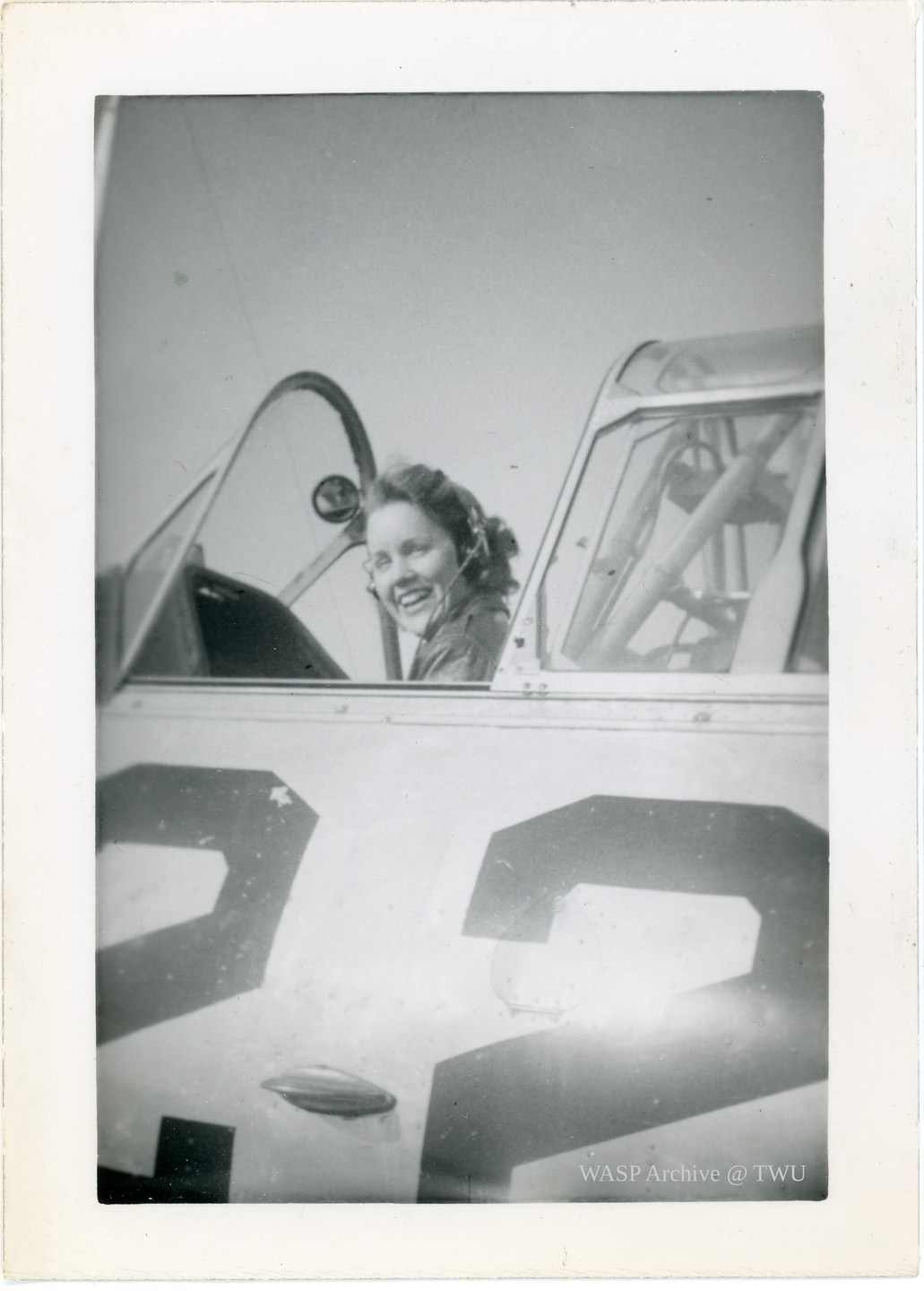
Ready for Takeoff
Bettie Scott sits in the cockpit of an AT 6 training aircraft at Avenger Field in Sweetwater, Texas, in 1944. The AT 6 Texan was used during the advanced stage of pilot training to prepare aviators for the handling and performance of military combat aircraft. Women in the WASP program trained on several types of aircraft at Avenger Field as part of a rigorous program modeled after Army Air Forces cadet instruction. | Source: Images Courtesy of WASP Archive, The TWU Libraries’ Woman’s Collection, Texas Woman’s University, Denton, Texas.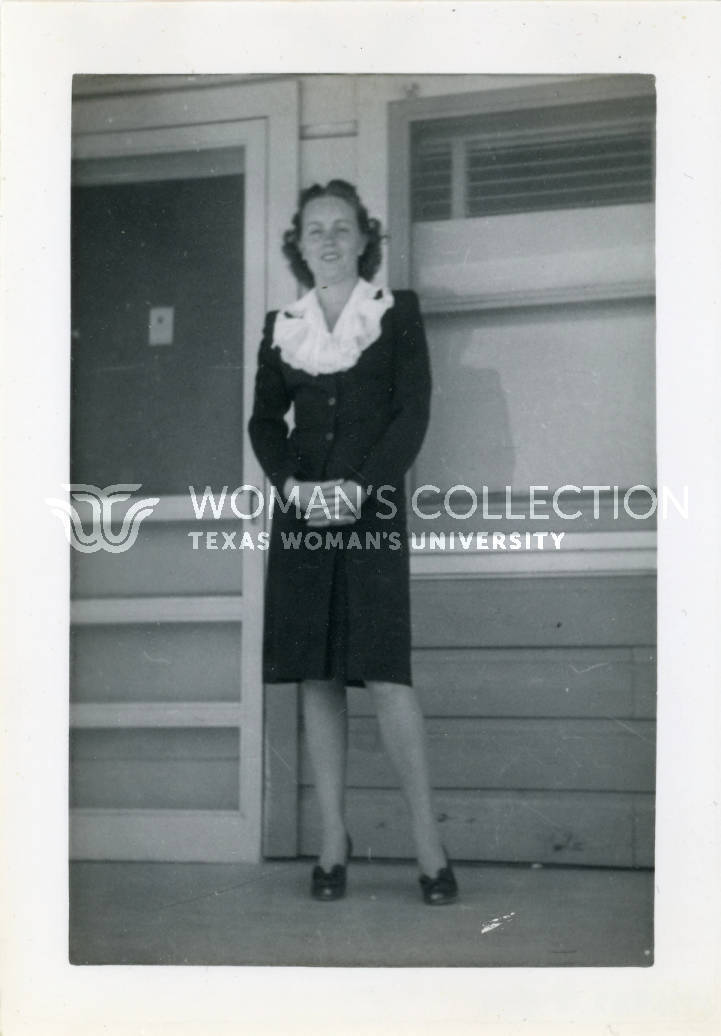
Between Two Worlds
Bettie Scott stands at Avenger Field in Sweetwater, Texas, dressed in civilian clothing during her time in the WASP program. Although Women Airforce Service Pilots wore Army Air Forces–style uniforms while on duty, they remained officially classified as civilian employees and for decades received none of the military rank or benefits granted to male pilots. On base, these women were evaluated on their skill as aviators and entrusted with flying military aircraft. Beyond the airfield, however, society remained attached to ideals of traditional womanhood, often judging these pilots less by their accomplishments in the cockpit than by expectations placed on them as women. | Source: Images Courtesy of WASP Archive, The TWU Libraries’ Woman’s Collection, Texas Woman’s University, Denton, Texas.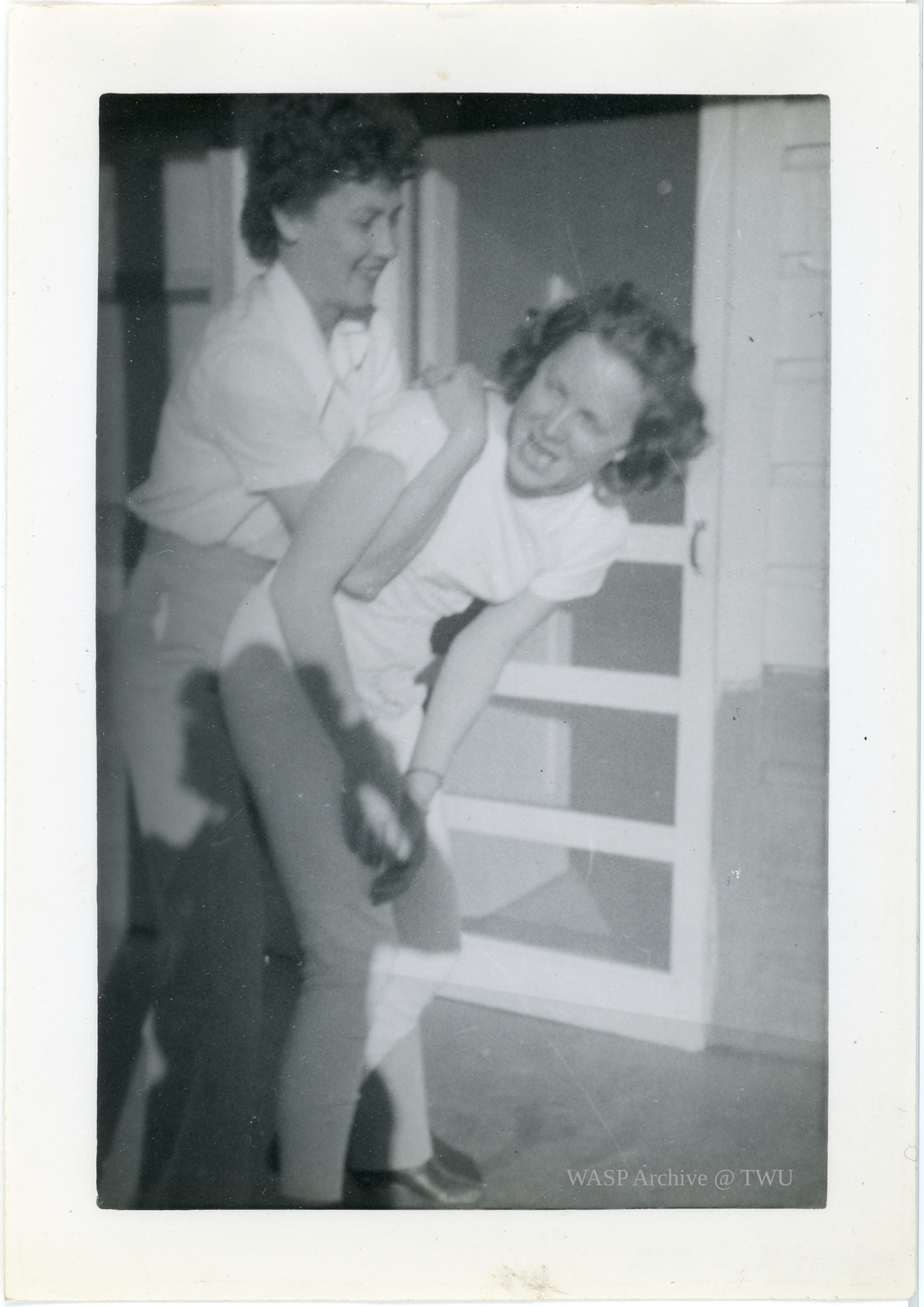
Sisters of the Sky
Bettie Scott (left) and fellow WASP Dorothy Moulton share a playful moment at Avenger Field in Sweetwater, Texas. The women who trained there lived, studied, and flew together during the program’s seven month training course, forming close friendships in an environment where female military aviators were still rare. Many WASPs later recalled that the camaraderie they built at Avenger Field helped sustain them through the demands and risks of wartime flying. | Source: Images Courtesy of WASP Archive, The TWU Libraries’ Woman’s Collection, Texas Woman’s University, Denton, Texas.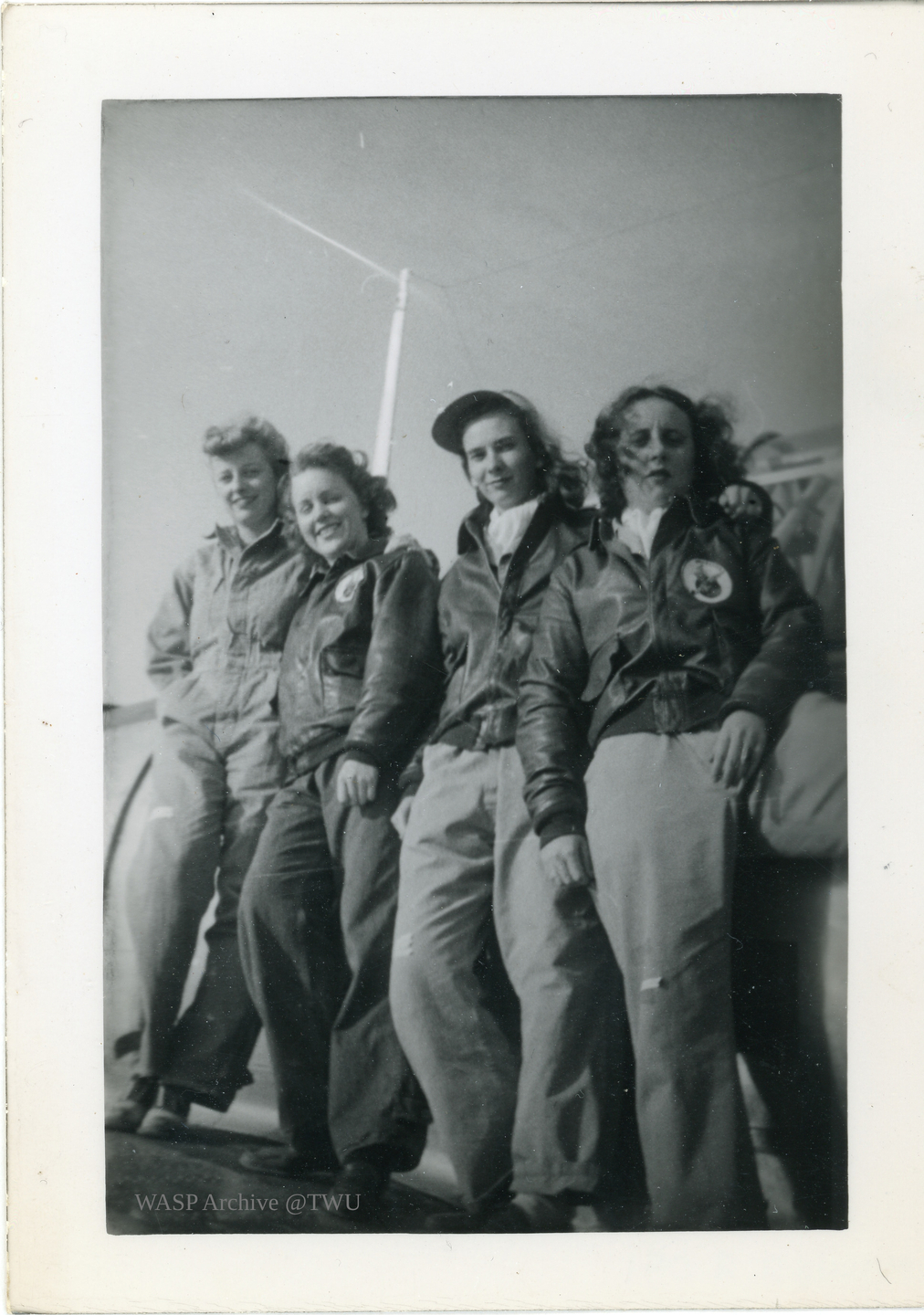
Elite Aviators
Pilots Kristin Swan, Bettie Scott, R. M.S., and Meriem Roby (left to right) lean against an aircraft at Avenger Field which served as the sole training site for the Women Airforce Service Pilots (WASP) program. Out of more than 25,000 applicants about 1,000 women graduated from training. At a time when military aviation was overwhelmingly male, the concentration of women training together at Avenger Field created one of the first large communities of female military aviators in the United States. | Source: Images Courtesy of WASP Archive, The TWU Libraries’ Woman’s Collection, Texas Woman’s University, Denton, Texas.
Serving the Nation
This 1944 recruitment advertisement by illustrator Maurice Bramley for the Department of National Service encouraged women to enter wartime occupations. During World War II, labor shortages opened new roles for women in fields ranging from factory work to aviation, and government campaigns promoted these positions as patriotic “victory jobs.” At the same time, many advertisements carefully portrayed female workers in traditionally feminine ways such as with styled hair, makeup, and tailored uniforms—emphasizing that women could contribute to the war effort without abandoning conventional ideals of femininity. By presenting wartime labor as both patriotic service and socially acceptable womanhood, such images sought to mobilize female workers while reassuring male audiences that established gender norms remained intact. | Source: “Join Us in a Victory Job.” Illustration by Maurice Bramley, Department of National Service, 1944. Courtesy of the Department of Defense.
Towing the Line Between Danger and Duty, Part 1
In this oral history, WASP pilot Ruth Florey recalls the high‑risk target towing missions and the losses at Camp Davis, where fellow pilots Mabel Rawlinson and Betty Taylor Wood were killed in crashes. The target towing missions consisted of the WASP pilot flying with a fabric sleeve behind the aircraft while ground gunners fired live ammunition at it for practice. This was one of the most dangerous assignments given to Women Airforce Service Pilots during World War II. Despite the risks, Florey explains that she and other WASP accepted the work out of a strong sense of duty to the war effort. | Source: Florey, Ruth. Interview by Deanie Parrish. Ruth Florey Oral History Interview, September 20, 2000. Wings Across America: Women Airforce Service Pilots (WASPs) of WWII, Baylor University Institute for Oral History, Waco, TX. Access full interview here.Towing the Line Between Danger and Duty, Part 2
In this oral history, WASP pilot Ruth Florey recalls the high-risk target towing missions and the losses at Camp Davis, where fellow pilots Mabel Rawlinson and Betty Taylor Wood were killed in crashes. The target towing missions consisted of the WASP pilot flying with a fabric sleeve behind the aircraft while ground gunners fired live ammunition at it for practice. This was one of the most dangerous assignments given to Women Airforce Service Pilots during World War II. Despite the risks, Florey explains that she and other WASP accepted the work out of a strong sense of duty to the war effort. | Source: Florey, Ruth. Interview by Deanie Parrish. Ruth Florey Oral History Interview, September 20, 2000. Wings Across America: Women Airforce Service Pilots (WASPs) of WWII, Baylor University Institute for Oral History, Waco, TX. Access full interview here.