Waco Navigators
Text
Waco’s sporting history is colorful and diverse, not least due to the various minor league baseball teams that have called the city their home. One of the longest standing and most successful of these teams was the Waco Navigators, who played in Katy Park from 1906-1919.
Although the state of Texas did not boast a major league baseball team until 1962, Texans had been playing baseball since the 1860s. Initially, Texas baseball consisted only of a few amateur clubs, but by the 1880s, these teams began to pay some of their players, usually the pitcher, catcher, and shortstop. By 1887, there were at least six professional leagues in the United States, and Texas was not far behind. Spearheaded by John McCloskey, player and manager for the Joplin Independents, the Texas League came into a shaky existence in 1888, teams from Austin, Dallas, Ft. Worth, Galveston, Houston, and San Antonio making up its ranks. The first few years were a rollercoaster for the fledgling league, with some teams sporadically running out of cash for their players’ salaries, others folding in the middle of the season, and the league sometimes terminating seasons ahead of schedule.
Waco’s baseball history began years before the founding of its first minor league clubs. Along with a few amateur teams, Waco was the home of several semi-professional black baseball teams beginning in the 1870s. It was not until 1889 that Waco’s first minor league baseball team began play. Between 1889 and 1906, Waco was the home of several minor league baseball teams, including the Waco Babies, Texans, Tigers, and Steers. Each of these teams belonged to the Texas League. In 1906, during the league’s early turmoil, Waco embraced yet another new baseball team. A public contest decided the team’s name, with the winners, Mrs. W. Sparks and Miss Mattie May Wilkes, selecting the name of “Navigators,” reflecting the efforts of Texans to navigate the Brazos River. The Navigators’ first season was less than impressive, resulting in a final record of thirty-two wins and ninety-six losses. These abysmal numbers earned the Navigators the last-place spot in that year’s Texas League standings. The next four years were equally unimpressive, possibly due to frequent turnover in the manager’s position. Between 1906 and 1911, the Navigators went through eight different managers. Finally, the team hired Ellis Hardy. Formerly the head baseball coach for Texas Christian University, Hardy became the most successful and longest tenured of the Navigator’s managers, and he led the team to its first winning season in 1911. From there the team began to climb, with its record improving steadily until 1914, when the Navigators tied seven-time league champions Houston Buffaloes for first place.
The end of the 1914 season would go down in Texas League history as one of the wildest and most contested finishes the league had ever seen. Going into the last series of the season, the Houston Buffaloes led the Navigators by a single game. Waco easily won both of its slated games against the Dallas Giants, giving them a winning percentage of .670 for the season. Houston, in its turn, came away victorious over the Galveston Pirates in its first game, but their second game remained unfinished, called due to darkness in the fifth inning. They had been losing badly. With the unfinished contest, Houston finished at .673, seemingly earning themselves the pennant. Indignant, Waco contested the unfinished game, saying it had been bright and sunny when the umpires stopped the game. Texas League historian William Ruggles, who attended the game, states that it was indeed dark when the fifth inning began, but by the time Galveston had finished batting the sky had cleared. On top of this, Waco then found out that, earlier that season, Houston had broken a league rule stating that the first game of a doubleheader had to be nine innings long, stopping at seven innings in the first game of a doubleheader against Austin. Texas League President W.R. Davidson threw out the result of the shortened game, ignoring the rule that stated the teams had to replay the contest. However, he had also learned that Waco had played a game with a player acquired after intraleague trades had ended. Unfortunately for Waco, Davidson threw out that game as well. Eventually, league administration credited both teams with records of 102-50, and the pennant race ended in a tie.
The Waco Navigators won the pennant for the next two seasons, making them back-to-back-to-back champions, an impressive feat. The Navigators continued playing until 1919. The 1919 season was a dismal one, with the team posting a 59-88 record, their only losing record since 1910. At the same time, the growing city of Wichita Falls, Texas, was experiencing an oil boom. Suddenly flush with cash, a Wichita Falls group bought the Navigators and moved the team, renaming them the Spudders after the oilfield slang for starting an oil well (not potatoes).
That same year, the newly organized Texas Colored League began to play. Among its founding teams was Waco’s newest minor league team: the Waco Black Navigators. The Black Navigators would go on to spend 1919 and 1920 in Waco, before moving to San Antonio as the Black Aces. The Black Navigators were not the last professional baseball team Waco would see in the twentieth century. Between 1920 and the demolition of Katy Park in the 1960s, Waco was the home of the Cubs, the Black Cardinals, the Dons, and the Pirates. Although Katy Park no longer stands, and Waco has not boasted a professional team since the 1950s, Wacoans have retained their love of the national pastime and recall their old clubs fondly.
Files

Root for the Home Team
The Navigators played their home games in Katy Park. Built in 1905, the park was designed by entrepreneur and former ballplayer Henry Fabian, then owner of the Waco Tigers. Fabian is not only credited with the invention of the turtleback field, pitcher’s mound, sliding pads, and an early version of the catcher’s mitt, but is also the reason it became legal to play baseball games on Sundays in Texas. | Source: The Texas Collection, Baylor University, Digital ID: tx-gildersleeve-0430-pho_b109-f08-i141.
Legends Never Die
These photos feature Navigators manager Ellis Hardy, pitcher Cliff Hill, and one in-game shot. Hardy was the Navigators’ winningest manager, coaching the team to a winning record in every one of his eight seasons. Tom Carson, who coached only half of the 1913 season, was the only other Navigators manager to earn a positive record. | Source: All original photos owned by Lane Murphy, co-owner of 2nd and Clay. All photographs appear to be from the 1914 team.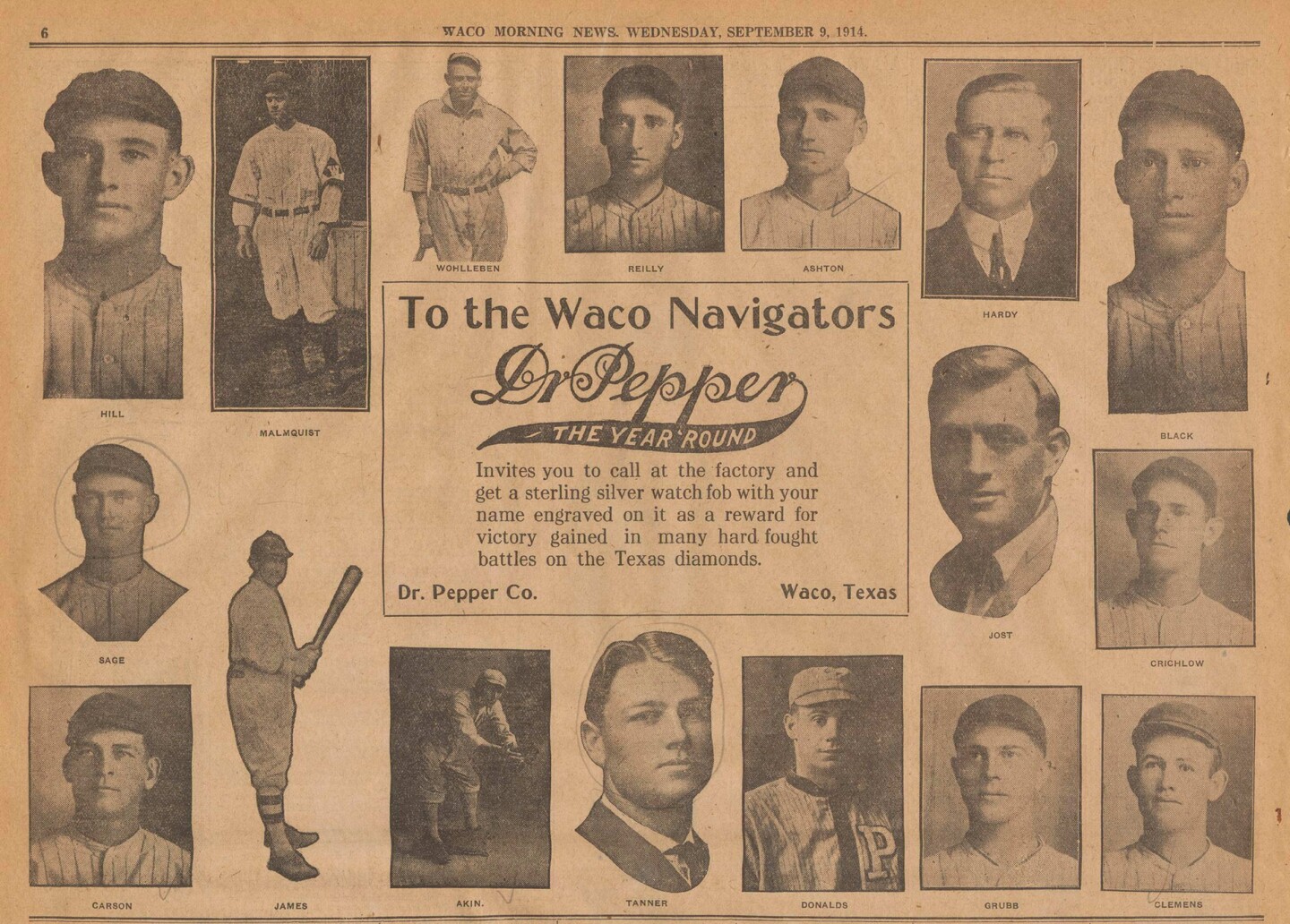
Don’t Mess with Texas (League)
From its humble beginnings, the Texas League, now a Double-A circuit, has grown to be a considerable influence on baseball nationally. In fact, the slang term for a hit ball that lands just between an infielder and an outfielder is “Texas Leaguer.” | Source: Historic Waco Newspapers, Texas Collection, Baylor University, Digital ID: tx-waconewsp-nwp_wmn_1914-09-09.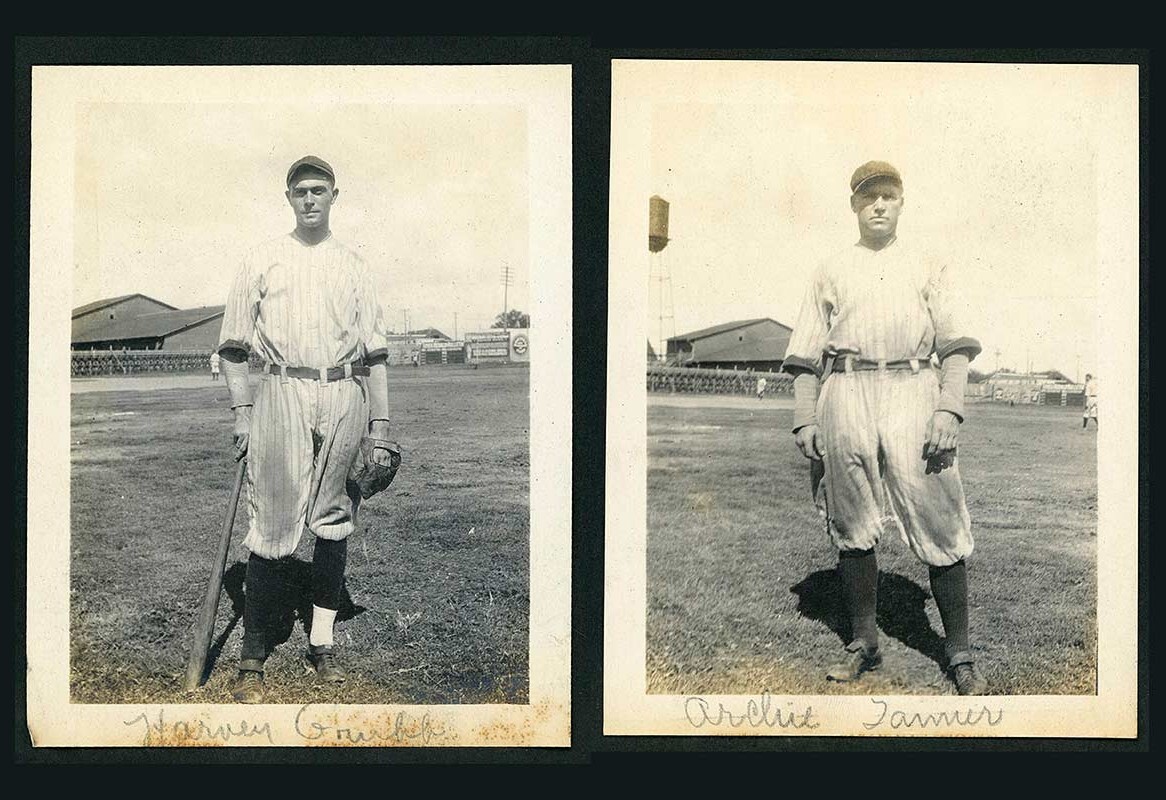
Put Me in, Coach
This group of photos features Navigators infielder Harvey Grubb and shortstop Archie Tanner. Prior to joining the Navigators, Grubb was briefly a member of the major league Cleveland Naps. Grubb was hit by a pitch in his lone at-bat with the Naps, earning himself a 1.000 career on-base percentage in the majors. | Source: All original photos owned by Lane Murphy, co-owner of 2nd and Clay. All photographs appear to be from the 1914 team.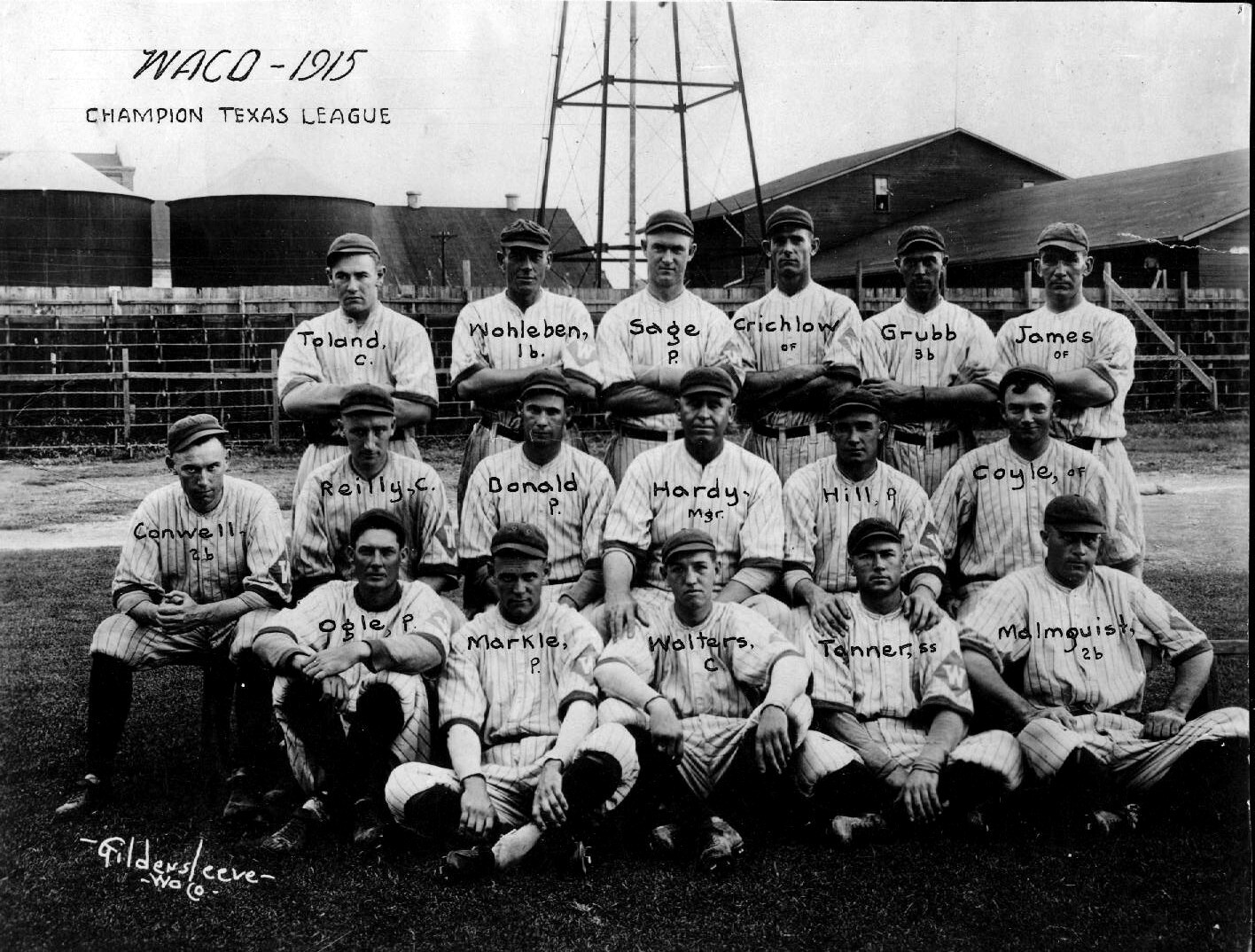
Welcome to the Show
Marlin, Texas, located less than thirty miles from Waco, was a popular spring training location for major league teams in the early 20th century. Because of their proximity to Marlin, the Navigators often played exhibition games against teams such as the New York Giants or the Detroit Tigers either at Marlin’s Emerson Field or home at Katy Park. | Source: Image courtesy of Jay Black, Texas Sports Hall of Fame.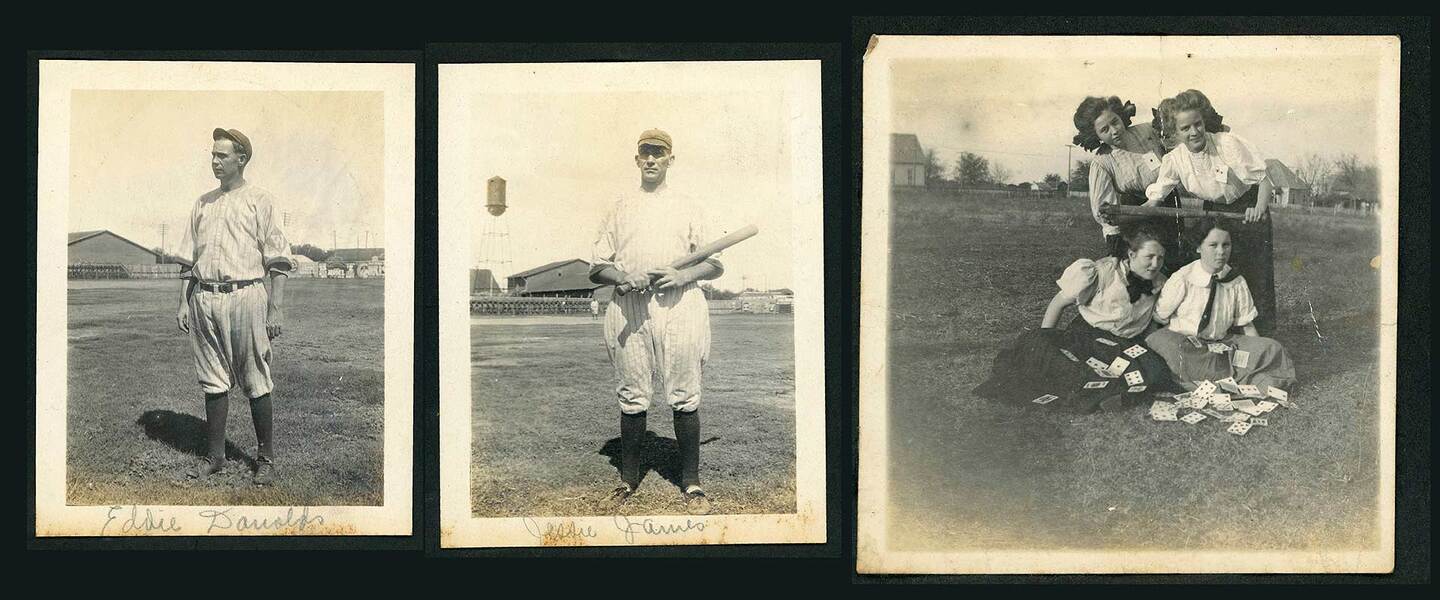
From the Brazos Bullpen
This set of photos features Navigators pitcher Ed Donalds, outfielder Bert “Jesse” James, and a group of young women who came out to cheer on the team. Donalds was a vital member of the 1914 team, pitching 304 innings over 42 games and earning a remarkable 30-4 record (for context, Nolan Ryan’s best season record was 22-16). | Source: All original photos owned by Lane Murphy, co-owner of 2nd and Clay. All photographs appear to be from the 1914 team.
Most Valuable Player
Many Wacoans know the story of when Babe Ruth and Lou Gehrig visited Waco and crossed bats with the Waco Cubs, but they might not know that another famous athlete once played ball at Katy Park. In 1916, multi-sport athlete and Olympic legend Jim Thorpe played left field for the New York Giants’ second team in an exhibition game against the Navigators. The Navigators beat the Giants 7-3. | Source: Image courtesy of Jay Black, Texas Sports Hall of Fame.
A Sturdy Batsman
These photos feature Navigators players dressed for an outing in town, outfielder Bob Clemens, and a team fishing trip. Clemens only played one season with the Navigators, but he made it count: over 702 plate appearances, Clemens posted a .327 batting average and an on-base plus slugging percentage of .853. | Source: All original photos owned by Lane Murphy, co-owner of 2nd and Clay. All photographs appear to be from the 1914 team.