Austin Avenue Pedestrian Mall
Text
Completed in 1970, the Austin Avenue Pedestrian Mall opened to high expectations. The City of Waco created the pedestrian mall in an effort to bring consumers back to the downtown district, closing down the street to automobiles and only allowing foot traffic. The Austin Avenue Pedestrian Mall featured walkways connecting many stores in one central location. After a 1953 tornado wiped out much of the city's downtown commercial life, Waco's Downtown Merchants Association proposed the creation of a pedestrian mall to lure Wacoans back into the traditional commercial district and away from the suburban shopping centers. In 1958, the City of Waco became one of thousands of cities to participate in the nationwide urban renewal program. Urban Renewal efforts in Waco aimed to clear blighted areas around the city including homes, buildings, and city streets, forcing many citizens and businesses to relocate.
The downtown district was one of the areas chosen for Urban Renewal in 1968. According to a city planning report from 1966, the attitude of downtown merchants had been one of discouragement, with clerks uninterested in making sales and large numbers of panhandlers downtown. The Urban Renewal Agency of Waco aimed to remedy this situation, and began efforts to restore downtown Waco through was became known as the Brazos Project. The Austin Avenue Pedestrian Mall was to be the central feature in the Brazos Urban Renewal district, which would cover 155 acres from 12th Street to the river, between Washington and Franklin avenues. The project awarded to Young Brothers Inc. in December 1969 and cost upwards of $850,000. When the mall was formally dedicated in January 1971, cars were banned from the area of Fifth to Ninth streets until the Waco City Council voted in February 1979 to reopen the Austin Avenue to vehicle traffic going one-way. Though the construction of the mall heralded a brighter future for the downtown district to the citizens of Waco, they were ultimately disappointed, and the Pedestrian mall proved a failure.
The reasons for the decline of the mall are numerous. For instance, customers could only enter the walkway of the mall by parking their vehicles outside and walking in through the back of a store. Parking for the mall was supposed to be "available, convenient and free," but those plans were never formulated. Inclement weather also proved to be a major issue since store awnings provided little cover from rain, and the hot days of Central Texas summers made the concrete structure unbearable for people to visit. By 1984, few pedestrians walked the closed-off streets, and even fewer made purchases. The perception of downtown business in Waco was so poor that a Waco Tribune-Herald article sarcastically noted that the debate about reopening Austin Avenue to traffic drew more attention to the mall and downtown Waco than it had received in years, and that the “pigeons have had no trouble keeping the right-of-way.”
In a nation where city planners attempted to renew the modern landscape, the Austin Avenue Mall was not the only pedestrian mall to fail. City planners throughout the country wanted all centers of government, businesses, and social life to be located in a single strong operating area. They believed the pedestrian malls would attract customers to downtown, and these customers would then make use of other services in the area while visiting retailers. The planners failed to realize that the automobile was changing the way people commuted, shopped, and went about most daily routines. Citizens were able to move farther away from city centers, and many retailers themselves moved to the suburbs as well. The late 1960s and 70s saw numerous new strip malls and businesses relocate to the residential neighborhoods across Waco and across the nation. The Austin Avenue Pedestrian Mall fell victim to this poor climate for downtown city life. Though city officials hoped the mall would reinvigorate downtown, it merely sped its decline. Only the most resilient merchants remained downtown following the reopening of Austin Avenue to traffic. Today, Waco’s city planners strive to revive downtown life, especially along Austin Avenue, through the preservation of historic buildings, bringing in more merchants and businesses, and bringing back the traditional pedestrian experience of downtown.
Files

Construction (1970)
A worker attends to the support frame of one of the pedestrian mall's many planters or fountains. After the Waco City Council approved the Brazos Urban Renewal Area plan to convert Austin Avenue into a pedestrian mall and build a convention center in the old city square, a federal grant was approved for the project in 1968. The mall cost approximately $850,000 to build. | Source: Image courtesy of the Texas Collection, Baylor University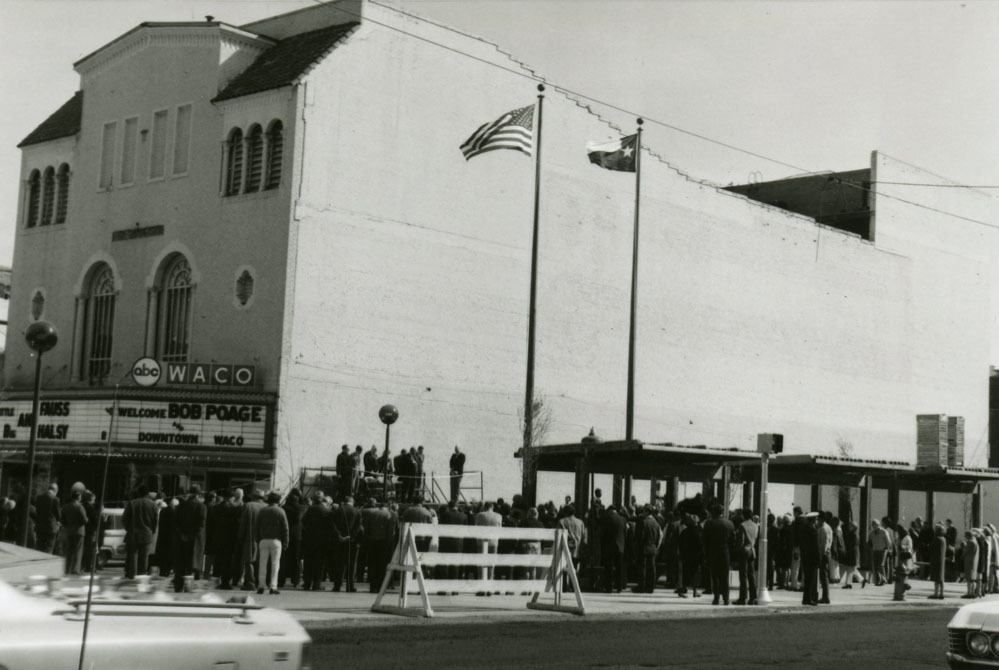
Dedication Ceremony
On January 16, 1971, the mall officially opened to the public. City officials and curious shoppers gathered near the Hippodrome Theatre to hear renowned politician and Wacoan Bob Poage give an address as part of the launch festivities. | Source: Image courtesy of the Texas Collection, Baylor University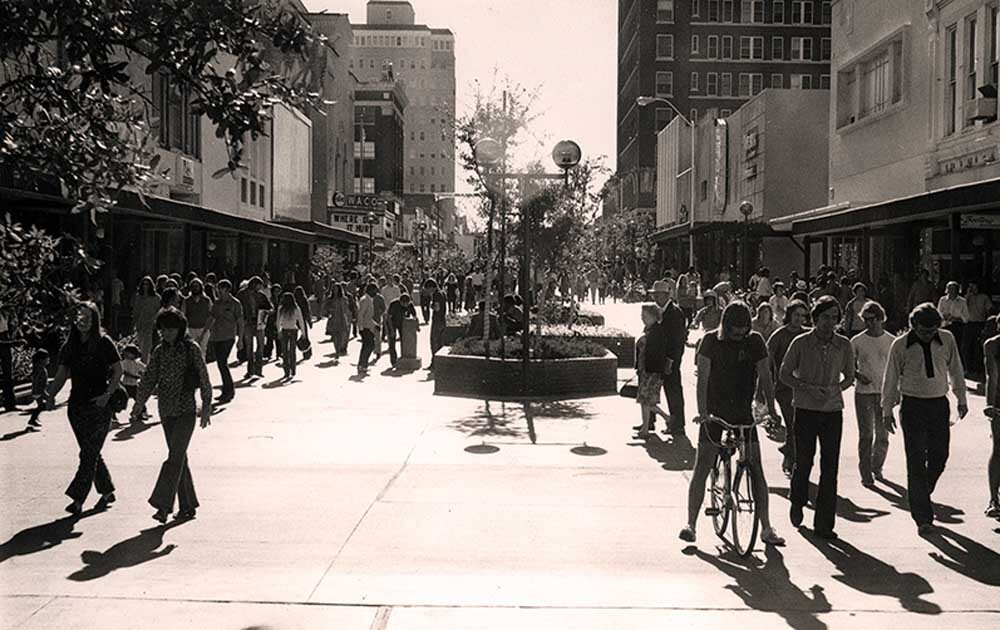
High Hopes
City planners and merchants alike were optimistic about the long-term success of the mall. Given the large crowds it attracted in its first year, the Austin Avenue Pedestrian Mall seemed to have a bright future ahead of it. | Source: Image courtesy of the Texas Collection, Baylor University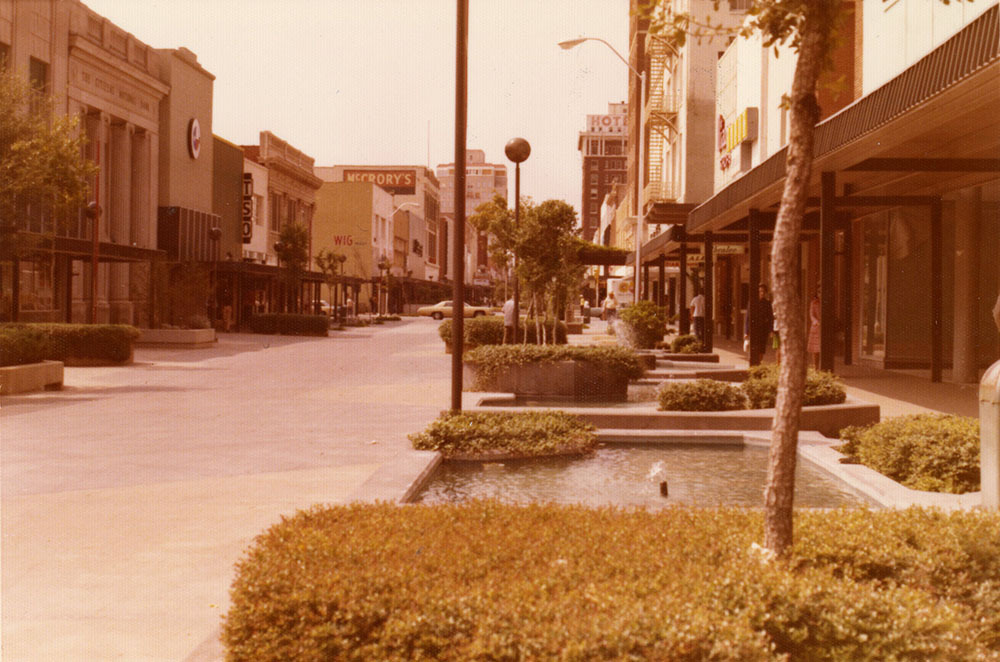
Best of Intentions
Architects placed fountains, planters, modern lighting, and cement blocks for seating and decoration along the mall in order to add to its aesthetic appeal. Some of these plans backfired when vagrants began to use the fountains to bathe and youth vandalized the area. | Source: Image courtesy of the Texas Collection, Baylor University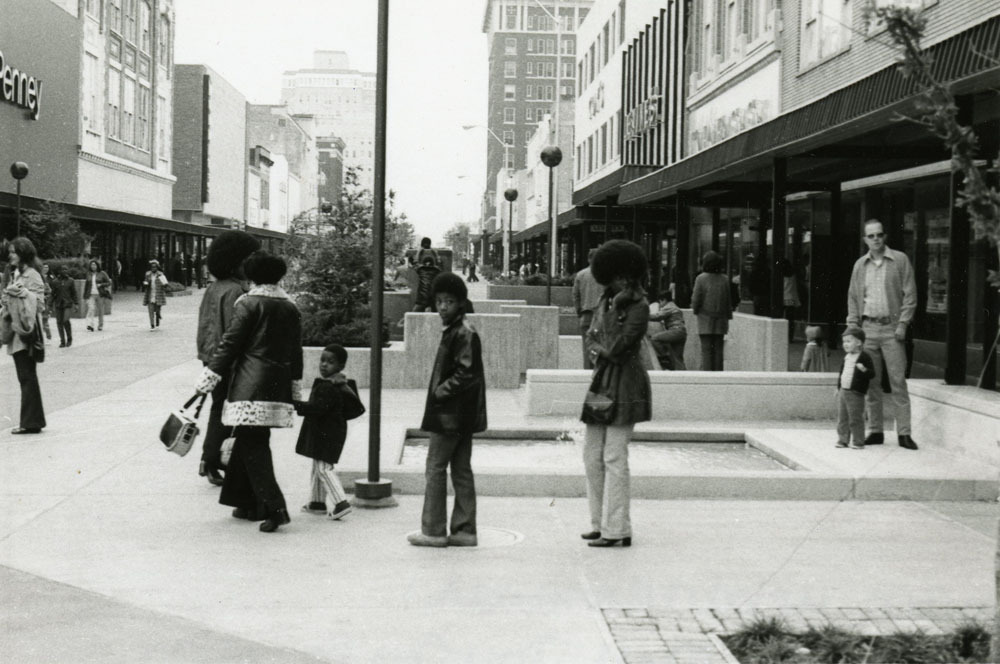
Strolling Shoppers
Many store owners initially saw increased sales due to the inviting atmosphere the downtown pedestrian mall provided. | Source: Image courtesy of the Texas Collection, Baylor University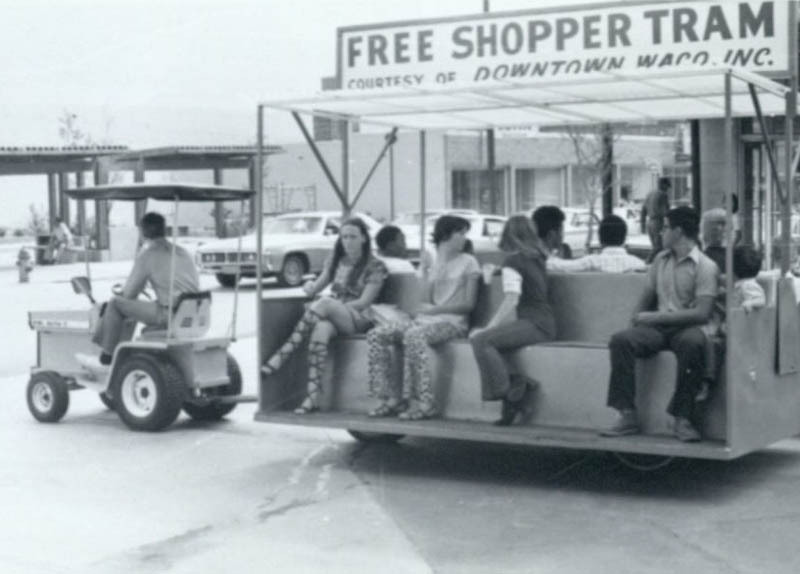
Tram Service
The mall employed several free shopper trams which were considered ahead of their time in the 1970s. Despite the added convenience of the trams, customers still cited frustration at having to park outside and walk through the stores to access the mall. | Source: Image courtesy of the Texas Collection, Baylor University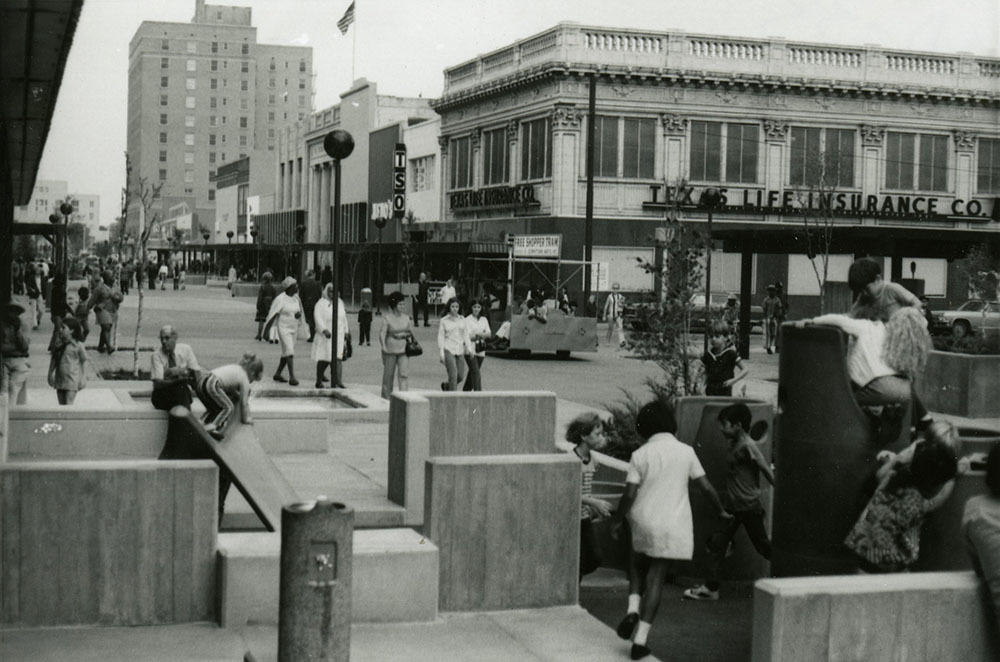
Urban Renewal
The mall contained not only department stores such as J. C. Penney and Goldstein-Migel, but also businesses such as Texas Life Insurance Company. City planners hoped to revive downtown by making it the center of all commerce and recreation. | Source: Image courtesy of the Texas Collection, Baylor University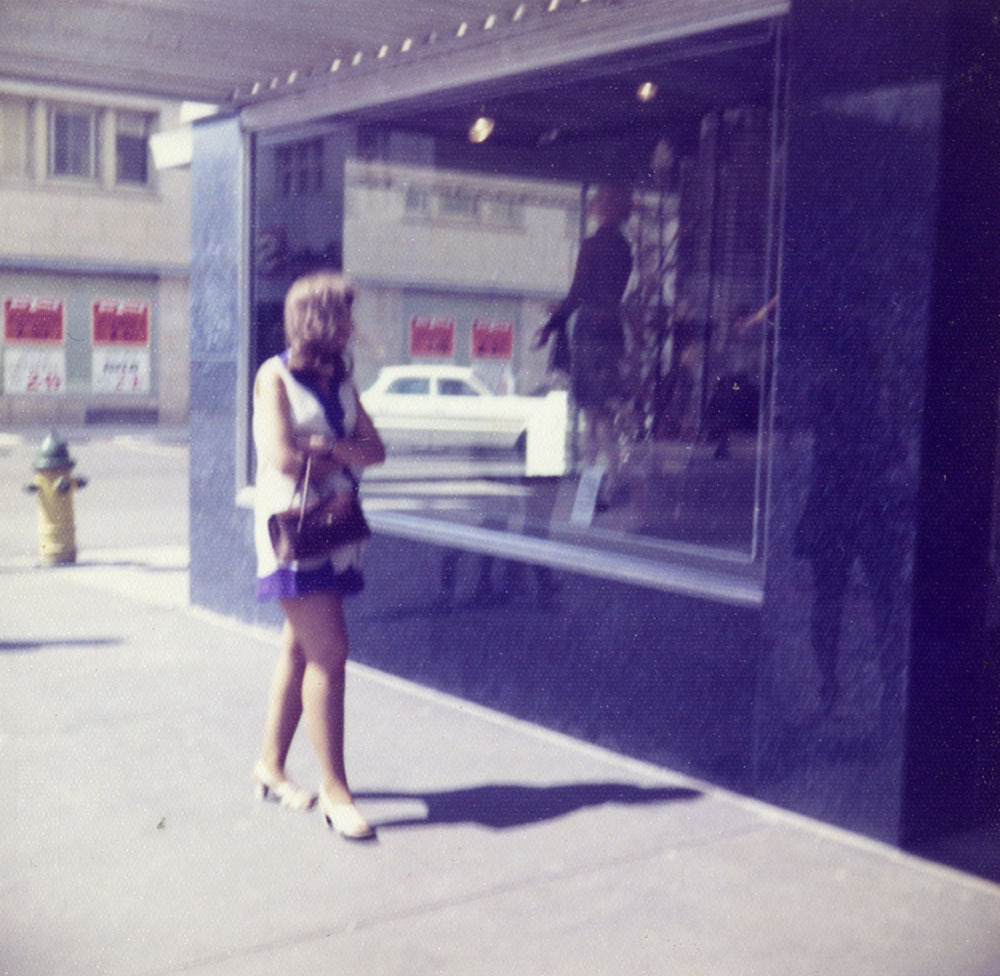
Window-Shopping
A woman gazes into a department store display window as she passes through the Austin Avenue Pedestrian Mall. One of the main reasons the mall struggled in its later years was because the few customers who did frequent the mall often did not purchase any merchandise. | Source: Image courtesy of the Texas Collection, Baylor University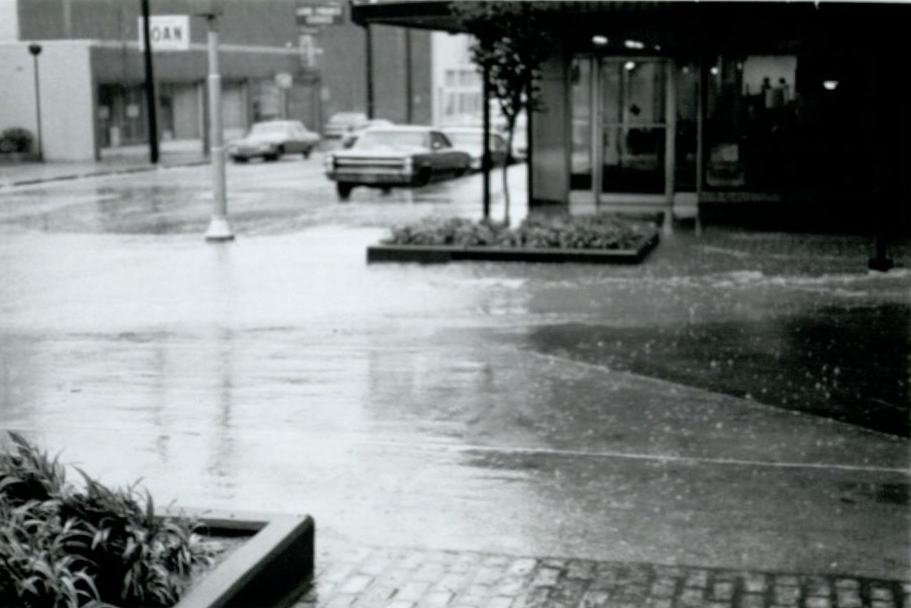
Washed Away
Bad weather hampered sales for businesses at the Austin Avenue Pedestrian Mall. The mall did not feature a gutter system, which led to many areas flooding when even light rains hit. | Source: Image courtesy of the Texas Collection, Baylor University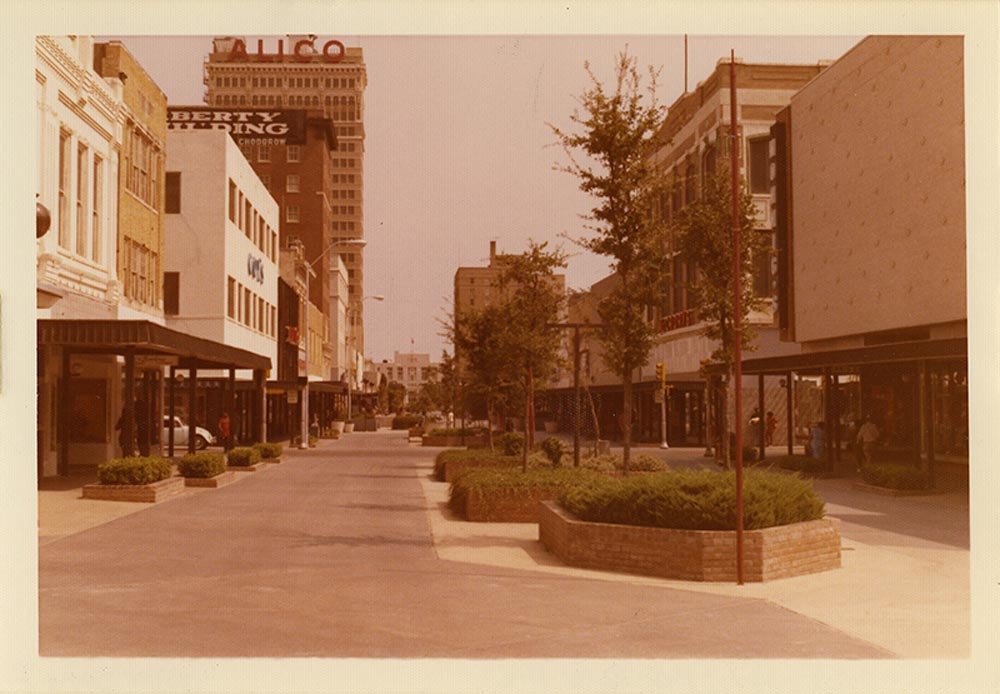
Faded Attraction
Many customers shopped at the mall in its early years. Yet by the late 1970s, the novelty wore off and the mall slowly became more and more deserted. After the largest department stores moved to the suburbs, several women told city officials they no longer felt safe shopping on Austin Avenue because of how empty it was. | Source: Image courtesy of the Texas Collection, Baylor University