Interurban Railway
Text
Waco was a city on the move at the turn of the twentieth century, and its run into modernity was aided by the advent of the interurban electric railway.
Although Waco had other forms of mass transit since the days of the stagecoach, with first mule-hauled and then electrically-powered streetcars, it was the Texas Electric Railway that ultimately inherited the early rights-of-way to do business in the city, though several transit firms vied for traffic in its early days.
Citizen’s Railway Company, formed in 1877, used eighteen mule-drawn cars, and ten electric ones after 1891, to get commuters and shoppers where they needed to go until 1912. Southern Traction Company succeeded it, reconstructing tracks and adding extensions. Additionally, a streetcar company named Huaco Heights leased equipment from Citizen’s Railway Company and operated from 1913 to 1918, servicing the Huaco Heights real estate development.
It took John Frank Strickland, a man of vision and drive, to pull together the diverse elements to craft an efficient system. Strickland traveled to Texas by wagon train in 1878 from his native Alabama. He later went on to create the largest interurban rail system in the Southwest, with more than two hundred miles of track connecting commercial and cultural centers throughout the state.
Working his way up through plowing, cotton ginning, and then the grocery trade, Strickland became involved in electric power generation in Waxahachie in 1892. He later served as president of companies such as Texas Power & Light and Dallas Power & Light, positions he held until his death. Strickland and partners saw construction of interurban railroads as a complementary function of their power companies, and in 1908, a Strickland company began interurban service from Dallas to Sherman.
By 1911, Texas Traction operated seventy-seven miles of track from Dallas and Denison as well as local lines in Sherman, Denison, and McKinney. In 1912, interurban transportation from Dallas to Waxahachie began. The company extended the line to Waco in October of 1913, and absorbed streetcar lines in Waxahachie and Waco.
On New Year’s Day in 1917, Strickland merged Southern Traction Company and Texas Traction Company to create the Texas Electric Railway Company. The rail also served as the right-of-way for the electric power lines. Area drugstores and hotel lobbies sold tickets, offering different rates for children, clergy, and “excursion” groups. As ridership soared and business boomed, Strickland also won a postal contract to transport US mail, and employed a clerk to sort the letters and packages along the way.
The system’s usage peaked around 1920, when some 819,000 passengers rode the rails. The interurban’s decline began during the Great Depression, and the line started taking freight to make up for the loss of passenger revenue. Business rallied again during World War II, when gasoline shortages and rationing of rubber made rail travel more attractive than driving.
But after the war, the lure of private-car ownership and the development of better roads led to the system’s decline. The streetcar operations of Texas Electric Railway were sold to Waco Transit Company in 1946. As part of that sale, the streetcar continued to run from downtown to East Waco along the Texas Electric’s city track. But streetcar service ended when Texas Electric Railway ceased operations on December 31, 1948. Commuter service lasted for another year by the Texas Electric Bus System before being entirely phased out. Within days of the company’s closure, workers began pulling up tracks and taking down copper wire to sell off the assets and liquidate.
Remnants of the interurban railway remain visible in downtown Waco today. Pylons which once supported the interurban bridge as it spanned the Brazos River (noted on the Waco History map) offer a constant reminder of the interurban’s legacy of providing citizens with a convenient and economical means of transportation both throughout the city and the state.
Files
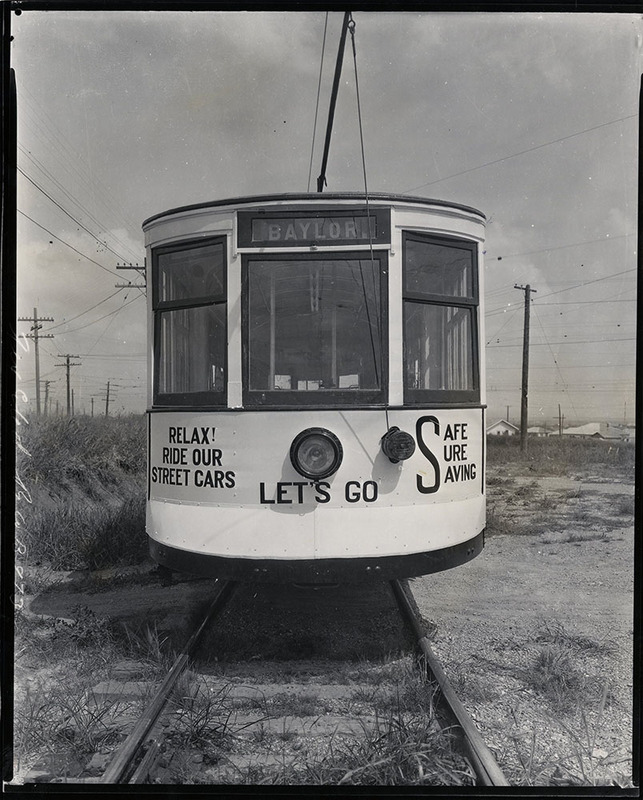
Safe, Sure Saving
This Waco streetcar from the late 1920s had been repainted orange and black shortly before this photograph was taken. Streetcars such as this likely provided Baylor students as well as Wacoans reliable transportation to and from downtown. | Source: Image courtesy of the Texas Collection, Baylor University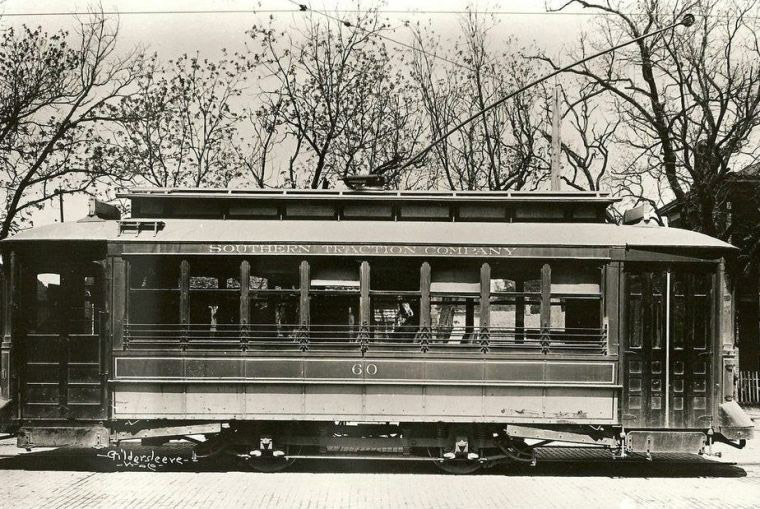
Southern Traction Company (c. 1910)
Southern Traction Company built up its Waco customer base by supporting local businesses and attractions. For instance, Waco newspapers praised the streetcar company in 1915 when it offered to place advertising cards for the Texas Cotton Palace on every single one of its cars throughout Texas, free of charge. | Source: Image courtesy of the Waco Tribune-Herald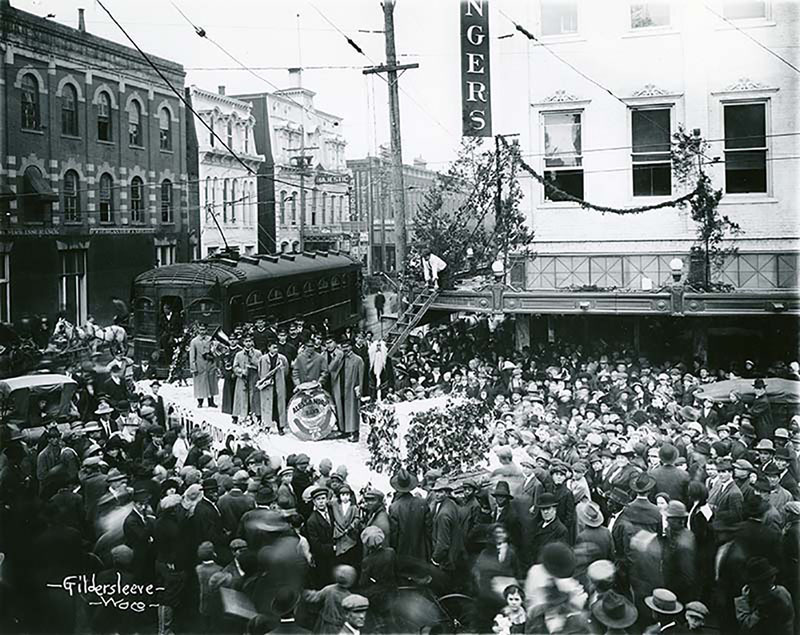
Opening Day
The interurban railway played a large role in community life in Waco. In this 1913 photograph, the opening day for a new streetcar coincided with a Christmas celebration outside of Sanger Brothers Department Store. | Source: Image courtesy of the Texas Collection, Baylor University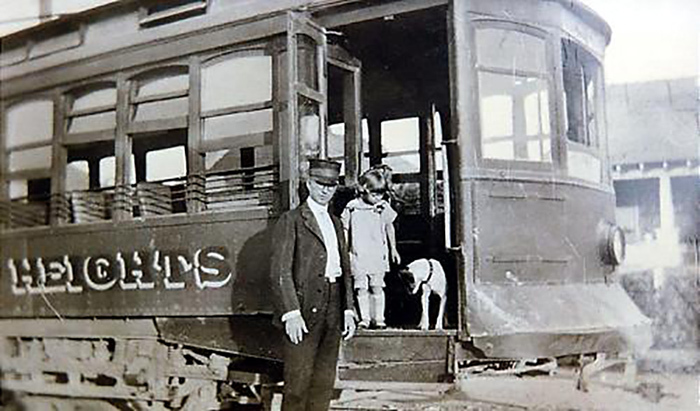
Huaco Heights (c. 1920)
A conductor poses at the entrance to the streetcar with a young girl and her dog. This streetcar line operated separately from other Waco companies, though it leased equipment from Citizens Railway Company. When the Huaco Heights line closed in the summer of 1927, many commuters found themselves walking to work. | Source: Image courtesy of the Waco Tribune-Herald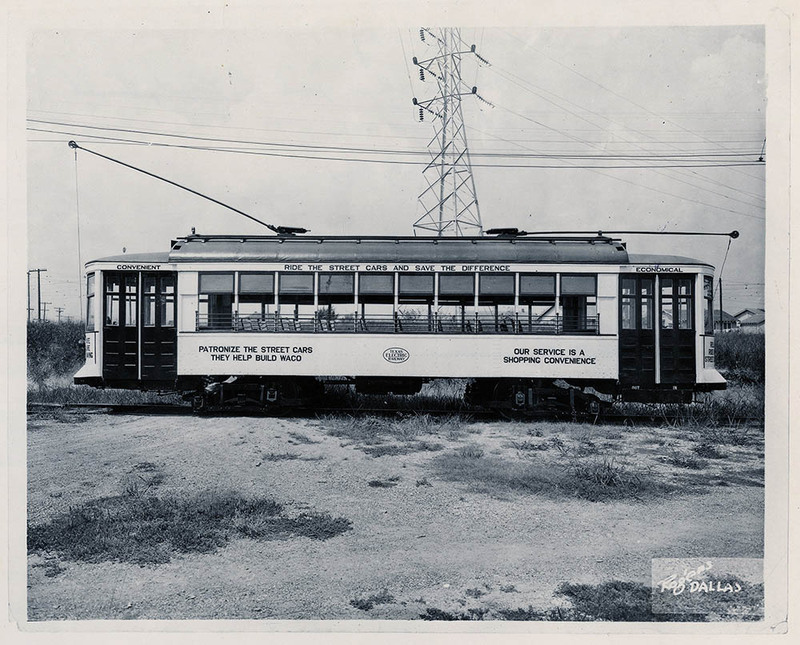
Building a Better Waco
The popularity of the interurban railway was largely due to its convenience. Streetcars allowed commuters, shoppers, and families alike to travel to and from the city with ease. As the advertisements on this streetcar suggest, the company also promoted the idea that frequenting the streetcar was not only economical, but a part of good citizenship. | Source: Image courtesy of the Texas Collection, Baylor University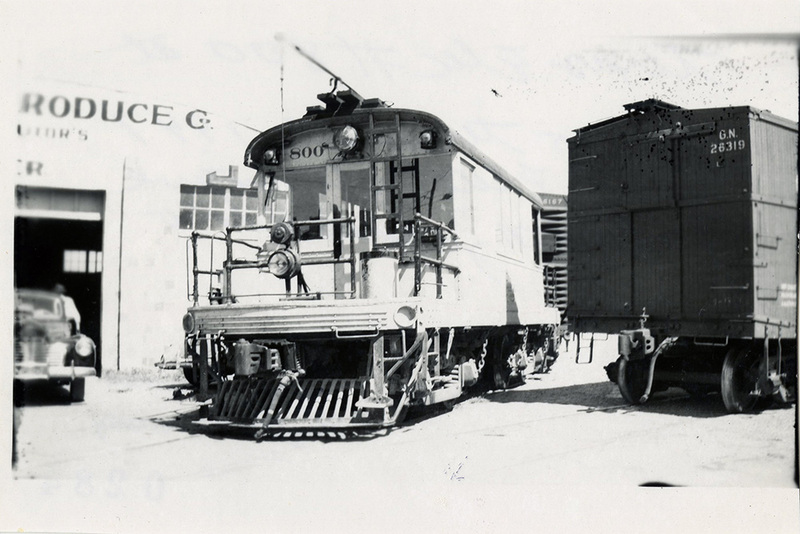
Local Enthusiast
The Waco railway caught the attention of train enthusiasts as well. Gordon Zahorik, a young solider stationed at Fort Hood with an interest in American railways, photographed the interurban trains as they traveled between Dallas and Waco during the mid-1940s and 1950s. Today, his photographs provide insight into the day-to-day operations of the Texas Electric Railway Company. | Source: Image courtesy of the Texas Collection, Baylor University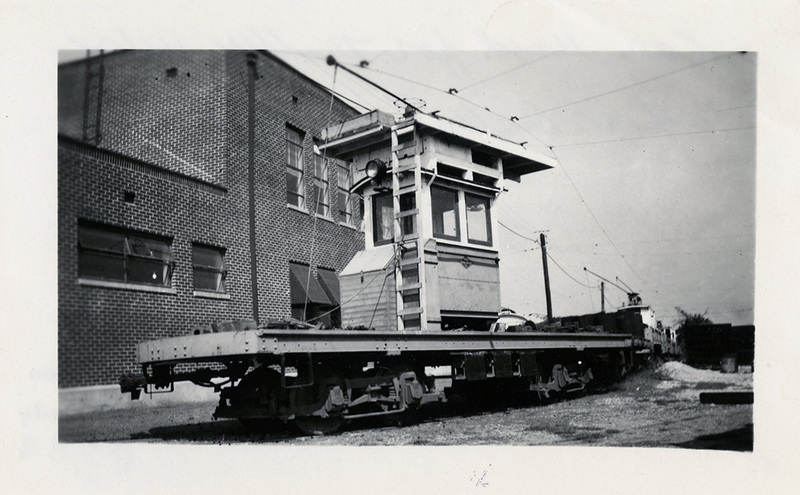
Wire Repair Trolley (c. 1947)
In addition to passenger cars, rail companies also possessed vehicles for maintenance of the railway, such as this 1947 line car. Workers stood on top of the platform in order to perform repairs to the trolley wire which ran overhead. | Source: Image courtesy of the Texas Collection, Baylor University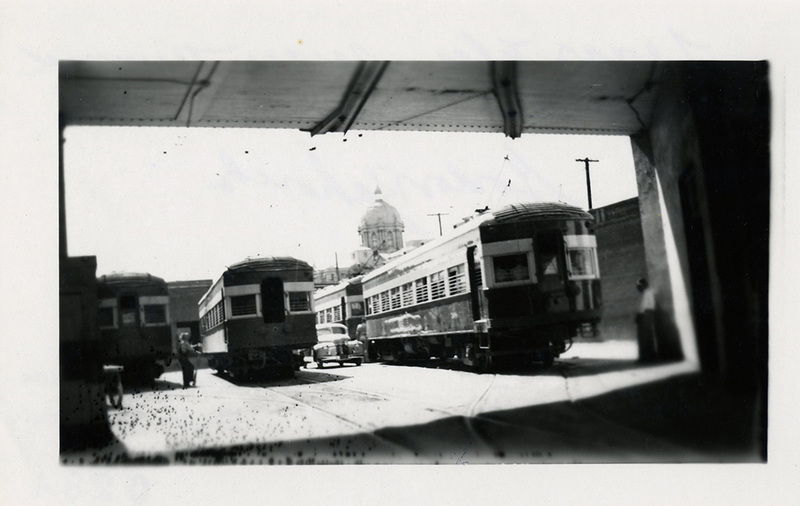
Carbarn
When not operating throughout the city, the Texas Electric Railway streetcars sat int he carbarn positioned at the east end of Franklin Avenue. Note the McLennan County courthouse visible in the background of this picture. | Source: Image courtesy of the Texas Collection, Baylor University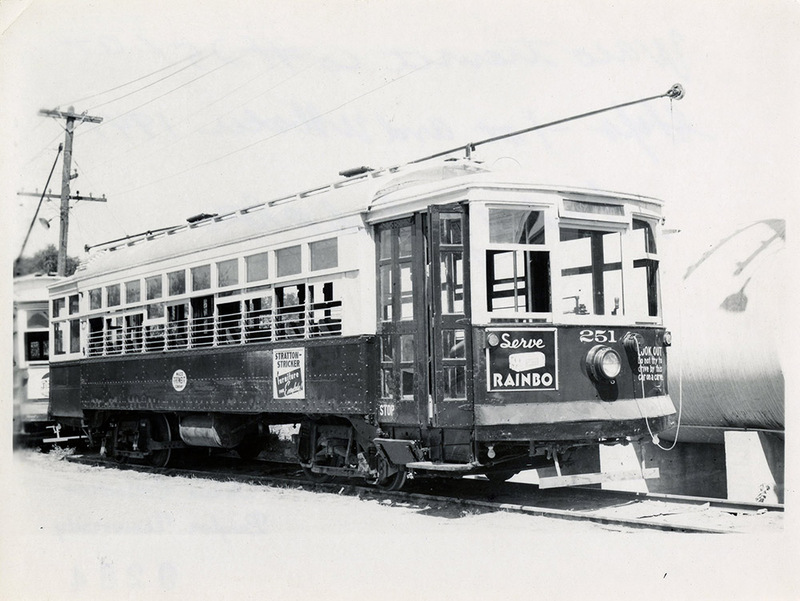
Local Advertising
Local businesses found that the streetcars provided a prime opportunity to advertise to large crowds throughout the city. This Texas Electric Railway car bears advertisements for Rainbo Bread and local furniture company Stratton-Stricker. | Source: Image courtesy of the Texas Collection, Baylor University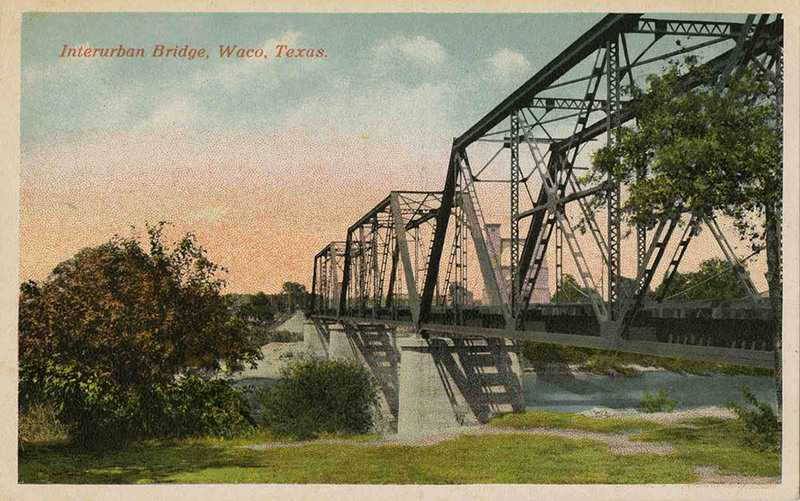
Commemorative Postcard
The Interurban Bridge, constructed circa 1910, allowed trains to cross the Brazos River. However, the bridge did not solve all problems related to crossing the river, as frequent flooding often closed the bridge and led to delayed trains. | Source: Image courtesy of the Texas Collection, Baylor University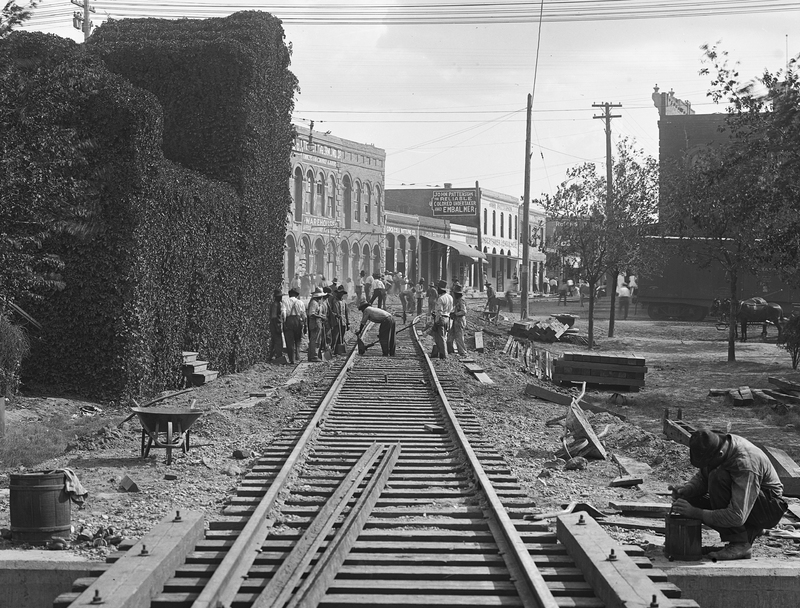
Completing the Interurban (1913)
The Dallas-to-Waco railway was part of a much larger network of interurban lines in the state of Texas. Together, these lines comprised almost 500 miles of railway, giving Texas the second-largest interurban railway system west of the Mississippi. In this photo, workers complete the laying of the roadbed on the west bank of the Brazos next to the ivy-covered Waco Suspension Bridge on the left. | Source: Image courtesy of the Texas Collection, Baylor University