Vietnam Veterans Memorial
Text
During the 1960s and 70s, the Vietnam War rocked American communities from coast to coast, leaving death and division in its wake. McLennan County was no exception. The Waco Vietnam Veterans Memorial stands on the banks of the Brazos River as a silent but powerful testimony of the war’s impact on both the Waco community and the nation at large.
While Waco’s memorial did not become a reality until several decades after the war’s end, its origin rests in the wartime experience of local veteran Manuel Sustaita. Sustaita joined the U.S. Marine Corp in 1963 at seventeen years of age. As part of the Delta Company, 3rd Reconnaissance Battalion, 3rd Marine Division, Sustaita was among the first marines to see combat in the conflict. This experience in Vietnam, including the death of his closest friend, Lance Corporal Joseph Ray Wynn Jr., left a deep impression on the young Marine. The idea of a Waco veterans memorial first emerged on Sustaita’s 1985 visit to the Vietnam War Memorial in Washington, DC, during which he was overcome by the visual magnitude of the war’s destruction. Writing several years later about his visit to the national memorial, Sustaita recalled, “I thought it would only take a few minutes to look up my [friends’] names…[but] I was wrong. Just to recover from the emotion and…the task of trying to find the name on that massive piece of stone was unreal.”
Sustaita wanted Wacoans to be able to share in a similar memorial experience, even if they were unable to travel to the nation’s capital. In 1989, Sustaita founded the Waco Citizens for a Vietnam Veterans Memorial, Inc., where fellow Wacoans Guy Cox and John Householder joined him as board members. This advisory board—comprised of veterans, Gold Star mothers, and local professionals—began the “Adopt in Memory Of” effort, in which individuals and religious, educational, business, and civic organizations could commit to raise $1,000 for the memorial in memory of a deceased casualty. A design for the memorial was settled on in 1989. The structure would consist of three pavilions total, symbolizing the experience of the country before, during, and after the war.
All of these preparations culminated in the site’s groundbreaking on Memorial Day 1990. Due to setbacks the memorial was not officially dedicated until 2004. The first pavilion of the memorial reads “Before the Vietnam War, We Were Whole.” The second reads, “The Vietnam War Brought Destruction and Turmoil.” On the third and final pavilion is inscribed, “The Sacrifices of Those We Honor Make This Hallowed Ground—Let us Strive to Reunite and Heal.” Under the third pavilion stands a monument into which the names of the fallen are etched. One linear wall also contains five bronze seals of the five branches of military service. The memorial includes a quote from Patrick Henry, which reads, “The battle is not to the strong alone; it is to the vigilant, the active, the brave.”
A ten-year anniversary event was held in 2014, at which time nine names were added to the monument. Including the seven names added in February of 2018, the total now stands at eighty-three. Situated along the city’s revitalized river trail, the Waco Vietnam Veterans Memorial stands not only as a reminder of a sobering chapter in local and national history, but of the participants in that history whose voices are now silent.
Files
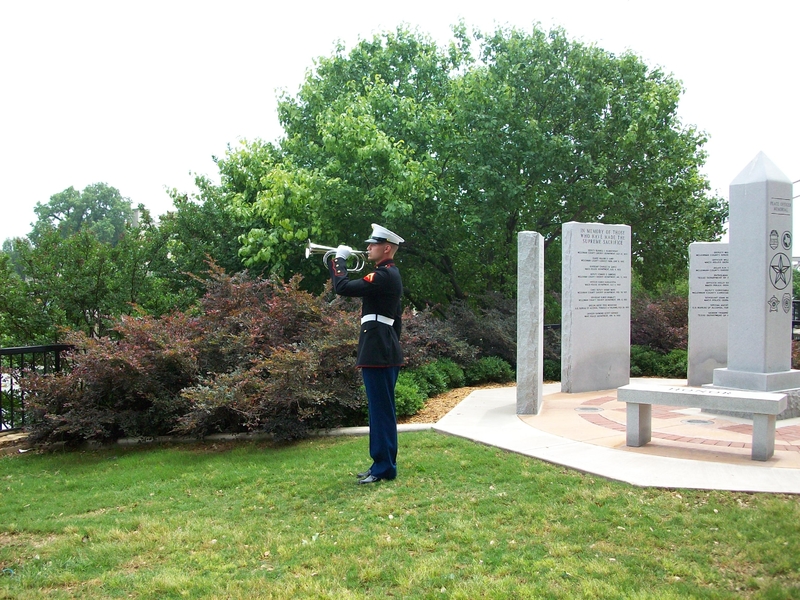
Honoring Waco's Veterans
On May 31, 1993, locals gathered to dedicate the site on which the memorial would be built. Attendees heard speeches, sang songs, offered prayers, shared food, displayed photos of the fallen, and observed a military salute and flyover in their honor. In 2010, the site held a rededication (pictured above), during which additional names were added etched into the monument. | Source: Baylor Collections of Political Materials, W.R. Poage Legislative Library, Baylor University, Waco, Texas.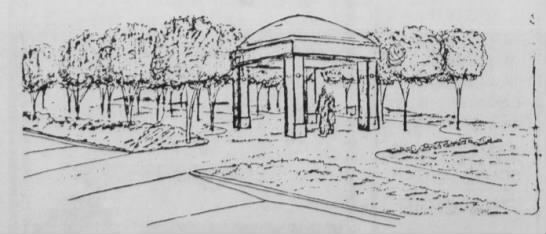
A Sketch Becomes a Reality
Initially, the memorial’s proposed location in MLK park sparked backlash when some saw a conflict between the civil rights activist’s advocacy for nonviolence and the bloodshed of a controversial war. Sustaita reassured Waco citizens that the group was not trying to glorify the war but rather to recognize the sacrifice of those involved. In the end, the Waco Citizens for a Vietnam Veterans Association, with the City of Waco, settle on an area on the west bank of the Brazos River near the intersection of University Parks Drive and Washington Avenue. | Source: Matthews, Don. “Vietnam Memorial Sketch.” The Waco Citizen. September 28, 1990.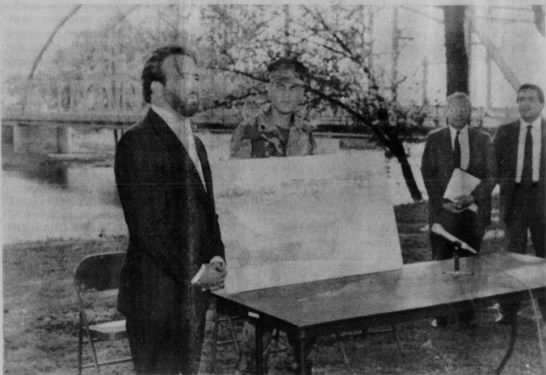
A Plan Unveiled
In the memorial’s development phase, the Waco Citizens for a Vietnam Memorial Association held a local contest in which dozens of individuals submitted designs for the memorial. The winner was Don Matthews, whose design serves as the basis for the memorial as it exists today. | Source: Foster, Bill. “Photo of Don Matthews.” The Waco Citizen. August 17, 1990.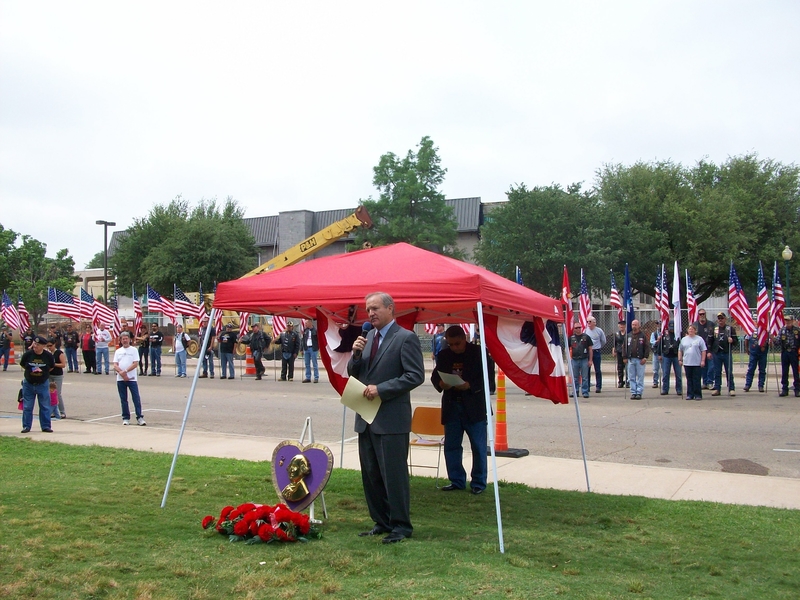
A Public Landmark
Although the construction of the memorial lasted far longer than was originally anticipated, the finished site drew large crows from the community during subsequent events. Here, Texas Representative Chet Edwards addresses the crowd at the memorial's 2010 rededication. | Source: Baylor Collections of Political Materials, W.R. Poage Legislative Library, Baylor University, Waco, Texas.
Coping with Loss
Gold Star mother Sarah F. Green recalls how faith and community helped her cope with the death of her son, Robert Earl Green, who died in Vietnam in February 1968. | Source: Green, Sarah F., Interviewed by Carson C. Garvin, November 29, 1995 in Waco, TX . Baylor University Institute for Oral History. View full interview.