The Branch Davidians
Text
Often confused with the Davidians, the Branch Davidians are a splinter group organized in 1955 by Ben Roden following the death of Davidian founder Victor T. Houteff. Houteff had founded the Davidians, a small Adventist reform movement, in 1929. Six years later, Houteff and thirty-seven of his followers resettled two miles from Waco, where they established the Mount Carmel Center. The community flourished there, growing to around ninety people by 1955. Houteff had complete authority, viewed by his followers as the only person who could reveal Biblical secrets about the end of time. Among his teachings, Houteff stated that he would not die, but would lead his people to old Jerusalem and therefore to the heavenly Canaan. Because of this, Houteff’s sudden death at Hillcrest Hospital, caused by heart failure, came as a huge shock to the Davidians. The loss of their leader led to instability within church organization leadership, along with the formation of several splinter groups.
Prior to his passing, Houteff had appointed his second wife, Florence Houteff, to lead the Davidians until the Lord chose another prophet to take charge. Under her leadership, the community sold their property near Lake Waco for residential development and resettled in 1957. They resettled on a 941-acre farm located nine miles east of Waco near Elk, which they called New Mount Carmel. Florence Houteff and the other leaders predicted the imminent establishment of God’s Kingdom on April 22, 1959. They called on members to gather at New Mount Carmel before that date, which coincided with Passover. About nine hundred gathered, but when signs did not appear, the Davidians began to disperse quickly.
While this gathering took place, Benjamin Roden, a former Seventh-day Adventist who had accepted the teachings of The Shepherd’s Rod in 1946, announced that he was the sign the Davidians were seeking. The failure of the prophecy discredited Florence Houteff, and a small following looked to Roden as their new prophet. Roden’s Branch Davidians claimed the New Mount Carmel property, which was now seventy-seven acres. Roden centered his teachings on the significance of the restored state of Israel, which would be a sign of preparation for Christ’s return to earth. Roden traveled to Israel and established a small community of followers there prior to his death in 1978.
Lois Roden assumed leadership of the Branch Davidians following her husband’s death. Her teachers centered on the female nature of the Holy Spirit and the co-dominion of women and men in the church. This corresponded with ideas circulating from the Feminist Movement in the 1970s and the growing egalitarian teachings of many Adventist sects. Beginning in 1979, Roden began publishing Shekinah, a short-lived journal on women’s place in religion. She also often spoke to media outlets about the femininity of the Holy Spirit, hoping to spread her teachings to a wider audience.
Throughout Lois Roden’s leadership, her son George Roden claimed to be the next heir apparent of the Branch Davidians. However, he was not widely respected within the community, and his own mother did not support his claim. She had aligned herself with Vernon Howell, a young, charismatic Bible teacher who had first arrived at Mount Carmel in 1981. After briefly leaving, he had returned in the mid-1980s and gained support and a growing following among the Branch Davidians. Despite this, George Roden was able to gain control of Mount Carmel in 1985, expelling Howell’s rival faction at gunpoint. Howell and his followers resettled in Palestine, Texas, but returned to Mount Carmel two years later to gain control of the Mount Carmel property. Eight men, including Howell, exchanged gunfire with Roden on November 3, 1987, before being arrested and charged with attempted murder. Howell’s followers were all acquitted, and Howell’s case was declared a mistrial. Because Roden owed thousands of dollars in unpaid taxes on Mount Carmel, Howell and his followers were able to raise the funds and reclaim the property.
Howell perpetuated many distinct Davidian traditions, including an authoritarian leader, communal life separate from society, and the anticipation of the imminent end of the world. In 1990, he changed his name to David Koresh, signifying his messianic role in carrying out a divinely commissioned task of defeating the enemies of God. While previous leaders of the Davidians, such as Houteff, had been pacifists, Koresh began stockpiling weapons and ammunition to defend the faithful. Authorities suspected the Branch Davidians possessed illegal firearms, and on February 28, 1993, the US Bureau of Alcohol, Tobacco, and Firearms raided the compound, beginning the fifty-one day Branch Davidian Siege.
Today, both Davidians and Branch Davidians exist in scattered communities in the United States and around the world. A small group of Branch Davidians live and worship at Mount Carmel today, called The Branch, The Lord Our Righteousness. This group claims David Koresh twisted Biblical teachings, but other Branch Davidians—some also living at Mount Carmel—still align themselves with Koresh and his version of the Branch Davidian faith.
Files

Apocalyptic Art
To more easily convey the Davidians’ interpretations of historical events in relation to the end times, Victor T. Houteff created a series of large, brightly colored illustrations. The Harvest Period and the Close of Probation is the eighteenth scroll in the original series of eighteen images Houteff created. It depicts men and women alongside mythological creatures as they approach blazing flyers, referencing the book of Revelation and other scriptures in the New and Old Testaments. The illustrations are simplified for legibility and compressed into single-page narratives that weave together historical and Biblical timelines. The Texas Collection at Baylor University houses twenty-one of these illustrations; twenty are attributed to Victor Houteff, and one was attributed to Benjamin Roden, founder of the Branch Davidians. The collection was donated by Ron Armstrong, who owned a large printing company in Fort Worth, Texas, in the 1970s. He came into possession of the scrolls when a customer brought them in to be copied, but never returned. ~ Source: Courtesy of the Texas Collection at Baylor University. The Harveest Period and the Close of Probation, Victor T. Houteff, 1931. [Waco] Branch Davidians: Ron Armstrong Collection, Accession #3810. ~ Date: 1932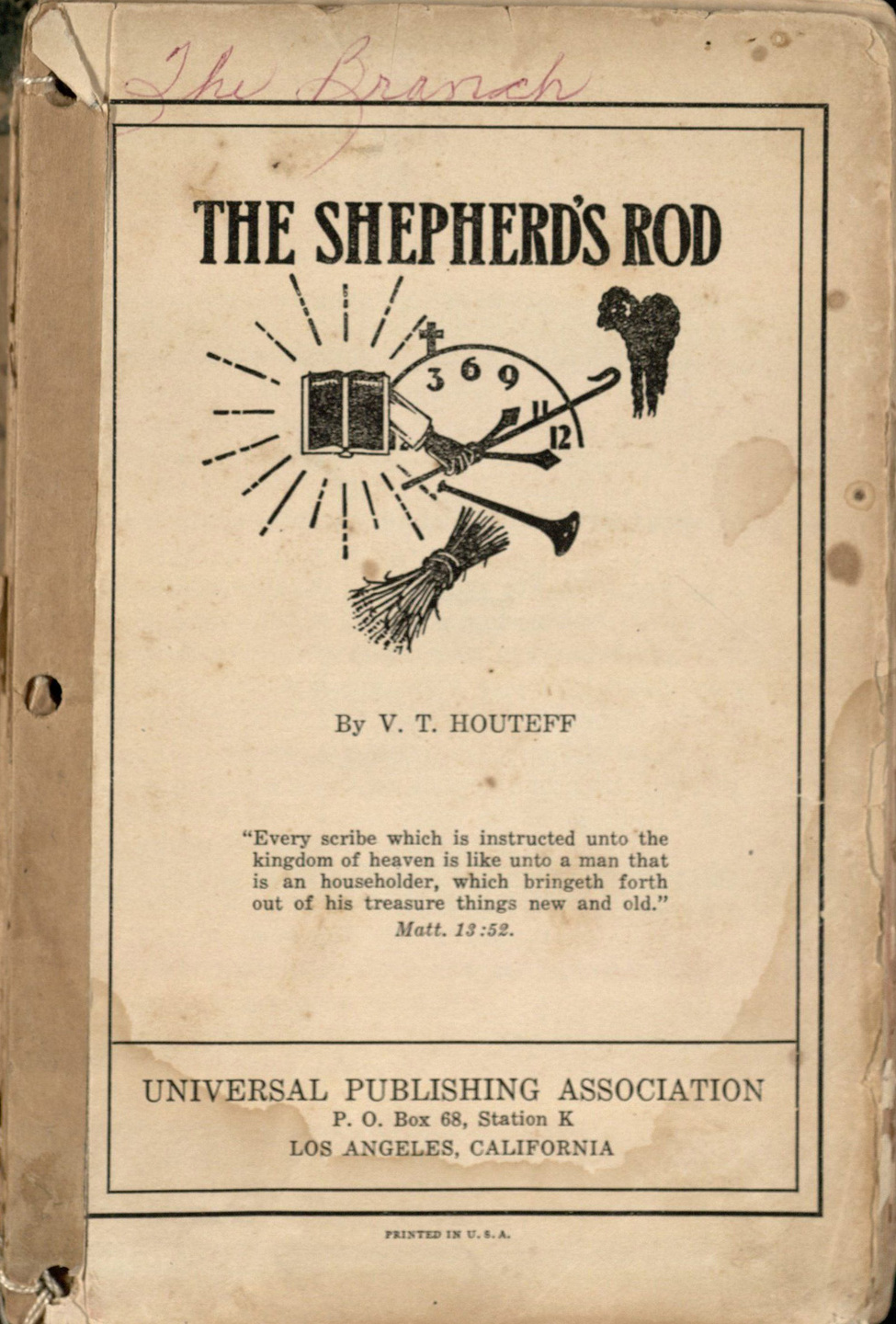
The Shepherd’s Rod
In 1918, Victor T. Houteff, a Bulgarian immigrant, left the Bulgarian Orthodox Church and accepted Seventh-day Adventist teaching. As he continued study of scripture, he began to criticize the General Conference of Seventh-day Adventists for compromising with worldly standards of behavior. Houteff wrote The Shepherd’s Rod, a series of religious tracts, to call for church reform. Like all Adventists, he focused primarily on the imminent return of Christ, teaching that an elect group of 144,000 followers would establish a reformed church, and that the formation of this pure church was a prerequisite for Christ’s return to earth. The Davidians, the offshoot group established by Houteff in 1929, came to also be known as The Shepherd’s Rod or The Rod. A symbol that came to be associated with the movement was a clock with its hands at the eleventh hour, indicating that the end of time was quickly approaching. ~ Source: Courtesy of the Texas Collection at Baylor University. The Shepherd’s Rod, Victor T. Houteff, 1932. [Waco] Branch Davidians, Joe Robert, Series III – Literary Productions, Collection #3205, Box #4, Folder #1. [Vertical File]. ~ Date: 1932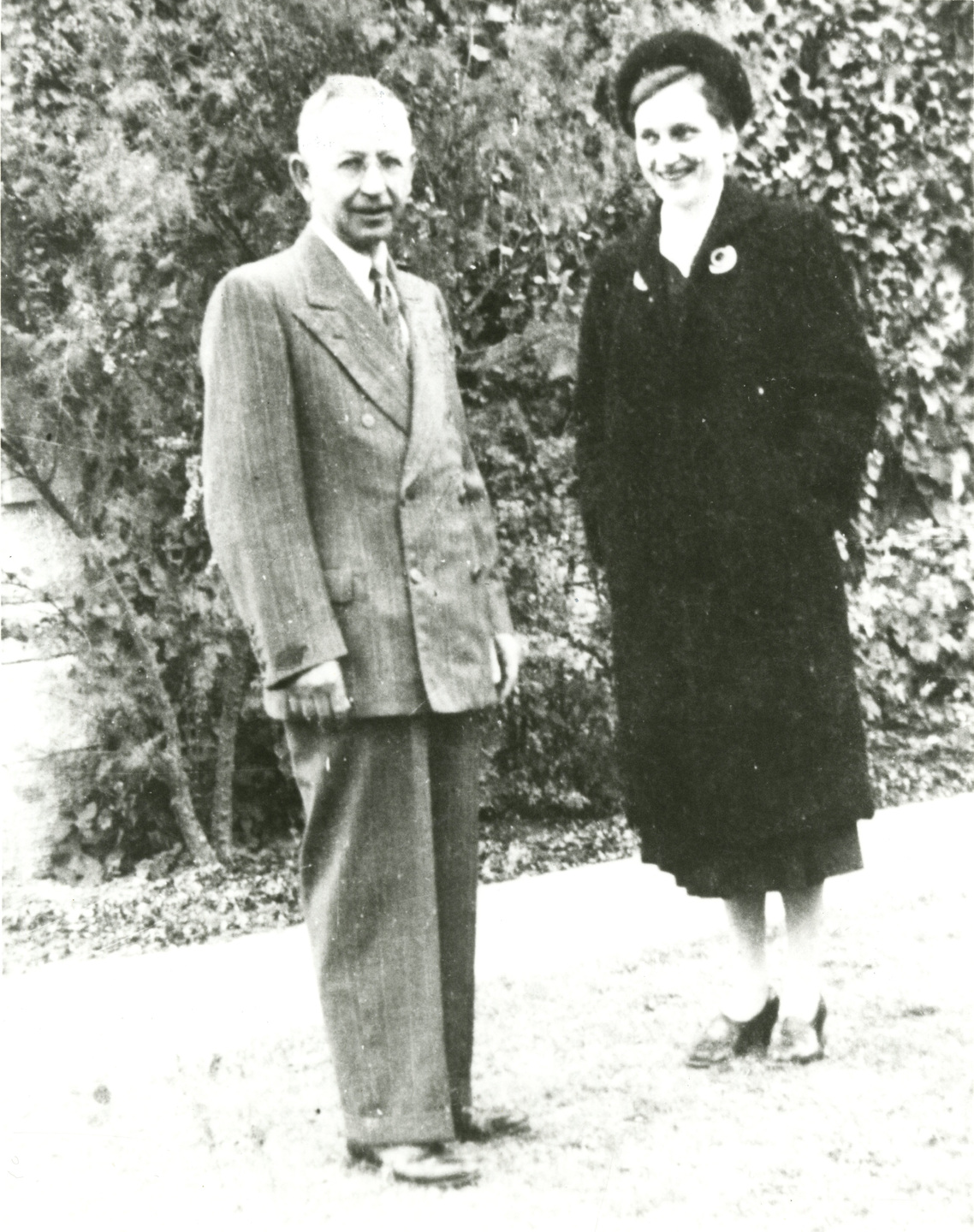
The Failed Prophecy
After Victor T. Houteff’s sudden death in 1955, his second wife, Florence Houteff, became the first female leader of the Davidians. Because she did not claim to be a prophet, the executive council elected her to the office of Vice-President of the Davidian Seventh-Day Adventists. Florence had long been connected to the Davidians. Her parents, the Hermansons, provided $10,000 to the group early in its history as a down payment for the original Mount Carmel Center. Florence’s marriage to Victor Houteff in 1937 placed her in close proximity to the power center of the organization. After assuming leadership upon her husband’s death, Florence announced the imminent establishment of the Davidian kingdom, a bold move meant to energize the Davidians and consolidate her authority. In April 1959, she called on members to gather at the New Mount Carmel site which she had helped establish. April 22, 1959, was set as the date for the resurrection of Victor Houteff and a war in the Middle East, events that would coincide with the Passover. People sold businesses, farmsteads, homes, and most of their worldly possessions to move to Mount Carmel in anticipation of these signs from God. About nine hundred people gathered for a formal meeting, which began on April 18 and peaked on the Passover. But hope quickly dwindled when signs did not appear, leading the Davidians to disperse. All but seventy-seven acres of the new Mount Carmel property were sold. The debacle largely discredited Florence, and the Davidians and splinter groups such as the Branch Davidians began looking to others for leadership. ~ Source: Courtesy of the Texas Collection at Baylor University. Victor T. Houteff and Florence Houteff. [Waco] Branch Davidians: Robert F. Darden III Collection #2334, Series IV Photographic Materials, Photographic Materials: Photographs: “Mad Man in Waco.” (1 of 2), 1938-1993, Box 4, Folder 26. ~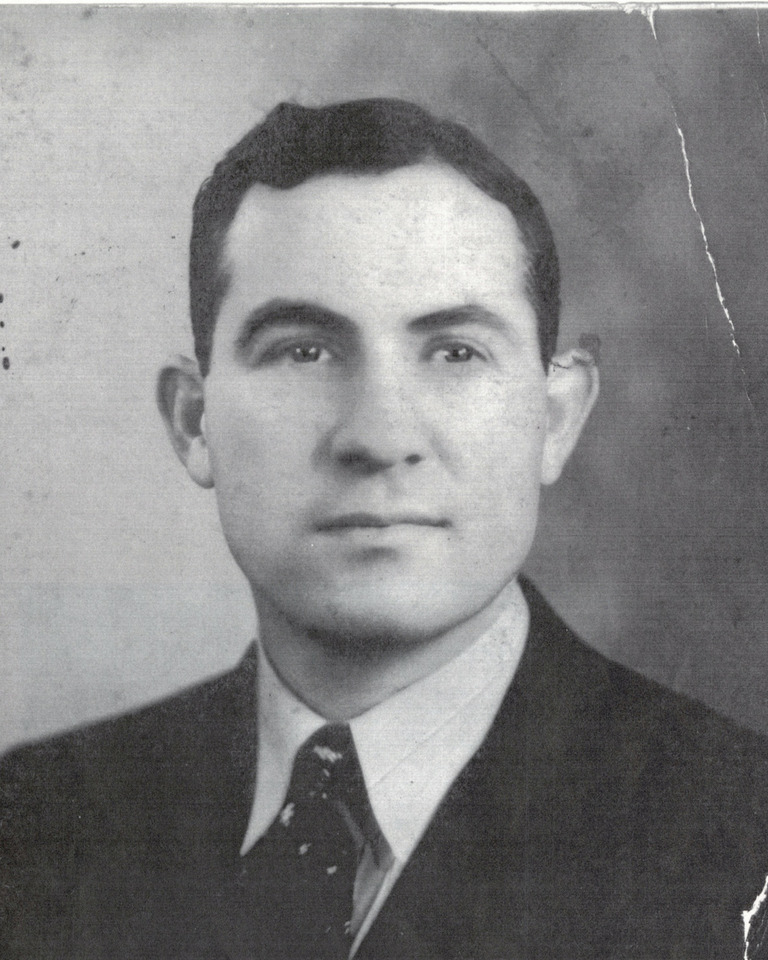
The Branch
Benjamin Roden grew up in Oklahoma and spent a brief time working as a schoolteacher before being employed in oil fields in Oklahoma and later Odessa, Texas. Roden married Lois Irene Scott in 1937. Three years later, the Rodens were baptized into the Seventh-day Adventist Church in Kilgore, Texas, by Cree Sandafur, who later served as president of the Southern Union of Seventh-day Adventists from 1974 to 1979. The Rodens came to accept the teachings of The Shepherd’s Rod in 1946. For a short time in 1953, the Rodens and their six children lived at the old Mount Carmel Center. Roden was in charge of the gardens and provided fresh produce to Victor Houteff. Following Houteff’s unexpected death in 1955, Roden believed he was endowed with a prophetic gift, which allowed him to understand God’s plan for the Davidian and Seventh-day Adventist movements. He claimed to be instructed by God to give a message to Florence Houteff and the executive council of the Davidian Seventh-day Adventists. After hesitating, he was called to write a letter and sign it “The Branch,” an allusion to the anointed branch mentioned in Zechariah that was to be Jesus’ new name. It also came to be the name adopted by the church, establishing the Branch Davidian Seventh-day Adventists. ~ Source: Courtesy of the Texas Collection at Baylor University. Benjamin Roden. [Waco] Branch Davidians: Robert F. Darden III Collection #2334, Series IV Photographic Materials, Photographic Materials: Photographs: “Mad Man in Waco.” (1 of 2), 1938-1993, Box 4, Folder 27. ~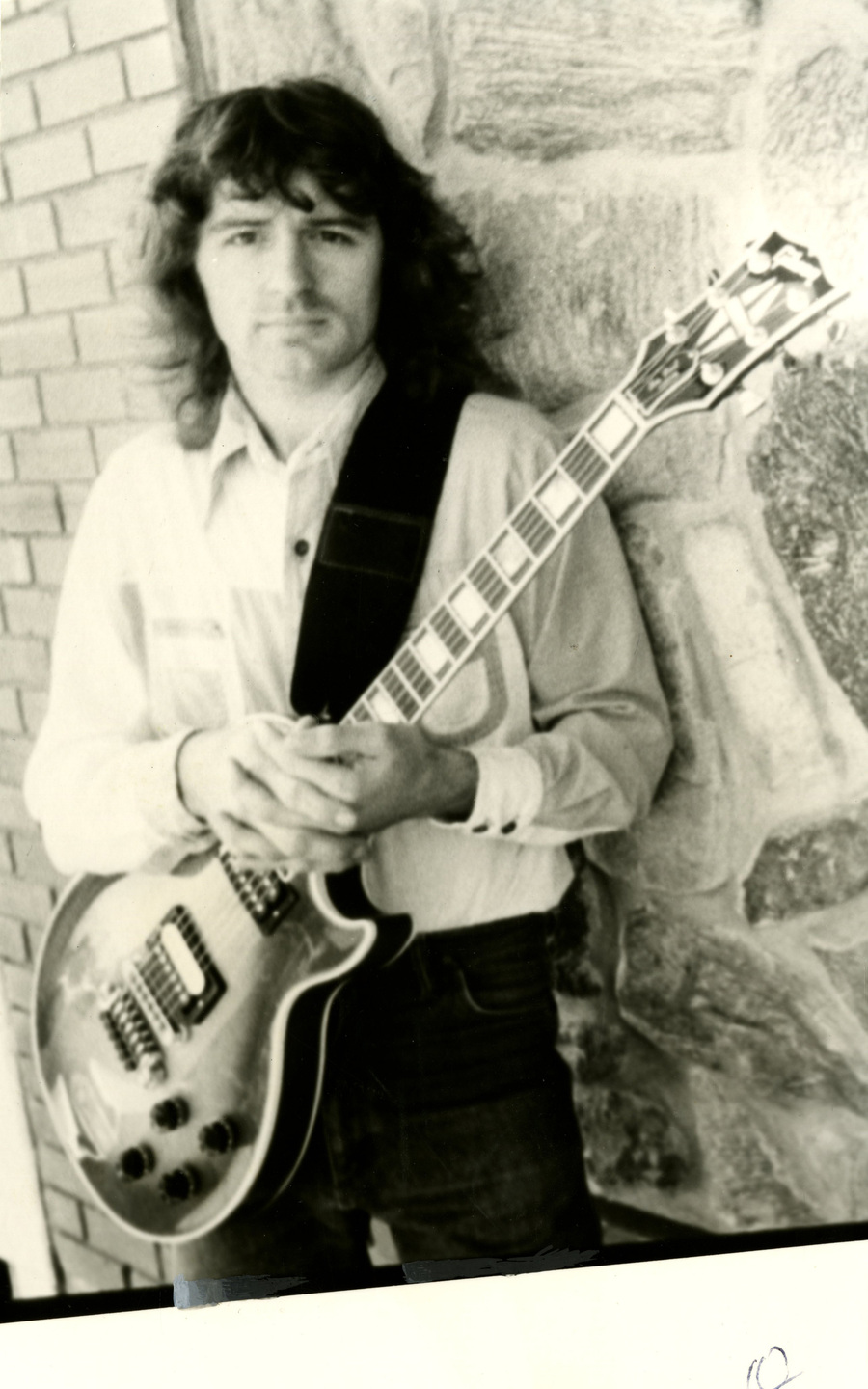
Mad Man in Waco
Vernon Wayne Howell was born on August 17, 1959, to 14-year-old single mother Bonnie Sue Clark. He described his early childhood as lonely, and alleges that he experienced abuse. Beginning in junior high, Howell developed passions for the Bible and the guitar. After being disfellowshipped from the Seventh-day Adventist church he attended in Tyler, Howell moved to Waco, where he joined the Branch Davidians in 1981. He played guitar and sang in worship services at Mount Carmel Center. He also performed at venues in the Waco community, including Chelsea Street Pub & Grill, then located in Richland Mall, and Cue Sticks, a bar behind a former Kmart on Old Dallas Highway. Howell often invited older Branch Davidians to his gigs—a stark contrast to the typical, young rock and roll scene. Between songs, Howell would quote from the Bible and often hand out his phone number at the compound. Interested in using music as an evangelistic tool, he opened a music studio in Waco called Cyrus Productions to make an album. . With a group of Waco musicians, he recorded a song titled “Mad Man in Waco,” and released it on 45 and cassette formats, along with a publicity photo of himself. The song centers on George Roden, who claimed to be the rightful leader of the Branch Davidians after the death of his mother, Lois Roden. In 1987, Howell went to Lone Star Music—a shop he often visited to haggle for guitars—to give owner Calvin Ross a copy of his demo tape. Howell’s music career never took off as he had hoped, and he began to focus his attentions on his role as leader of the Branch Davidians—having superseded George Roden. In 1990, Howell legally changed his name to David Koresh. The name was a nod to the messianic role he saw himself undertaking and a parallel to King Cyrus, who destroyed the Babylonians, enemies of Israel. ~ Source: Courtesy of the Texas Collection at Baylor University. Vernon Howell promotional photo. [Waco] Branch Davidians: Robert F. Darden III Collection #2334, Series IV Photographic Materials, Photographic Materials: Photographs: “Mad Man in Waco.” (1 of 2), 1938-1993, Box 4, Folder 27. ~
The Shootout at Mount Carmel
Gary J. Coker Jr., who later would defend Vernon Howell and his followers in court in 1988, describes their initial arrest after the November 1987 shootout at the new Mount Carmel Center—an attempt to regain control of the property from George Roden. | Source: Source: Coker Jr., Gary J., Interviewed by Rebeckah Ann Crowe, November 20, 2003 in Waco, TX. Baylor University Institute for Oral History. View full interview.Celebrating a Court Victory
Gary J. Coker Jr., who defended Vernon Howell and his followers in court, recalls a celebration event the Branch Davidians held after the verdict. | Source: Source: Coker Jr., Gary J., Interviewed by Rebekah Ann Crowe, November 20, 2003 in Waco, TX. Baylor University Institute for Oral History. View full interview.