The Branch Davidian Siege: February 28 - April 19, 1993
Text
For most of their history, the Davidians and later the Branch Davidians had lived in isolation from the Waco community. As a city with deep religious roots, Branch Davidians were generally accepted and allowed to practice their religious beliefs without interference. The group had garnered some attention from local media in 1987 due to a shootout at the new Mount Carmel Center. But five years later, the Branch Davidians were thrust into the national spotlight.
Vernon Howell, who changed his name to David Koresh in 1990, had assumed leadership of the Branch Davidians and increasingly incorporated radical ideas into his messages. He claimed that God instructed him to build an Army of God to prepare for the end of days, and encouraged the stockpile of ammunition and weapons. Koresh also stated he was told by God to procreate with the women in the group to establish a “House of David,” and to this end took several wives. While never directly claiming to be Jesus himself, Koresh had proclaimed that he was the final prophet.
On a routine delivery to the compound in 1992, local UPS representative Larry Gilbreath discovered firearms, inert grenade casings, and black powder in a broken package. Gilbreath contacted authorities, and in May, Chief Deputy Daniel Weyenberg of the McLennan County Sheriff’s Department contacted the Bureau of Alcohol, Tobacco, and Firearms (ATF). A formal investigation was launched in June that year, and the ATF began surveillance from a house across the road from Mount Carmel Center. In addition to allegations that Koresh and his followers were stockpiling illegal weapons, Koresh was also accused of sexual abuse. On February 27, 1993, the Waco-Tribune Herald began publishing “The Sinful Messiah” series, which alleged that Koresh had physically abused children at Mount Carmel and had committed statutory rape by taking several underage women as brides.
The ATF obtained search and arrest warrants for Koresh and other followers on weapons charges, noting the many firearms the group had accumulated. The ATF originally planned their raid of Mount Carmel for Monday, March 1, 1993, using the code name “Showtime.” The date was changed to February 28 in response to the Waco Tribune-Herald’s series on Koresh, which the ATF had tried to prevent from being published. Any advantage of surprise was lost early that morning when a KWTX-TV reporter, who had been tipped off about the raid, asked a mail carrier for directions, who was actually Koresh’s brother-in-law. The ATF commander ordered the raid move forward, despite being informed that the Branch Davidians were aware that ATF agents were coming. At 9:45 a.m., a gun battle began. ATF agents stated they heard shots coming from within the compound, while Branch Davidian survivors claimed the first shots came from ATF agents outside. By the time a ceasefire was announced at 11:30 a.m., four ATF agents had been killed, and another sixteen had been wounded. Five branch Davidians were killed, and later that day, a sixth was killed by ATF agents. That evening, four children were permitted to leave Mount Carmel, and Koresh, who had been wounded, was interviewed by CNN and spoke to KRLD in Dallas.
For the next forty-nine days, the FBI Hostage Rescue Team worked to negotiate a peaceful end to the siege. In the first few days, a supposed breakthrough was made when Koresh agreed that the Branch Davidians would leave the compound in return for a message, recorded by Koresh, being broadcast on national radio. But Koresh told negotiators that God had instructed him to remain in the building and wait. Despite this, nineteen children were released. As time passed, the FBI used increasingly aggressive techniques, such as sleep deprivation by means of all-night broadcasts and recordings of loud noises and pop music, to try to force all the Branch Davidians out. Koresh later forced a group of eleven followers to leave, and they were arrested as material witnesses, with one person charged with conspiracy to murder.
On April 19, US Attorney General Janet Reno approved recommendations by the FBI to mount an assault. Explosives were used to puncture holes in the walls of the buildings of the main compound so tear gas could be pumped in, in hopes of flushing the Branch Davidians out without harming them. Around noon, three fires broke out in different parts of the building and spread quickly. While the government maintains that the fires were started deliberately by Branch Davidians, others, including some Branch Davidian survivors, believe that the fires were started either accidentally or deliberately by the FBI. Only nine people left the building during the fire. The remaining seventy-six Branch Davidians, including children, were killed either by rubble, suffocation from the effects of the fire, or shot. Footage of the blaze was broadcast live by television crews, who had remained near the compound throughout the siege.
Extensive investigations took place following the siege, and the events that transpired in Waco transformed the way federal officials conducted future operational tactics. Four months after the fire, a federal grand jury indicted twelve of the surviving Branch Davidians for aiding and abetting the murder of federal officers, along with the unlawful possession of firearms. Four members were acquitted, and the remaining eight were convicted, but only for firearms-related offenses. By 2007, all members had been released from prison. Nothing remains of the original compound, but a new Branch Davidian community now exists on the property called Branch, The Lord Our Righteousness.
Files
Camp Boredom
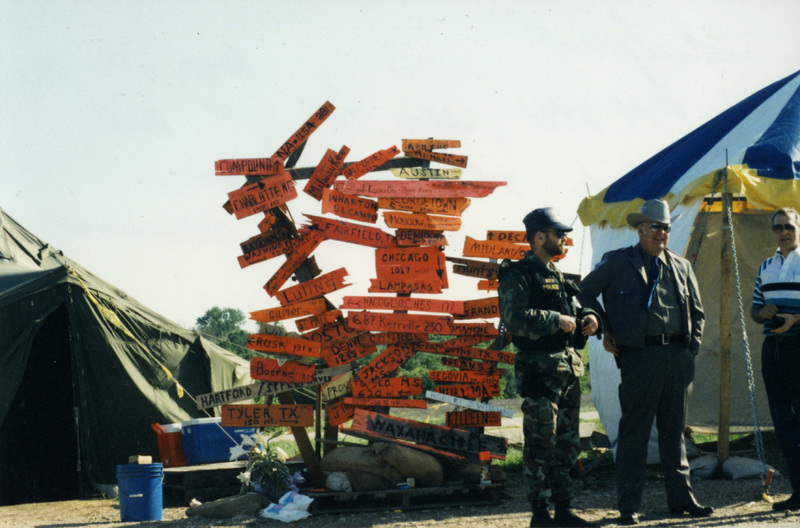
A series of signs evoking the popular television show M*A*S*H was placed at the first checkpoint and roadblock to Mount Carmel Center, located at the intersection of Loop 340 and FM 2491. The Texas and US cities listed represented the home bases of law enforcement personnel working the siege. A sign listed on a nearby tent labeled the checkpoint as “Camp Boredom,” alluding to the idleness many felt during the ongoing negotiations overseen by FBI site commander Jeff Jamar, head of the Bureau’s San Antonio field office. ~ Source: Courtesy of the Texas Collection at Baylor University. Loop 340 and FM 2491 Checkpoint, 1993. [Waco] Branch Davidians: Robert F. Darden III Collection #2334, Series IV Photographic Materials, Photographic Materials: Photographs: Brad Bailey, Box #4, Folder 29. ~ Date: 1993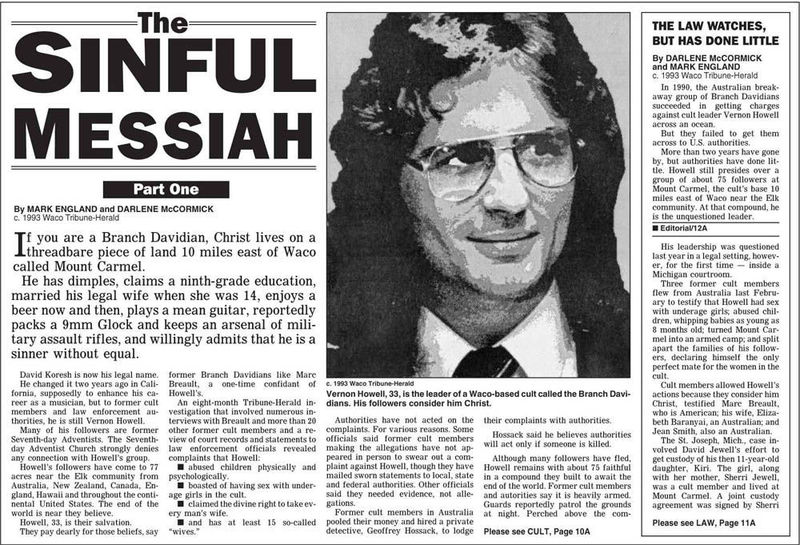
The Sinful Messiah
On Saturday, February 27, 1993, the Waco Tribune-Herald published the first article of its seven-part investigative series on the Branch Davidians, written by Mark England and Darlene McCormick. For many law enforcement officials responding to the siege, the series was their initial primer on the Branch Davidians and David Koresh. While the national media referred to Koresh by the name he adopted in 1990, the Waco Tribune-Herald chose to call him by his previous name, Vernon Howell, because this name was “more familiar to local readers.” The series was one of three finalists for the 1994 Pulitzer Prize for investigative reporting. ~ Source: Courtesy of the Waco-Tribune Herald, February 27, 1993. ~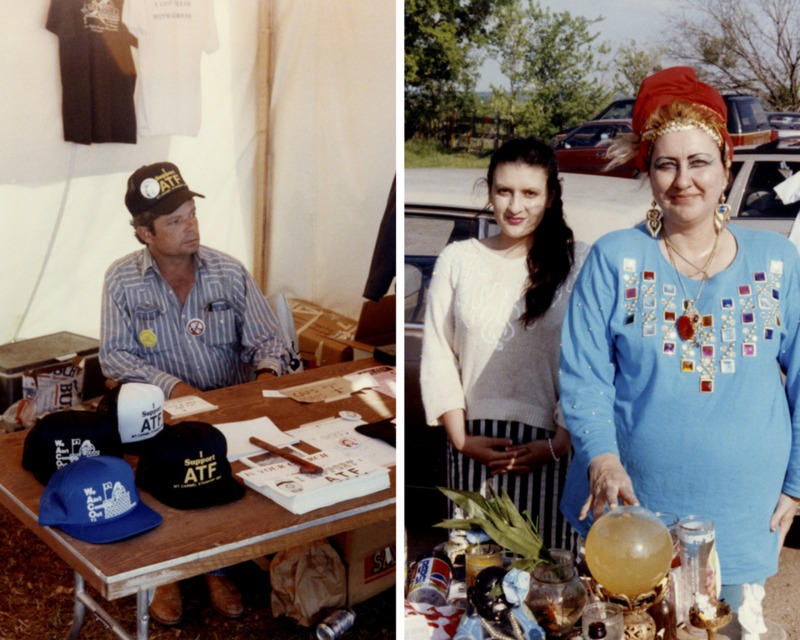
Commercializing the Compound
While most chose to watch the daily updates in the news, many people chose to come to Waco to see the siege unfold before their eyes, using telescopes and binoculars to view the compound nearly ten miles away—the closest they could get. For opportunists, the draw was the crowd itself—a way to make a buck off the buzz Waco was generating. T-shirt salesmen set up stands—or sold T-shirts from the trunks of their cars—with phrases like “WACO – We Aren’t Coming Out” and “Wacko WACO.” Other vendors sold baseball caps, buttons, and tote bags. Palm reader Linda Parker (right photo, pictured at left) and her mother offered to tell the fortunes of passersby. David Mevis set up a grill, selling “Koresh Burgers” and “Koresh Dogs” for $2 each. The siege continued to bring in crowds in the weeks leading up to its tragic end on April 19. Among the visitors was Timothy McVeigh, a Gulf War veteran who distributed pro-gun rights materials and bumper stickers with phrases such as “When guns are outlawed, I will become an outlaw.” Two years later, McVeigh perpetrated the Oklahoma City bombing on April 19 as revenge for the government sieges at Waco and Ruby Ridge. ~ Source: Courtesy of the Texas Collection at Baylor University. Vendors selling goods and services near Mount Carmel Center, 1993. [Waco] Branch Davidians: Robert F. Darden III Collection #2334, Series IV Photographic Materials, Photographic Materials: Photographs: Brad Bailey, Box #4, Folder 29. ~ Date: 1993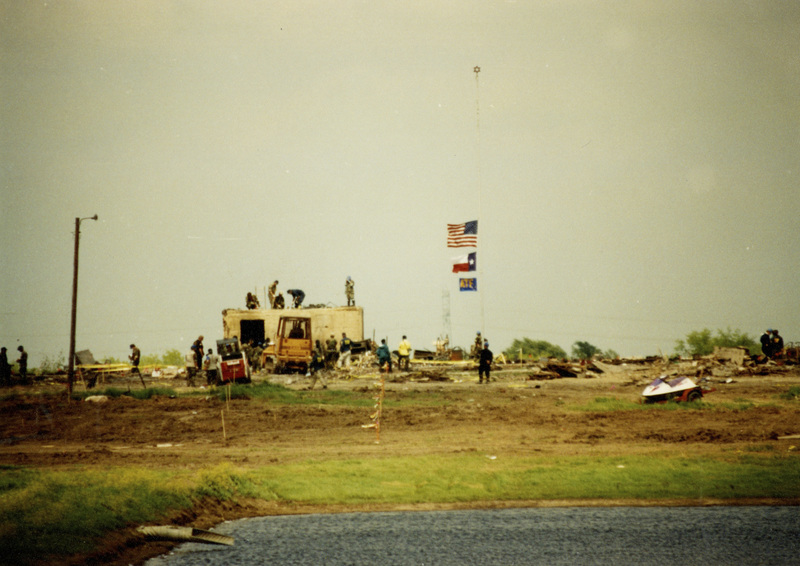
Picking up the Pieces
Nothing remains of the original buildings today besides concrete foundations. Two weeks after the tragic conclusion to the siege, the site was bulldozed after remains and evidence had been gathered. Environmental cleanup did not begin until July 7, 1994, due to ongoing legal delays. Visiting judge Frank G. McDonald gave a Waco lawyer representing several Branch Davidians until July 1 to prove that CS tear gas that was shot into the compound had combined with another chemical to produce cyanide, which is highly poisonous. The Texas Natural Resources Conservation Commission (TNRCC) officials were more concerned with lead contamination. It was estimated that about 600 cubic yards of lead-contaminated soil would have to be removed. The site was safety cleared, and today several Branch Davidians live on the property. A small chapel was built years later, where memorials have been held. ~ Source: Courtesy of the Texas Collection at Baylor University. Cleanup following the siege, 1993. [Waco] Branch Davidians, Joe Robert. Series IV: Photographic Materials, Collection #3205, Photographic Materials: Photographs: Mt. Carmel: General. April 1993, Box #5, Folder #9. ~ Date: 1993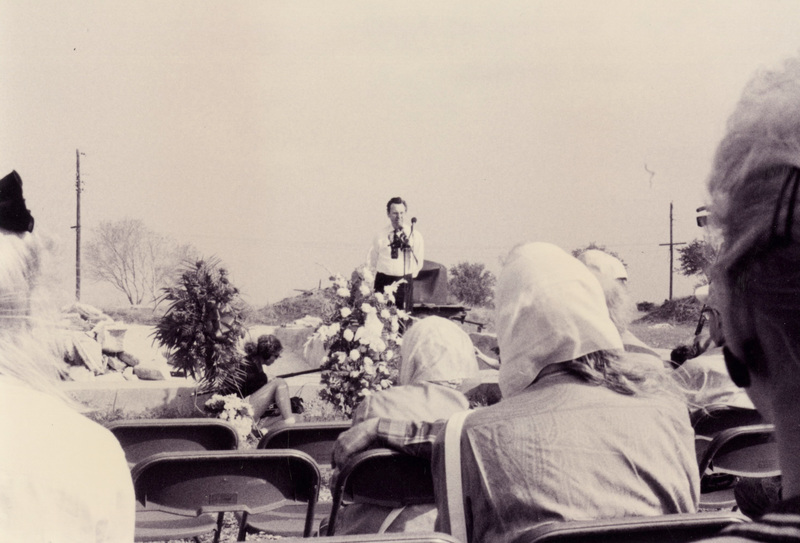
Keeping the Faith
Clive Doyle, a Branch Davidian and survivor of the 1993 siege, leads a memorial service at Mount Carmel in 1995. Doyle was working as a currency printer in his native Australia when he became a Branch Davidian in 1964. Two years later, he and other members of his group were asked to come to Mount Carmel Center in Waco. Doyle stayed in Waco until 1984, when he left during the power struggle between Vernon Howell and George Roden. He returned in 1988 after Howell had assumed leadership. Doyle escaped the fire in 1993 and was one of eleven Branch Davidians tried in court. He was later acquitted on all accounts. Since 1995, Doyle has lived in Waco on the Mount Carmel property, awaiting the resurrection of David Koresh and the other Branch Davidians who lost their lives, including his daughter Shari who was eighteen when she died in the fire. While Doyle and others still align themselves with David Koresh and his teachings, another Branch Davidian community has been established that also resides on the property called Branch, The Lord Our Righteousness. They consider David Koresh’s interpretations of the faith incorrect. ~ Source: Courtesy of the Texas Collection at Baylor University. Mount Carmel memorial ceremony, 1995. [Waco] Branch Davidians, Joe Robert. Series IV – Photographic Materials. Collection #3205. Photographic Materials: Photographs: Memorial Ceremony, April 1995. Box #4, Folder #14.~ Date: 1995
Early Impressions of Koresh
Waco lawyer Gary J. Coker, Jr., who represented Vernon Howell and other Branch Davidians in court in the 1980s, descibes his impressions of Howell, who would later change his name to David Koresh. | Source: Source: Coker Jr., Gary J., Interviewed by Rebekah Ann Crowe, November 20, 2003 in Waco, TX. Baylor University Institute for Oral History. View full interview.A Charismatic Leader
Waco lawyer Gary J. Coker, Jr., who represented Vernon Howell and other Branch Davidians in court in the late 1980s, recalls when he recognized that Howell was the leader of the Branch Davidians. | Source: Source: Coker Jr., Gary J., Interviewed by Rebekah Ann Crowe, November 20, 2003 in Waco, TX. Baylor University Institute for Oral History. View full interview.