Evangelia Settlement
Text
Seeking to provide refuge to children and families in need, the Evangelia Settlement Home opened in 1908. Established by religious reformers Ethel Dickson and Nell Symes, the home aimed to care for the least of these throughout Waco’s community for nearly a century.
Evangelia Settlement was part of a broader settlement house movement that began in Great Britain and moved to the United States. In the late nineteenth century, white, middle- and upper-class women, often motivated by their Christian faith, began to establish homes for those in low-income areas with few resources. Settlement houses popped up across the country. Jane Addams and Ellen Gates Starr established one of the most well-known settlement houses, Hull House, in Chicago, Illinois. As the movement spread across the country in the early twentieth century, an estimated eighteen settlements opened throughout Texas, including in Dallas, Houston, San Antonio, and Waco.
Inspired by a traveling evangelist who spoke in Waco, Dickson and Symes opened a small nursery on Webster Street. Initially a modest room located on Thirteenth Street, Waco’s Evangelia Settlement began as a humble effort to care for children whose mothers worked as sewing machine operators at Slayden-Kirskey Woolen Mills. Seeking to expand Evangelia’s reach as a charitable, educational, and religious institution, the founders partnered with Protestant churches in the area to garner community support and to secure funding.
By 1910, with financial aid from local churches, volunteers for Evangelia Settlement began working from a rental house. The next year, additional donations from Waco citizens enabled the opening of Evangelia’s own home, complete with a playground and five full-time staff. The State of Texas issued a charter for Evangelia Settlement Home in June 1912. Though backed by the state government, Evangelia’s board members and volunteers continued to depend on community support.
Donations and funding from those across Waco provided necessary aid for the growing settlement house. An upper floor and additional rooms were added to Evangelia in the late 1910s, and the Karem Shrine constructed a building for boys and a space for kindergarten classes in 1927. The Waco Community Chest, organized in 1924, regularly allocated money to Evangelia, and other generous donors also helped improve the building. For instance, donations from the Cooper Foundation, United Way, and the Andrew J. Dossett family facilitated the construction of a cottage for infants. Later in 1953, Evangelia operated with financial support from the United Fund of Waco and continued to improve the building on site. With each expansion, Evangelia Settlement grew in capacity and provided additional children with housing, meals, and educational and religious instruction.
In partnership with the Salvation Army and the YMCA, Evangelia joined the “Yes-For-Youth” Building Fund Campaign in 1956. The fund enabled the construction of a new building, which opened in June 1958. From 510 South Twelfth Street, Evangelia volunteers and workers continued their efforts to serve children and families throughout the community. By the late 1950s, Evangelia was authorized to care for sixty-two children and offered twenty-four-hour day care. To subsidize costs, parents paid on an individual basis, and the price of care depended on each family’s financial situation. Some children stayed for free, while others paid around five dollars a week per child. For those who placed their children in twenty-four-hour care, Evangelia sought to provide parental education so that children could eventually return home. Still, depending on the family’s circumstances, others were placed in foster homes and at times, orphanages.
Hoping to accept the growing number of interested families, Evangelia continued to expand throughout the mid-twentieth century. Despite Evangelia’s broad efforts, though, the institution remained segregated from its founding until the mid-1960s and only offered resources to white parents and children. Other organizations, including the Joyce Stamps Nursery and the Latin American Neighborhood Center provided care for Black and Latino children in the area.
By the 1970s, Evangelia offered services to over one hundred children and continued to partner with community organizations to ensure children received necessary care. Evangelia held kindergarten classes for children not yet enrolled in school, and for those who attended Waco Public Schools, Evangelia provided after-school care to assist working parents. The settlement house worked with social workers, public school teachers, nurses, doctors, and psychologists. Providing resources to children and families in need remained central to Evangelia’s efforts.
Evangelia Settlement continued to operate in Waco until the state denied their licensure in 2007. After advocacy from Buck Cole, whose family found refuge at Evangelia Settlement in the mid-twentieth century, the Texas Historical Commission placed a marker at the site in 2022. While the settlement house no longer exists in its original form, the site now accommodates EOAC Head Start, an organization that provides educational opportunities and childcare to families across McLennan and Fall Counties. Other organizations in Waco also heed the message of communal care that Evangelia promoted. The Good Neighbor House, founded in 2016, draws on the settlement house movement as its volunteers and workers aim to provide resources and enrichment for Waco’s youth. Through these organizations, Evangelia Settlement’s effort to support under resourced children and families endures.
Files
Community Partners
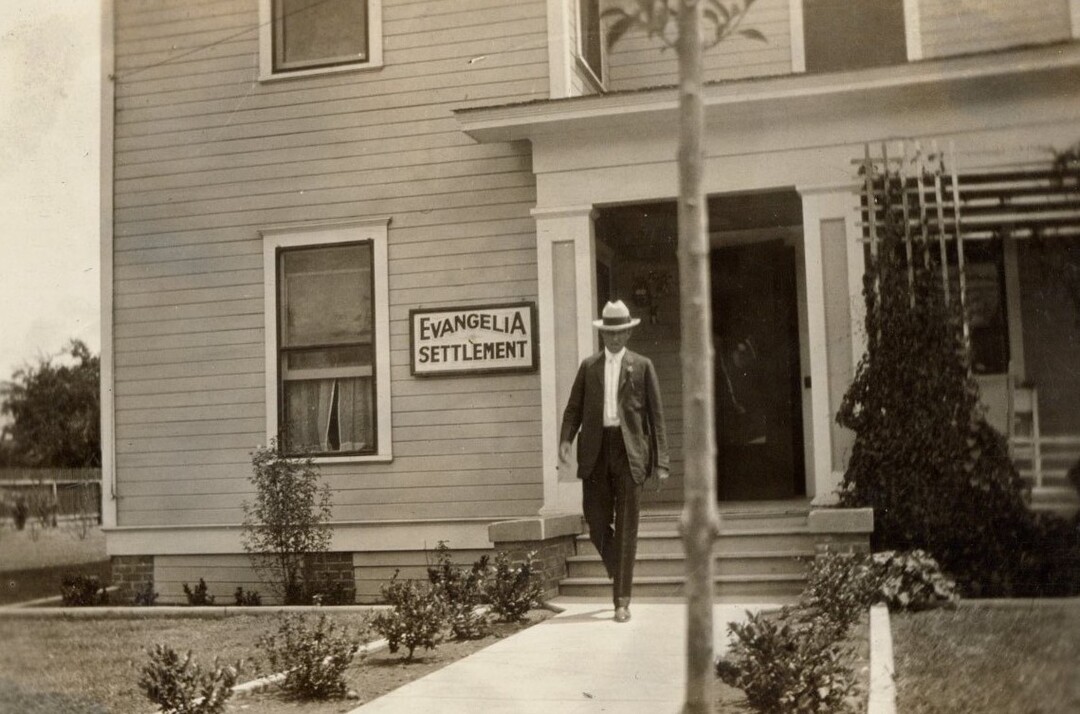
Murrell Skinner, pictured here, exits Evangelia Settlement. Skinner married Georgia Murdock Skinner, Evangelia’s director throughout the 1920s. Under Murdock Skinner’s leadership, the institution partnered with Waco’s Community Chest, Red Cross, Child Welfare, Police Matron, Travellers Aid, Good Will Industry, Humane Society, and McLennan County Health Society. | Source: Courtesy of the Texas Collection; “Evangelia Home’s Work Explained,” The Waco News-Tribune, March 16, 1929.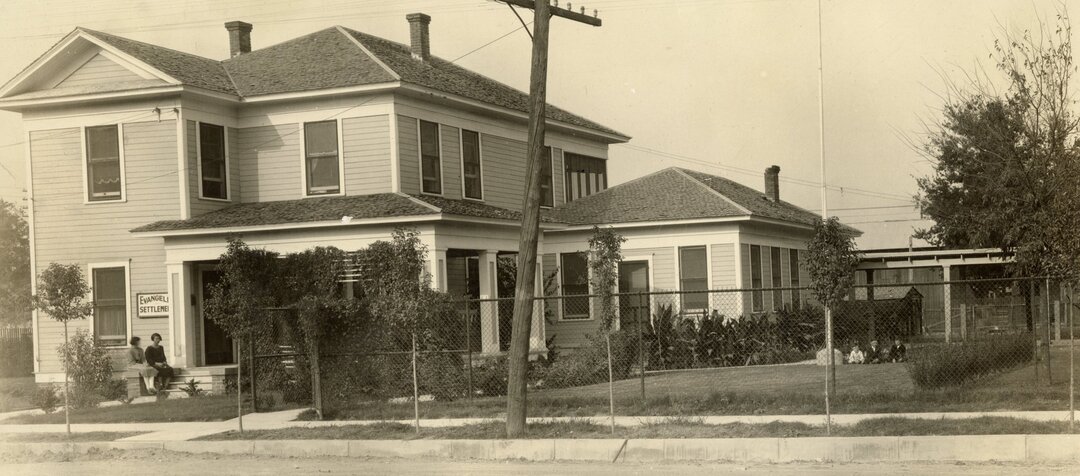
Work of the Founders
After establishing Evangelia Settlement, Ethel Dickson returned with her family to Canada. There, she met and married a medical missionary and moved to India, where she lived until she passed away unexpectedly in 1915. Nell Symes remained in Waco, married, and continued charity work in the area. She volunteered with the Red Cross, taught Bible classes, and campaigned for funds for the Waco Community Chest. | Source: Courtesy of the Texas Collection; “The Death Roll,” Waco Semi-Weekly Tribune, September 25, 1915; “$35,608 Put Up By Waco On First Day,” The Waco Times-Herald, November 15, 1927; “Church Affairs,” The Waco News-Tribune, October 27, 1960.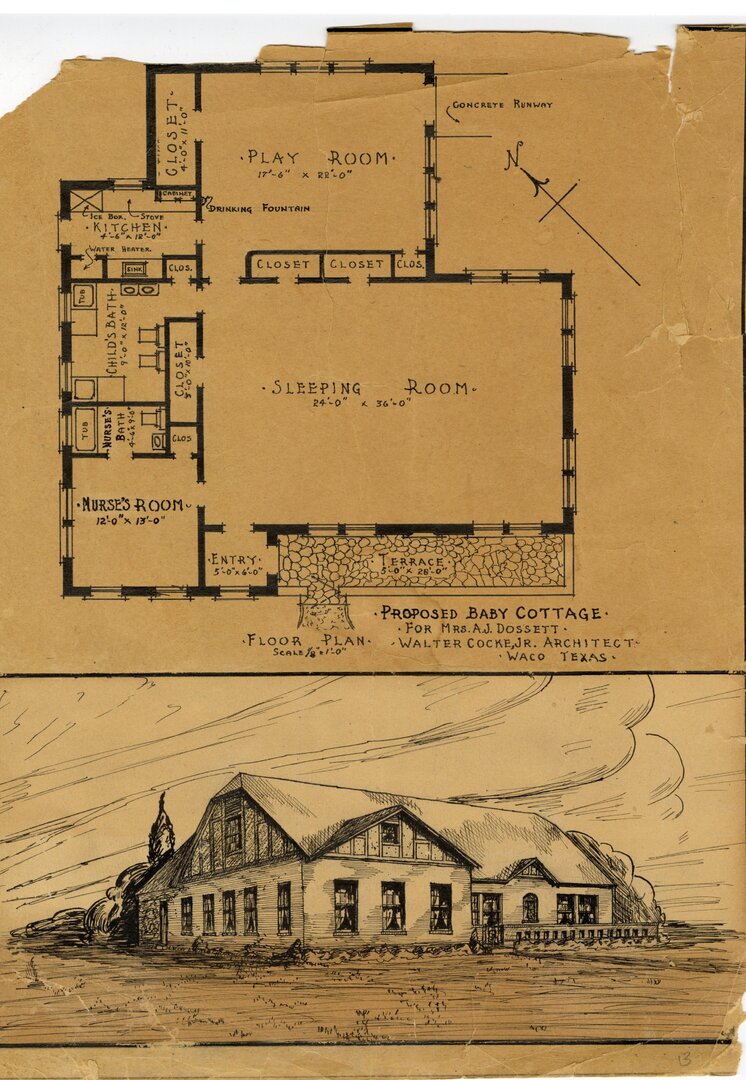
Open House
After the opening of Evangelia’s new structure, the settlement house hosted an open house for those across Waco in 1921. By opening the home to the public, Evangelia hoped to express their gratitude for the financial support of Waco organizations and individual Wacoans. | Source: Courtesy of the Texas Collection; “Open House at the Evangelia House,” The Waco Times-Herald, May 22, 1921.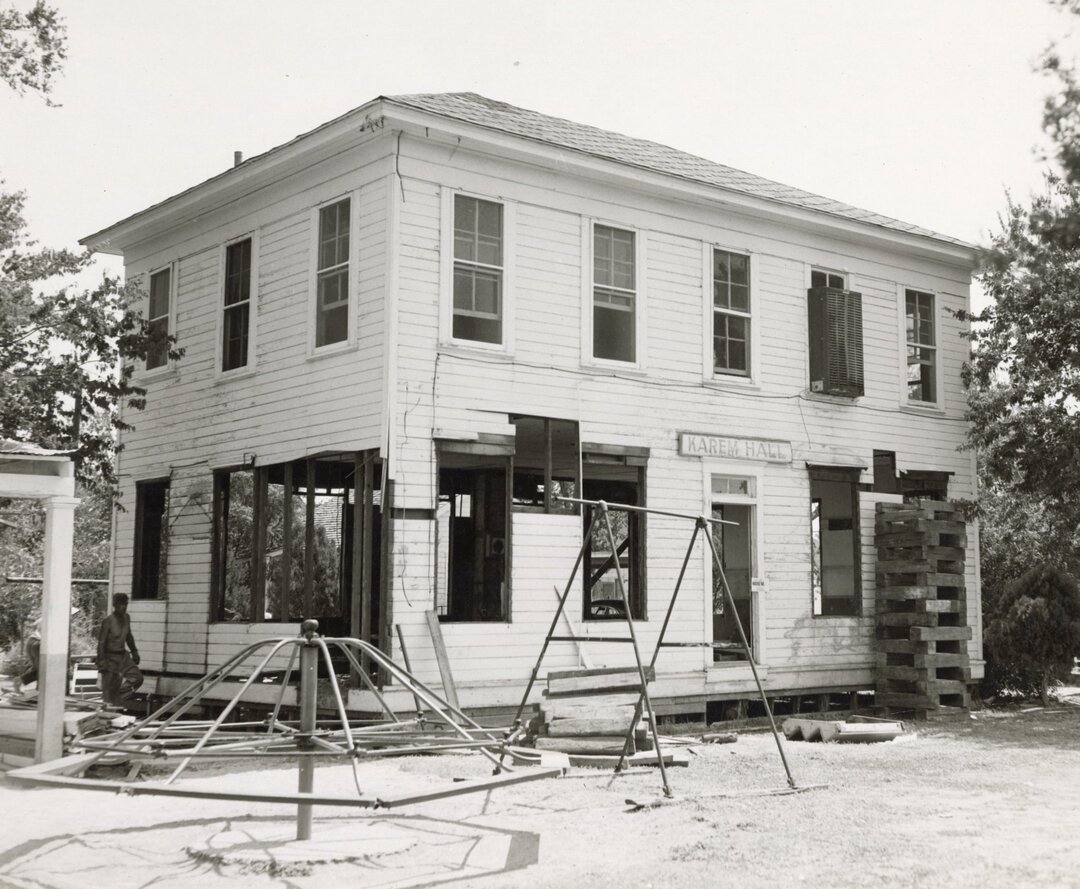
Support from the Shriners
The Karem Shriners offered regular financial support to Evangelia Settlement. Their donations enabled the construction of Karem Hall and the installation of two fire escapes, and they also provided free tickets for children at Evangelia to attend the Karem Circus in 1970. | Source: Courtesy of the Texas Collection; “Shriners Good Samaritans for Evangelia Home,” Waco Times-Herald, August 25, 1922; “Shrine Circus to Entertain,” The Waco Citizen, July 30, 1970.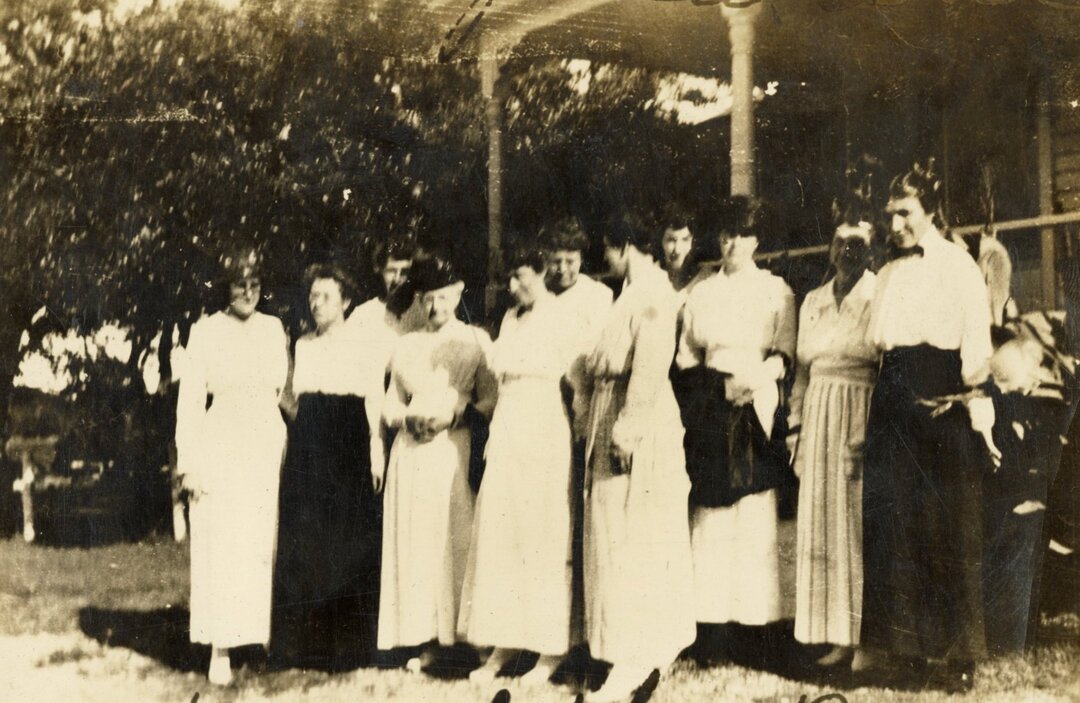
Women Led
For seventy years, Evangelia had only female presidents and board members. In 1977, the board voted in the first male president, but women remained prominent leaders within the institution. | Source: Courtesy of the Texas Collection; Painter, Rosemary. Interviewed by Mrs. Clifton [Betsy] Robinson, March 25, 1977, in Waco, TX. Baylor University Institute for Oral History, Waco, TX. Access full interview here.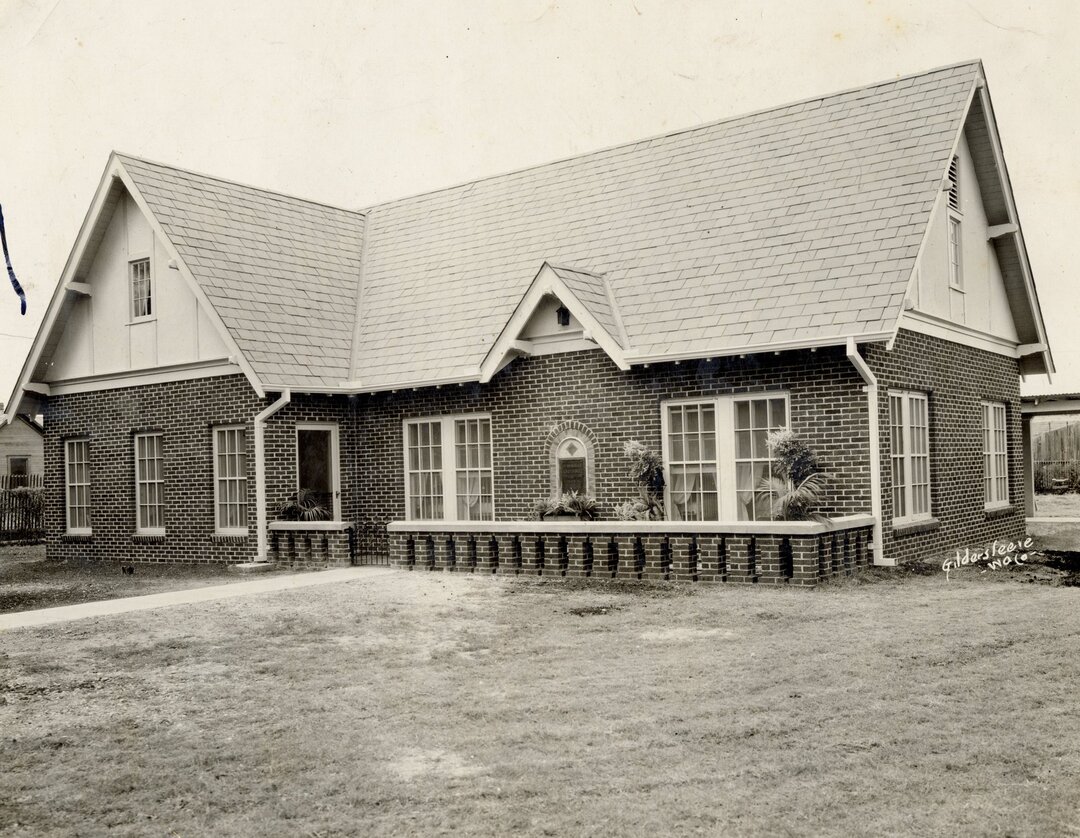
Dossett Donation
Gifted by Mrs. A.J. Dossett in 1927, the Evangelia Home and Baby Cottage allowed Evangelia to extend care to fifteen infants. The building contained a large playroom, dormitory, nurse’s station, bathroom, and kitchenette. A cement walkway with a cover connected the cottage to the main building. | Source: Courtesy of the Texas Collection; “Evangelia Home Addition Dedicated,” The Waco News-Tribune, May 4, 1927.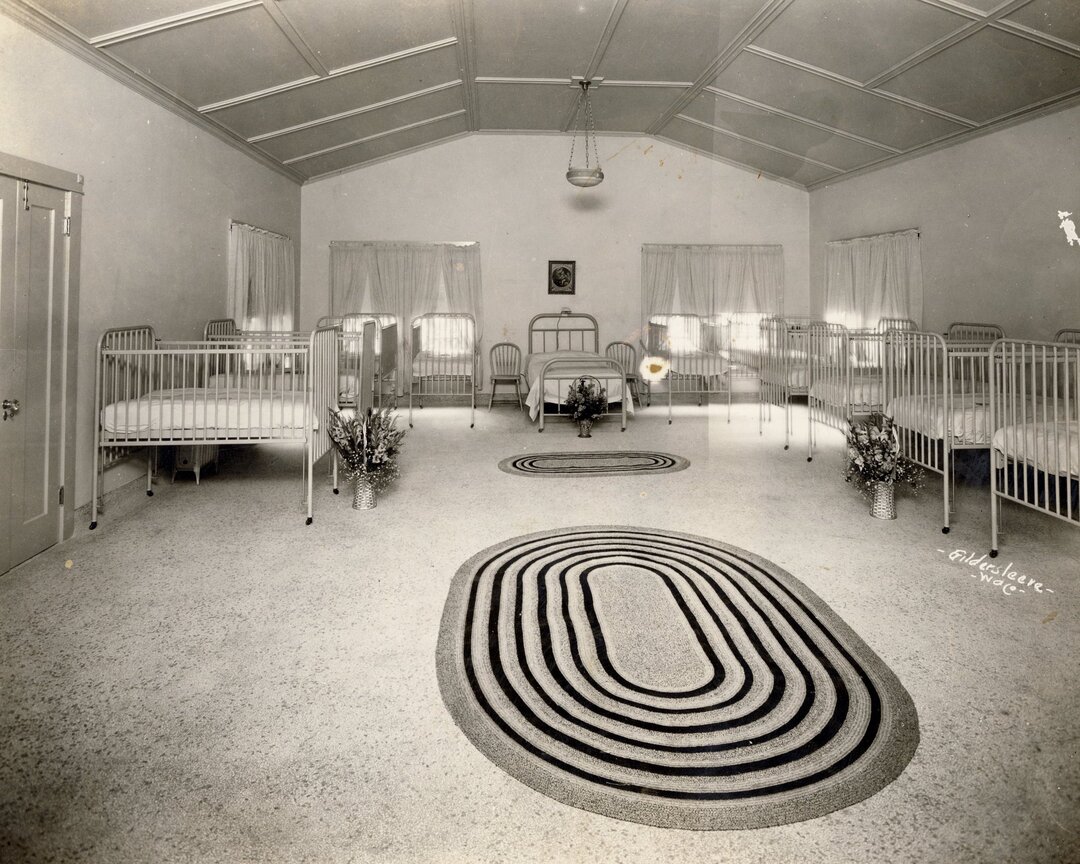
Cribs in the Cottage
Prior to the construction of the cottage in 1927, Evangelia was only authorized to care for children ages two to twelve. The cottage and the later Emergency Care Cottage allowed Evangelia to care for infants and provide twenty-four-hour care when needed. | Source: Courtesy of the Texas Collection.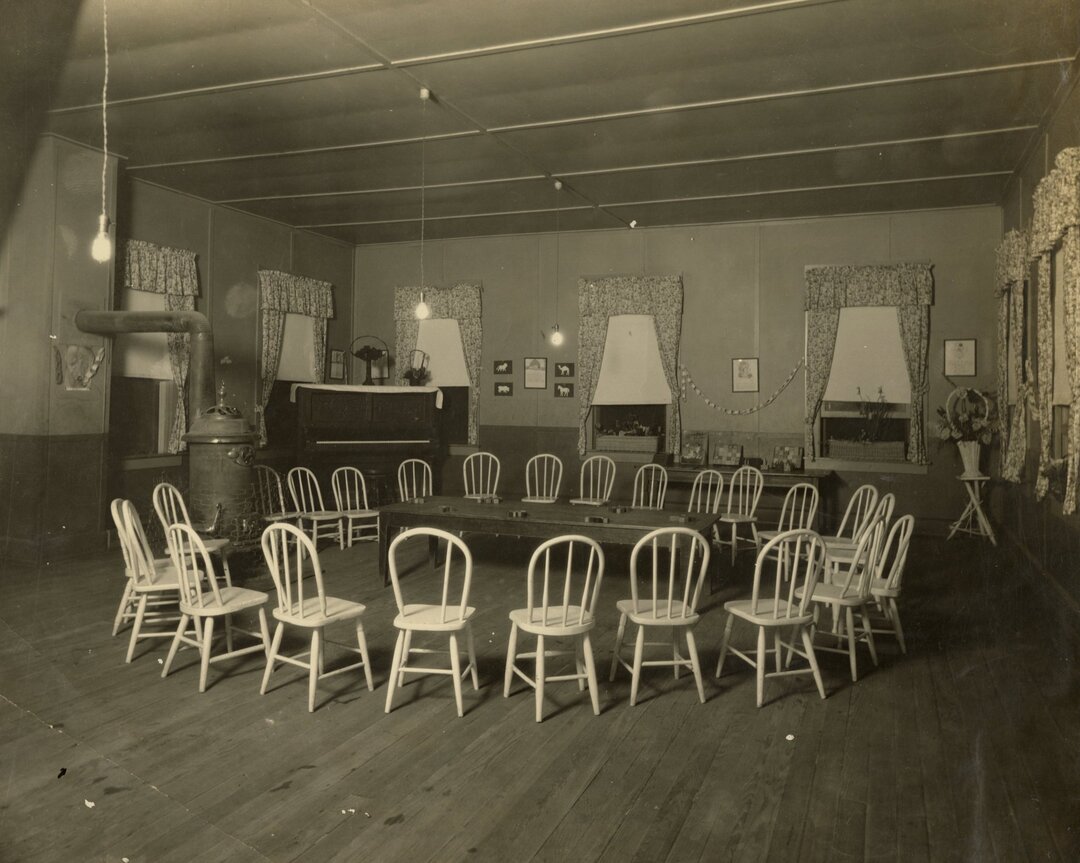
Early Education
School age children staying at Evangelia attended Waco Public Schools. For younger settlement house residents, Evangelia hosted a kindergarten class and recreational activities on site. | Source: Courtesy of the Texas Collection; “Evangelia House Finds More Work Than It Can Do,” The Waco News-Tribune, January 18, 1925.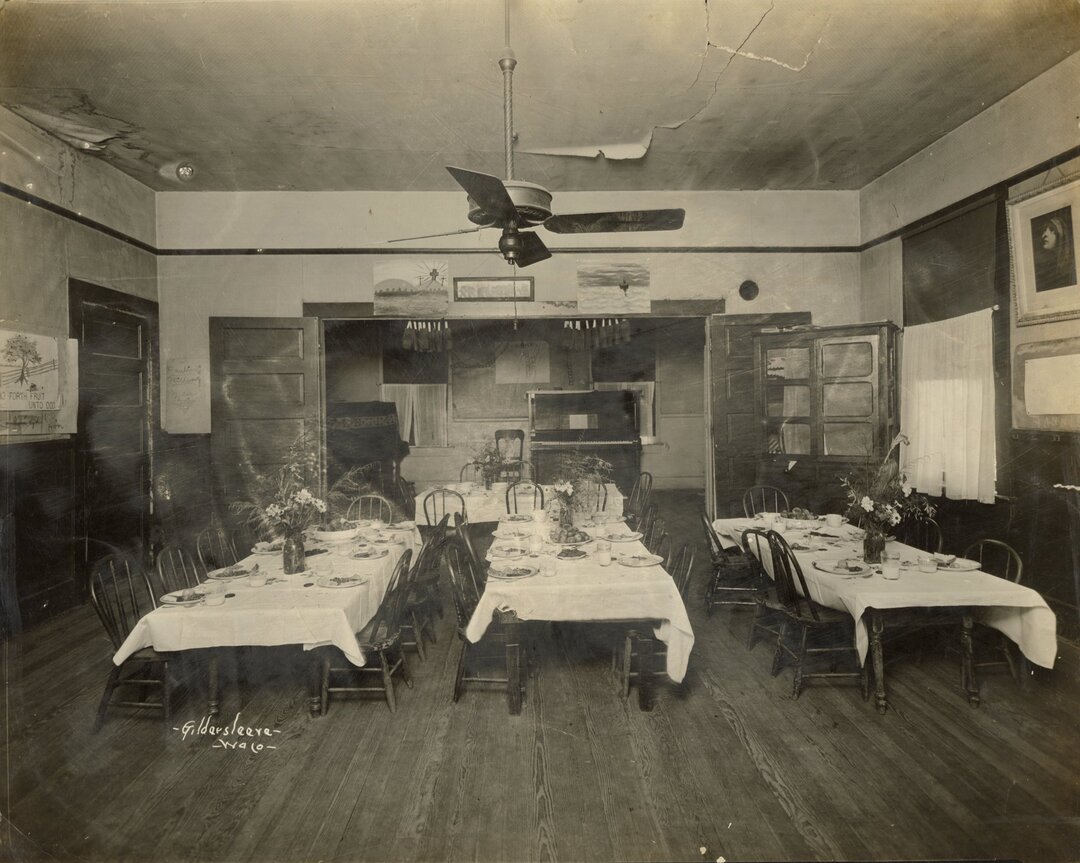
Turkey Dinner Dining
Evangelia hosted a Thanksgiving dinner in 1924. Children, board members, teachers, and other guests dined at Evangelia and enjoyed turkey, cranberries, potatoes, and cake. | Source: Courtesy of the Texas Collection; “Thanksgiving Dinner Given At Evangelia,” The Waco Times-Herald, November 29, 1924.
Founding Initiatives
Rosemary Painter, Evangelia’s executive director from the late 1960s through the 1970s, describes the institution’s founding by Ethel Dickson and Nell Symes. The settlement house offered childcare for working mothers and was the first of its kind in Waco. | Source: Painter, Rosemary. Interviewed by Mrs. Clifton [Betsy] Robinson, March 25, 1977, in Waco, TX. Baylor University Institute for Oral History, Waco, TX. Access full interview here.State Charter
The settlement home received the name Evangelia after the state chartered the institution in 1912. Painter reports that Evangelia was Waco’s oldest welfare agency. | Source: Painter, Rosemary. Interviewed by Mrs. Clifton [Betsy] Robinson, March 25, 1977, in Waco, TX. Baylor University Institute for Oral History, Waco, TX. Access full interview here.Dependent on Donations
Painter describes that Evangelia struggled financially as it depended on organizational and individual donations. Later funding from the state government helped supplement donations and ensured that Evangelia received necessary monetary support. | Source: Painter, Rosemary. Interviewed by Mrs. Clifton [Betsy] Robinson, March 25, 1977, in Waco, TX. Baylor University Institute for Oral History, Waco, TX. Access full interview here.Generous Givers
The Dossett family donated the cottage for infants in memory of their late grandson. Painter notes that prior to World War II, some Waco families depended on the cottage for weekly childcare. | Source: Painter, Rosemary. Interviewed by Mrs. Clifton [Betsy] Robinson, March 25, 1977, in Waco, TX. Baylor University Institute for Oral History, Waco, TX. Access full interview here.Friendly Fees
Since Evangelia charged families based on their income, some families received free childcare. As Painter highlights, though, most paid at least a small fee. | Source: Painter, Rosemary. Interviewed by Mrs. Clifton [Betsy] Robinson, March 25, 1977, in Waco, TX. Baylor University Institute for Oral History, Waco, TX. Access full interview here.Government Guidelines
To receive federal funding, Painter states that Evangelia followed federal regulations for staff. Accommodating more children required that Evangelia hire additional staff members. | Source: Painter, Rosemary. Interviewed by Mrs. Clifton [Betsy] Robinson, March 25, 1977, in Waco, TX. Baylor University Institute for Oral History, Waco, TX. Access full interview here.Structural Shifts
Painter describes Evangelia’s move from a small house on Thirteenth and Webster to a larger house. Then, as she notes, Evangelia moved into a new structure in 1958, complete with an infant care area, baby cottage, and main building. | Source: Painter, Rosemary. Interviewed by Mrs. Clifton [Betsy] Robinson, March 25, 1977, in Waco, TX. Baylor University Institute for Oral History, Waco, TX. Access full interview here.Age Ranges
Painter explains that Evangelia eventually extended care to infants. The institution could accommodate children from six weeks old to twelve years old. | Source: Painter, Rosemary. Interviewed by Mrs. Clifton [Betsy] Robinson, March 25, 1977, in Waco, TX. Baylor University Institute for Oral History, Waco, TX. Access full interview here.Rules and Requirements
To qualify for childcare at Evangelia, mothers had to work or attend school. Most children who stayed at Evangelia came from low-income homes. | Source: Painter, Rosemary. Interviewed by Mrs. Clifton [Betsy] Robinson, March 25, 1977, in Waco, TX. Baylor University Institute for Oral History, Waco, TX. Access full interview here.Outnumbered by Applications
In 1977, Evangelia stayed at full capacity. Painter emphasizes that the institution cared for one hundred forty-seven children and had a waiting list. | Source: Painter, Rosemary. Interviewed by Mrs. Clifton [Betsy] Robinson, March 25, 1977, in Waco, TX. Baylor University Institute for Oral History, Waco, TX. Access full interview here.Working Mothers in Waco
Painter believes that Evangelia’s childcare enabled many mothers in the area to return to work. Without the settlement house, many mothers in the area would have lacked necessary childcare and resources. | Source: Painter, Rosemary. Interviewed by Mrs. Clifton [Betsy] Robinson, March 25, 1977, in Waco, TX. Baylor University Institute for Oral History, Waco, TX. Access full interview here.Helping Hands
Various communal organizations partnered with Evangelia, including the Waco Public Library and the Waco Art Center. Painter also highlights that Evangelia worked with the Latin American Neighborhood Center and regularly delivered hot meals to the organization, which was a mere seven blocks away. | Source: Painter, Rosemary. Interviewed by Mrs. Clifton [Betsy] Robinson, March 25, 1977, in Waco, TX. Baylor University Institute for Oral History, Waco, TX. Access full interview here.Teaching Teachers
Through a fully funded program, teachers at Evangelia attended McLennan Community College. These courses, Painter states, improved the educational opportunities offered to children at Evangelia. | Source: Painter, Rosemary. Interviewed by Mrs. Clifton [Betsy] Robinson, March 25, 1977, in Waco, TX. Baylor University Institute for Oral History, Waco, TX. Access full interview here.Safe Space
Maxine Flynn, Director of Social Services for Waco ISD, notes that Evangelia Settlement functioned as an in-between space for foster children. The home provided a place for children until they were placed in a more permanent foster home or with adoptive parents. | Source: Flynn, Maxine. Interviewed my Mrs. Clifton [Betsy] Robinson, March 9, 1977, in Waco, TX. Baylor University Institute for Oral History, Waco, TX. Access full interview here.Financing and Fundraising
Evangelia researcher Buck Cole explains that Evangelia depended on community funding. Donations from local organizations such as the Salvation Army and YMCA made it possible for Evangelia to move into an upgraded house in 1958. | Source: Cole, Buck. Interviewed by Stephen Sloan, July 26, 2023, Waco, TX. Rogue Media Network, Waco History Podcast. Access full interview here.