Sandtown Neighborhood
Text
Sandtown was a vibrant and predominately Mexican American neighborhood that was active from the turn of the twentieth century to the 1960s. It encompassed the area of downtown Waco between Third Street and the Brazos River, and the seven blocks between Mary Street and present-day Baylor Law School. There were multiple interpretations on the actual boundaries of Sandtown as no official borders were ever established by the city of Waco.
At its peak during the 1950s, approximately fifty working-class families, such as the Fuentes, the Martinezes, and the Vasquezes, resided in Sandtown. For many of the community’s families, the neighborhood was the first place they called home within the United States after emigrating from Mexico. Former resident Jesse Serrano, recalling his experience of growing up in Sandtown, remarked, “I wish that we were still at our neighborhood here and that I could return to live here because it was an enjoyable place and we did keep it clean in spite of everything – the storms, the sandstorms, for what reason Sandtown was named.” Indeed, the neighborhood's sandy surroundings were a result of its proximity to the Brazos River. One resident later recalled watching his neighbors cast a line out their bedroom window to fish.
There were a few businesses located within Sandtown, from grocery stores and auto garages to barbershops and beer joints. Memorable establishments include Sunbright Waste Paper Company, Ruben Bravo’s Produce Company, and Rubles’ Grocery Store. Some of the schools in the neighborhood included South Third Street Elementary and A. J. Moore High School. Religious and social gathering sites such as an Assembly of God sanctuary and "The Blue Moon" nightspot also dotted the Sandtown landscape.
In 1958, the city of Waco voted to participate in the federal urban renewal program. As only property owners could vote, Sandtown residents, who were tenants primarily, had almost no chance of defeating the proposition. Only a small portion of the neighborhood’s residents were able to participate. One of the purposes of urban renewal was to eliminate slums in the downtown area, and the program directors quickly set their sights on Sandtown. As a result, the residents of the neighborhood soon found themselves scattered across the city, county, and beyond. “I’ve been quoted more than once as calling it ‘urban removal’ because it uprooted the Hispanic family in the worst way,” maintained former resident Robert Gamboa.
The people of Sandtown added greatly to Waco’s rich diversity and its working class residents contributed to the economic growth of the city. Though small in size and for many years lacking formal recognition, there is no dispute over Sandtown’s significance amongst its former residents. For these individuals, Sandtown was the place they grew up in, suffered hardships, and created countless wonderful memories. As Jesse Serrano affirmed, “Sandtown did exist, Sandtown is still here, and it will always be here in our hearts.”
Files

Bird's-Eye View (1950s)
Depicted here is the eastern part of the Sandtown neighborhood that was located between First Street and the south shore of the Brazos River. The cemetery on the top right was, according to former resident Robert Gamboa, a frequent playground for the children of Sandtown. | Source: Image courtesy of the Texas Collection, Baylor University
Julius Genecov Wholesale Grocers
While most of the businesses in Sandtown were owned by Hispanics, a few were not. One example, is Julius Genecov Wholesale Grocers, a Jewish-owned business located between the 300 and 400 blocks of Third Street. | Source: Image courtesy of the Texas Collection, Baylor University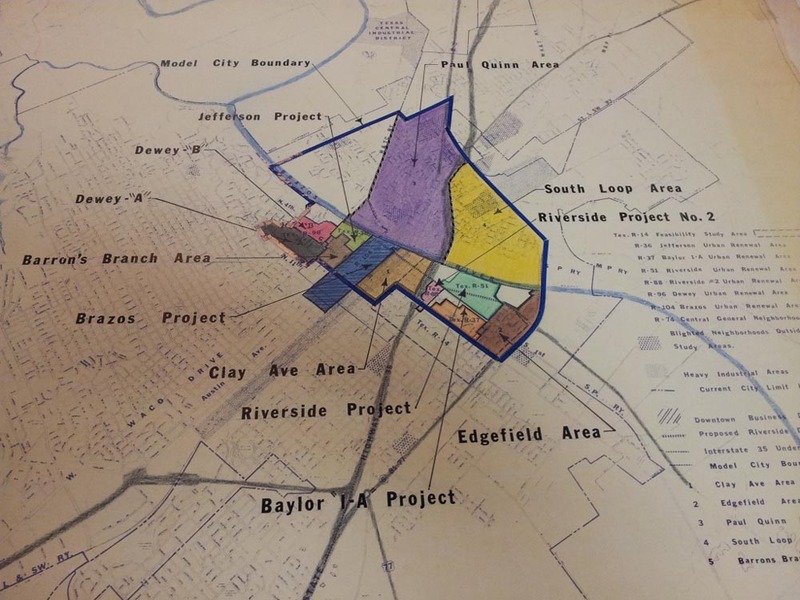
Mapping Out Renewal
This 1970s-era Waco Urban Renewal Agency map shows an inexact representation of where the former neighborhood once stood. The area of the Sandtown included the space north of First Street (now University Parks Drive) up to the Brazos River, located inside the individual sections called Riverside and Clay Avenue Areas. | Source: Image courtesy of the Texas Collection, Baylor University
Child-Friendly
When not playing outside their homes, Sandtown's children could be found at the nearby Boys and Girls Club located on the property of St. Francis on the Brazos Catholic Church. | Source: Image courtesy of the Texas Collection, Baylor University
No Place Like Home
The houses of Sandtown, though not of the best quality, were kept up by the residents as best they could. In addition to the ever-present blanket of sand that covered their homes, the residents of Sandtown also had to deal with the constant threat of muddy roads and floods. | Source: Image courtesy of the Texas Collection, Baylor University
Making Their Own Toys
Emmett Gayton explains how he made his own toys as a child who lived in the Sandtown Neighborhood. | Source: Gayton, Emmett, interviewed by Michael B. McCarty, March 4, 2006, in Waco, Texas. Baylor University Institute for Oral History, Waco, TX. View the full interviewSandtown Neighborhood in the 1930s
Lena Torres speaks of how the residents of Sandtown Neighborhood lived in the 1930s. | Source: Torres, Lena P., interviewed by Sean Sutcliffe, February 25, 2005, in Waco, Texas. Baylor University Institute for Oral History, Waco, TX. View the full interview