Allene Jeanes
Text
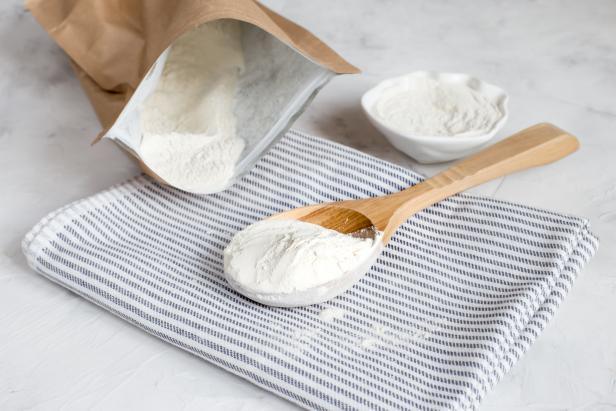
Most people have consumed the ingredient xanthan gum many times before, even if it was unknowingly. Xanthan gum is used in a wide variety of products, including gluten-free bread, ice cream, and cough syrup. This mysterious-sounding substance is a thickening agent invented by Dr. Allene Rosalind Jeanes, a nationally renowned chemist born in Waco, and it is only one of her ground-breaking achievements.
Born in 1906 and raised in Waco, Allene Jeanes attended Baylor University and graduated with a bachelor’s degree in chemistry in 1928. She went on to receive her master’s degree from the University of California at Berkeley, and then returned to Texas to teach high school for a year. She was soon hired as the head of the department of science for Athens College in Alabama, where she taught chemistry, physics, and biology from 1930-1935. She decided to continue her education, finishing her doctorate in organic chemistry at the University of Illinois in 1938. After receiving her PhD, Jeanes worked for the National Institutes of Health with researcher Claude Hudson, having received one of the first Corn Industries Research Foundation fellowships, and then briefly for the National Bureau of Standards with Horace Isbell. She earned the first of her ten patents in 1941 for her research on phenanedicarboxylic anhydrides, and the same year she began working for the U.S. Department of Agriculture’s Northern Regional Research Center (NRRL) in Peoria, Illinois, where she would work until 1976.
Jeanes’ research at NRRL focused primarily on polysaccharides, which are carbohydrates composed of sugar molecules, and she soon became especially interested in a polysaccharide called dextran. Researchers in Sweden were beginning to investigate the possibility of using dextran to extend blood plasma, helping a patient live long enough to receive a blood transfusion by increasing their volume of circulating blood plasma. Unfortunately, dextran was a rare substance and difficult to find in large quantities. By chance, a soda company sent NRRL a batch of root beer that had strangely become thick and viscous. Jeanes discovered that bacteria which produced dextran, a thickening agent, had infected the soda. By isolating these bacteria, she discovered a cheap way to produce large quantities of dextran. When the Korean War broke out in 1950, dextran was approved for medical use in the military, enabling wounded soldiers to survive until they could receive treatment. It was approved for civilian use after the war, extending the accessibility of this revolutionary treatment to the wider public and saving even more lives.
Dextran would not be Allene Jeanes’ only revolutionary discovery; her research on dextran propelled her eventual discovery of xanthan gum. Like dextran, xanthan gum is a polysaccharide with thickening properties, but it is produced by a different kind of bacteria. It is a safe, edible, and time-tested ingredient that is used globally, and it has become the most widely produced polysaccharide in the world.
Over the course of her lifetime, Jeanes wrote sixty publications, obtained ten patents, and received several prestigious awards. In 1956, she became the first woman to receive the Distinguished Service Award by the U.S. Department of Agriculture, and the same year she was awarded the Garvan Medal from the American Chemical Society. In 1962, Jeanes received the Federal Woman’s Award from the U.S. Civil Service Commission for her outstanding scientific achievements. She died in December 1995, and she was posthumously inducted into the National Inventors Hall of Fame in 2017.
Jeanes never married, choosing instead to focus all her attention on her career. As one of very few women working in chemistry research at the time, she cared deeply about inspiring the next generation of young women to pursue education. She even returned to Baylor in 1968 as the guest speaker for Woman’s Day at the university, to exhort her listeners about the vast benefits of women pursuing higher education and the dangers of “an overbalance of biological functions” to the detriment of the mind and spirit. She certainly practiced what she preached, and her accomplishments continue to inspire new generations of scientists today.
Files
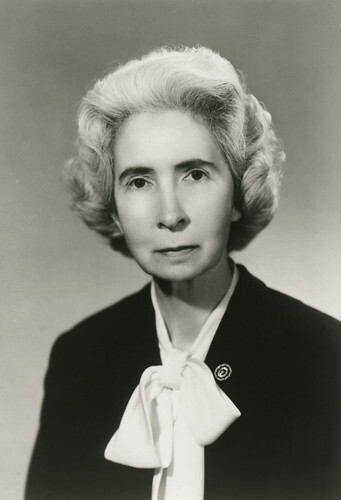
Brilliant Chemist
Allene Jeanes won ten patents and countless awards for her outstanding work in the field of organic chemistry. Her innovations revolutionized both the food industry and emergency medical care. | Source: O’Brien, Dennis. “A Root Beer-Based Discovery That Saved Lives.” USDA, November 9, 2016. https://www.usda.gov/media/blog/2016/11/09/root-beer-based-discovery-saved-lives.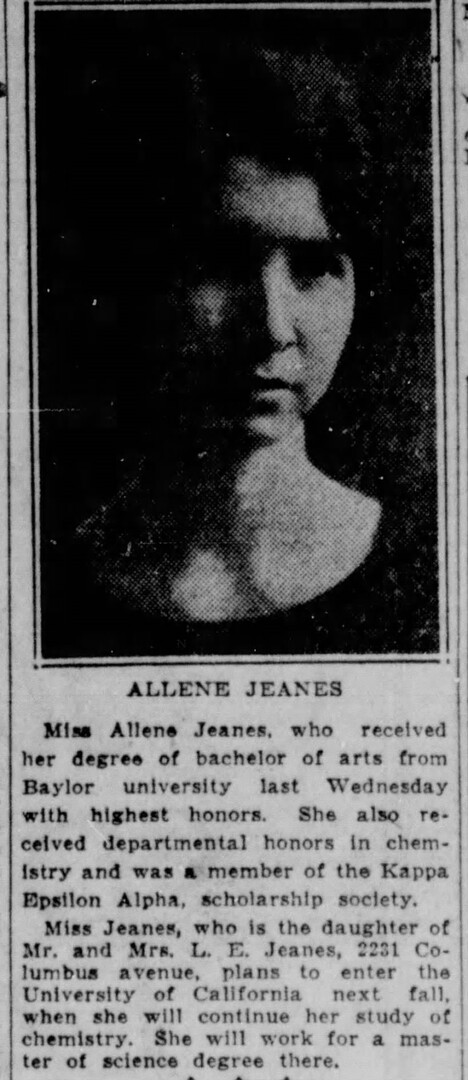
A Young Genius
Even as a young adult, Jeanes’ brilliant mind was evident in the high honors she achieved at Baylor and her intentions to continue her studies at the graduate level, at a time when very few women did so. | Source: The Waco News-Tribune, June 3, 1928.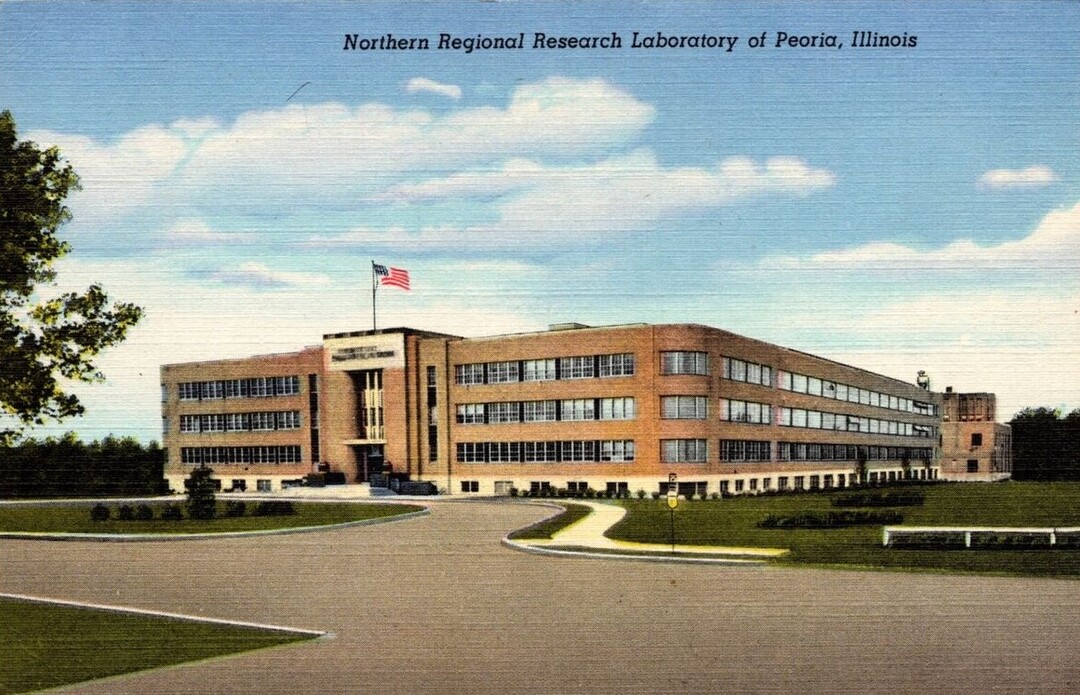
Famous Laboratory
Allene Jeanes worked at the Northern Regional Research Laboratory for 35 years. Dextran is not the only life-saving drug mass-produced by NRRL; the laboratory is most well-known for discovering how to mass-produce penicillin. | Source: Northern Regional Research Laboratory of Peoria, Illinois, postcard, 1943.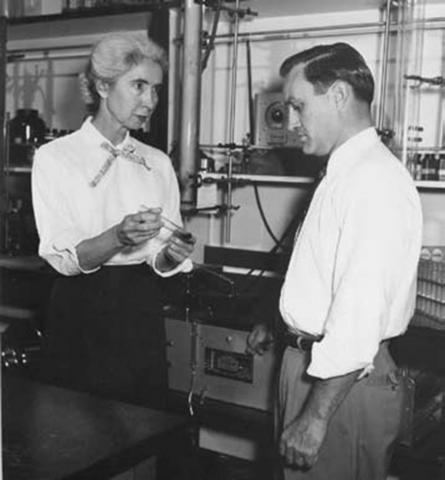
Researching Dextran
Carl Wilham assisted Jeanes in her dextran research at NRRL. Dextran had already been in use for five years when this photo was taken, but Jeanes continued to refine it for future use. | Source: Image courtesy of “Celebrating 200 Years of the U.S. House Committee on Agriculture (1820-2020).” National Agricultural Library, December 31, 2020. https://nal.usda.gov/collections/exhibits/houseag200th/list; Côté, Gregory L, and Victoria L Finkenstadt. “A History of Carbohydrate Research at the USDA Laboratory in Peoria, Illinois.” Bulletin for the History of Chemistry 33, no. 2 (2008): 103-11. https://acshist.scs.illinois.edu/bulletin_open_access/v33-2/v33-2%20p103-111.pdf.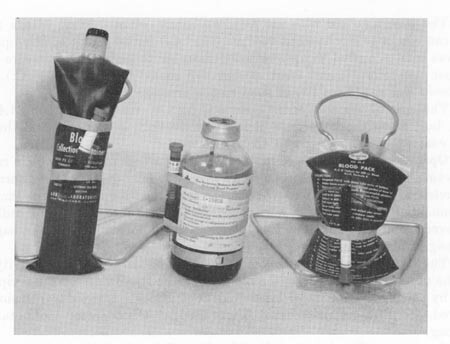
Life-Saving Drug
Dextran made it possible for many soldiers to survive until they were able to received blood transfusions. The blood packs pictured are typical of those used for blood transfusions during the Korean War. | Source: Kendrick, Douglas B. “The Blood, Plasma, and Related Programs in the Korean War.” In Blood Program in World War II. Washington D.C.: Office of the Surgeon General, Dept. of the Army, 1989. Retrieved from https://achh.army.mil/history/book-wwii-blood-chapter20.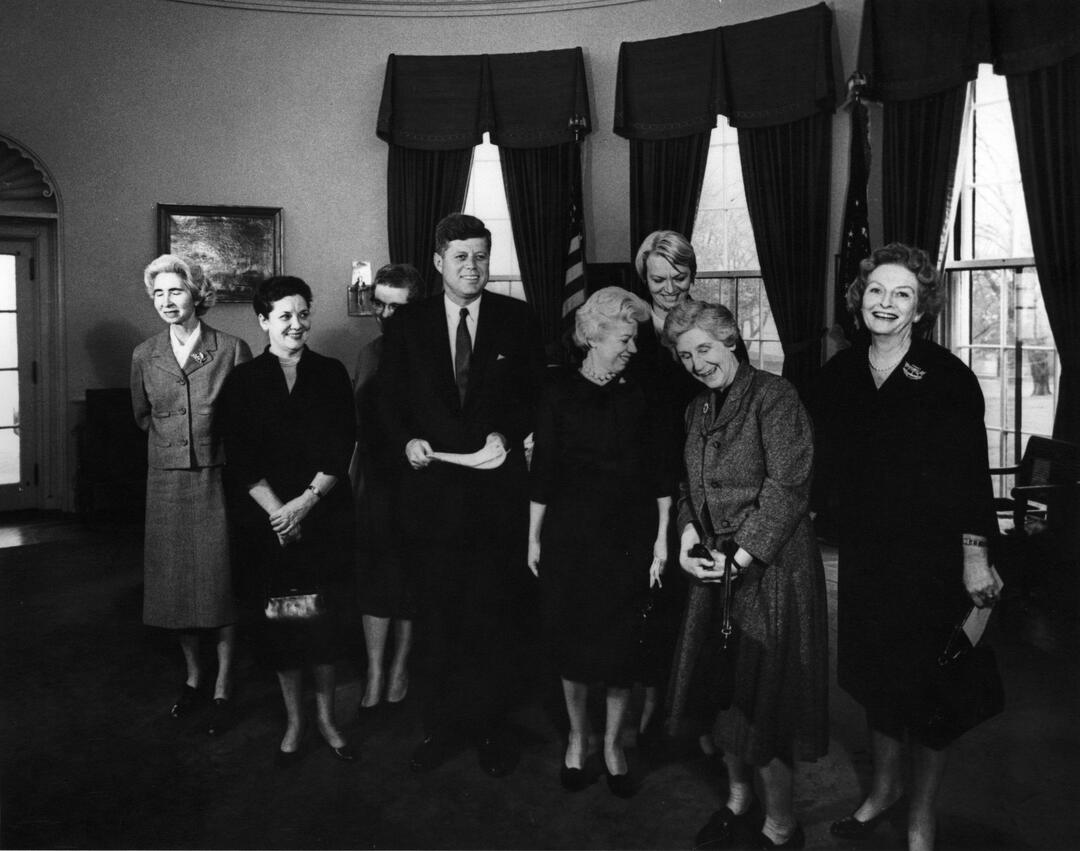
Jeanes Meets the President
The recipients of the 2nd Annual Federal Woman’s Award met with President Kennedy in the Oval Office for a ceremony to honor them. The women chosen for this award “demonstrated outstanding ability and achievement in an executive, professional, scientific, or technical position in the federal service.” | Source: Image courtesy of Abbie Rowe, “President John F. Kennedy Meets with Recipients of Federal Woman’s Awards,” 27 February 1962. White House Photographs. John F. Kennedy Presidential Library and Museum, Boston. “Federal Award for Women Lists Open.” Reno Gazette-Journal, December 30, 1962. https://www.newspapers.com/article/reno-gazette-journal-federal-award-for-w/76970243/.