The Baylor Bear Habitat
Text
One of the most popular places to visit on Baylor University’s campus is the Bill and Eva Williams Bear Habitat, home to Baylor’s live bear mascot. The first habitat was built in 1945, but through the years the desire to increase the quality of life for the bears drove the university to rebuild the habitat again and again, until it became the haven it is today.
Baylor has had a live bear mascot since 1917. The first live bear mascot, Ted, often called “Bruin,” belonged to a nearby Camp MacArthur soldier, who let students parade the bear across the football field during a game and then left the bear to the students when he was deployed overseas. Ted served as Baylor’s mascot until the early 1920s. As there was no habitat at this time, Ted was kept at the Texas Cotton Palace’s small zoo. The bears following Ted would sometimes live off campus but were for the most part kept on university grounds, usually in a pen along Waco Creek. In 1932, Baylor student Bill Boyd acquired a bear named Joe College from the Cotton Palace, which was closing. Joe had been a show bear, and his friendliness and personality quickly made him a favorite of Baylor students. Boyd kept the bear in his backyard until Joe grew to weigh 500 pounds and could no longer be safely housed at his residence. At this point, the Baylor University Chamber of Commerce volunteered to build him a home on campus. Joe College was retired in 1940, and Chamber officially assumed care of his successor, Little Joe.
In 1945, Chamber raised the funds and built Baylor’s first real bear habitat. Located (as it is today) on the banks of Waco Creek, the habitat was known as the “Bear Pit.” It featured a swimming pool and space for the bears to climb or walk around, surrounded by a barrier originally made of iron bed headboards. The Bear Pit underwent renovations in 1949, 1953, and 1969. Chamber also added a trailer in 1953 which transported the bears to and from football games, when previously the bears had been transported in a car or train. The bears frequently tested the strength and security of the Bear Pit with their repeated and often successful escape attempts. The Pit was the home of Baylor’s bears until 1977. At this point, the university decided to demolish it and build the Steve Hudson Memorial Bear Plaza in its place. The Steve Hudson Memorial Bear Plaza was built into the sloping bank of Waco Creek, with an open area where the bears could exercise at creek level and pens and viewing decks at ground level. It was three times the size of its predecessor and included a waterfall and AstroTurf. The Plaza held a Class-C zoo license from the United States Department of Agriculture and was approved by the Texas Parks and Wildlife Department to hold up to three bears.
In 1999, Chamber began pushing the university to update the habitat again, and in 2003 the university finally began the process. Chamber members worked with administrators from Cameron Park Zoo to develop the plans for the bears’ new home. The new habitat opened in 2005, and university administration named it the Bill and Eva Williams Bear Habitat Complex after the project’s lead donors. This complex, which still houses the university mascots, is Baylor’s most sophisticated habitat yet. The environment resembles the bears’ natural environment and includes many new features designed for the enrichment and care of the bears. Another major change to the enclosure was the elevation, as the whole complex was raised to ground level. Viewing areas encircle about half of the outside border, allowing visitors to easily observe the bears’ behavior, and placards provide information about both the history of Baylor’s bears and about black bears in general.
The Bill and Eva Williams Bear Habitat is the safest place on campus and could withstand winds from a category five hurricane, according to the Robert Reid Director of the Baylor Chamber of Commerce, Dakota Farquhar-Caddell. The habitat received accreditation by the Association of Zoos and Aquariums (AZA) in 2021. It is the only university mascot facility to achieve this designation and one of only two AZA accredited zoos on a college campus. Finally, the university added a Community Education Pavilion to the complex in 2022, promoting community engagement and education about the bears.
Files
Pit to Palace
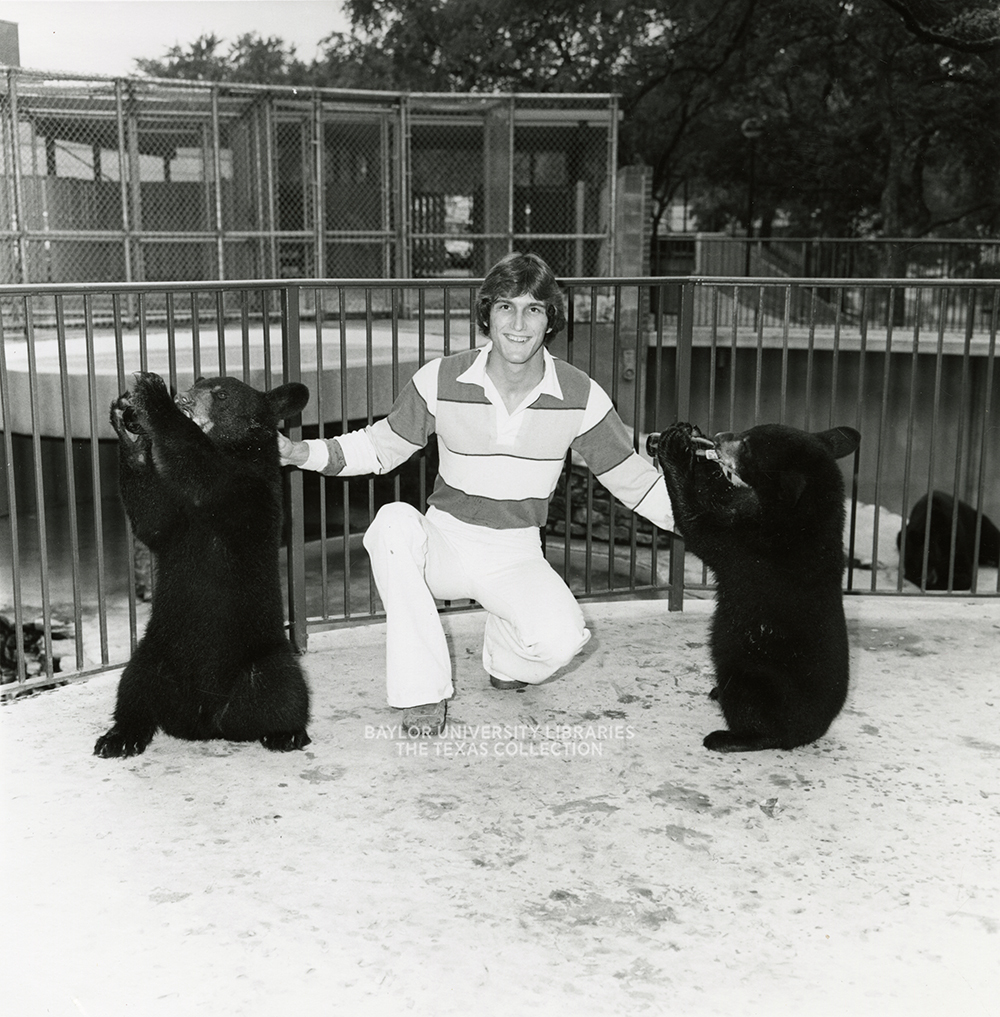
The university rebuilt the original “Bear Pit” in 1976 to include more space for the bears and new amenities. The first bears to live in the new habitat were Judge and Kelli, followed shortly by Abner and Daisy Mae, all of whom approved of their new space wholeheartedly. | Source: Image courtesy of the Texas Collection, Baylor University photo stream, Flickr, https://flic.kr/p/2k3N5gN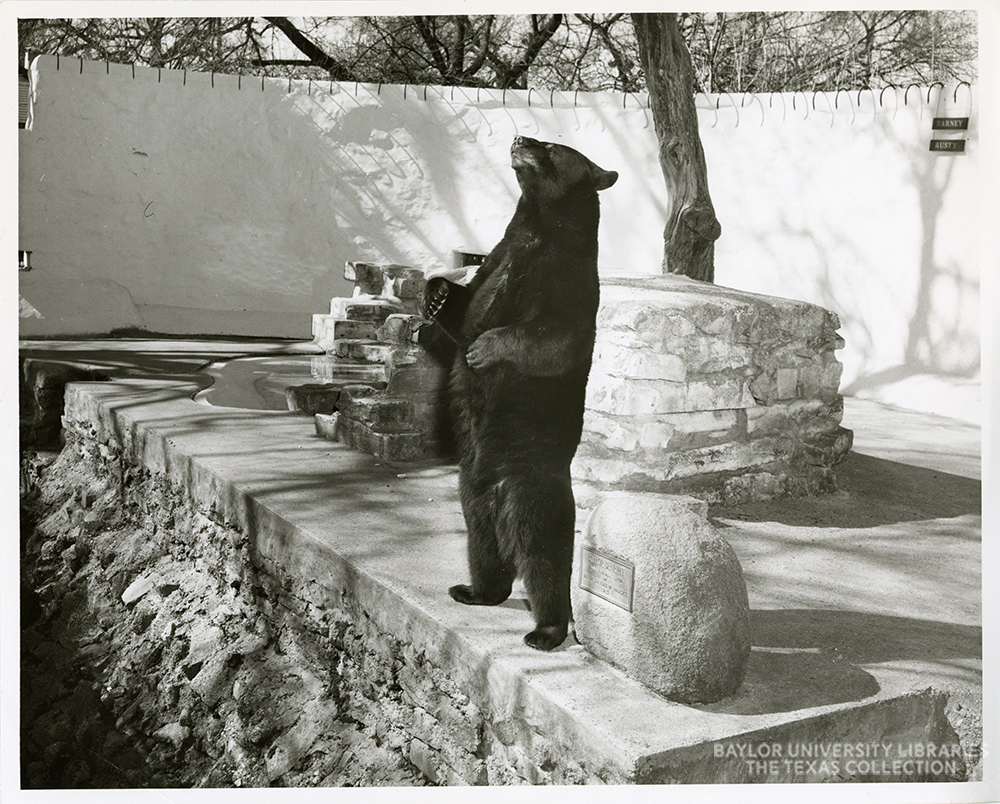
First Home
The Bear Pit was Baylor’s first real bear habitat. Baylor bears prior to the Bear Pit often lived in pens by the creek, chained to trees on campus, or off campus in parks, zoos, or even locals’ backyards. | Source: Image courtesy of the Texas Collection, Baylor University photo stream, Flickr, https://flic.kr/p/2k3Mo6r.
Bear Boosters
The football program considered the bear mascots a good luck charm, and the bears cheered on the team at games up until 2003. Mascot Joe College even considered himself to be part of the team and once tripped an opposing player during a game. | Source: Image courtesy of the Texas Collection, Baylor University photo stream, Flickr, https://flic.kr/p/2k3N5dX.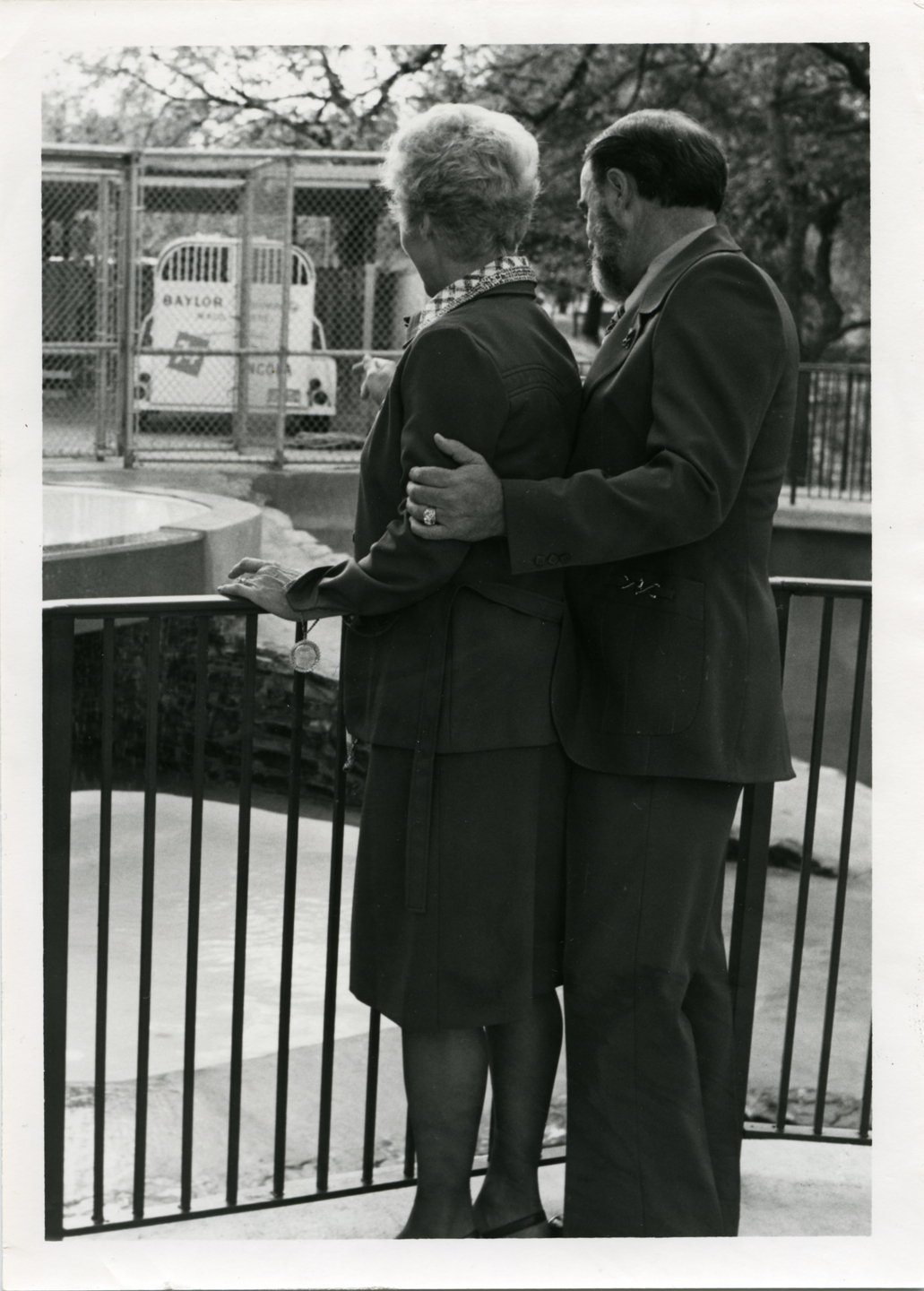
Hudson's Gift
Mr. and Mrs. Hudson gave a generous donation for the rebuilding of the Bear Pit in honor of their son Steve, who died in an accidental shooting in his third year as a Baylor student. The Hudson family loved the bears and felt that providing support for the new habitat was a fitting way to honor their son. | Source: General Photo File—Baylor Buildings, Texas Collection, Baylor University, Digital ID: tx-phoarch-pho_gen-bu-bls_001653.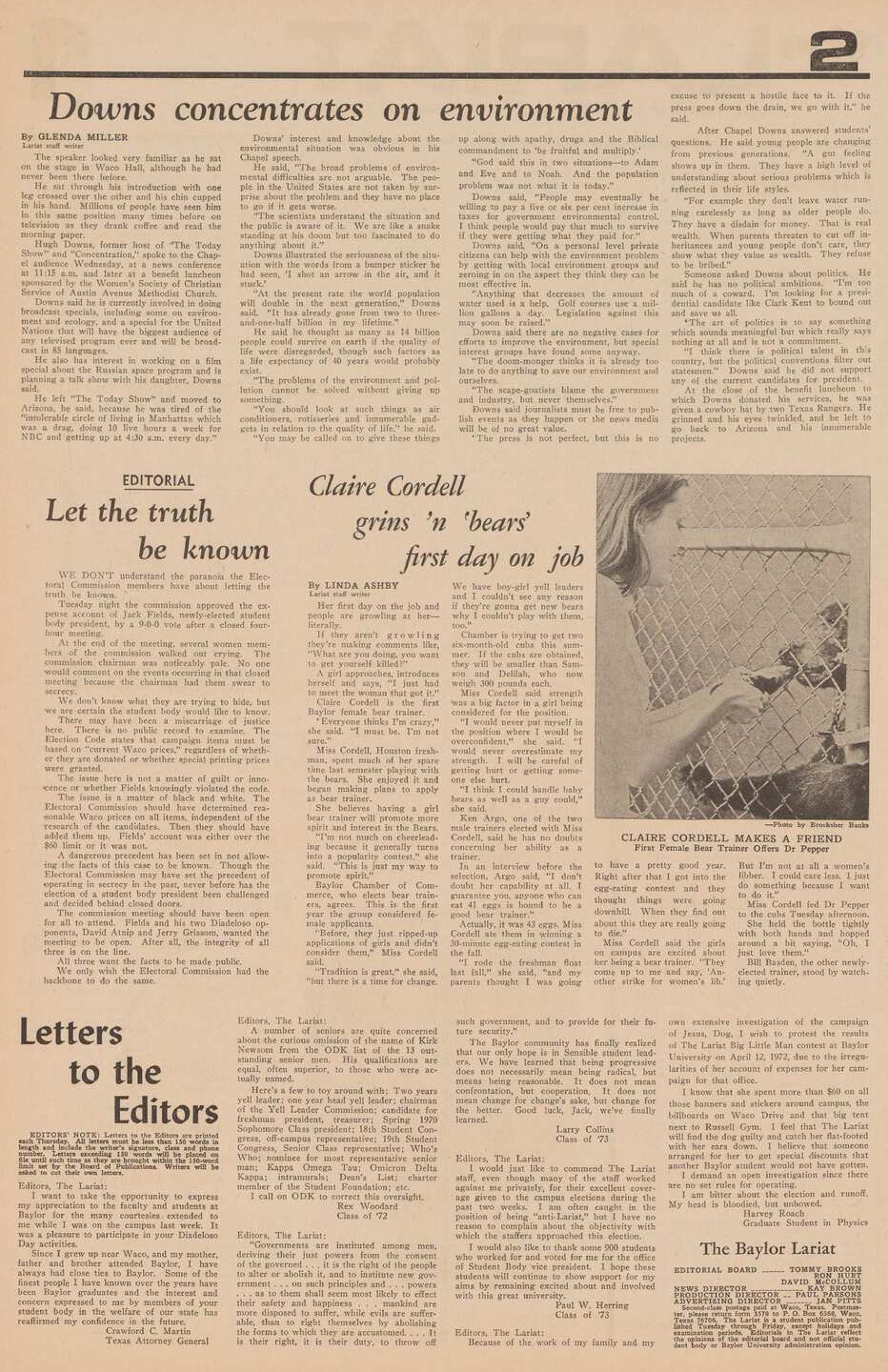
Women in the Bear Program
The Baylor University Chamber of Commerce has cared for the bears since the days of mascot Little Joe. Originally, only men served in the Bear Program, but in 1972, Claire Cordell became Baylor’s first female trainer. | Source: Baylor University Archive - The Baylor ‘Lariat,’ Texas Collection, Baylor University, Digital ID: bu-lariat-nwp_1972-04-20, https://digitalcollections-baylor.quartexcollections.com/Documents/Detail/the-lariat-waco-texas-vol.-72-no.-113-thursday-april-20-1972/163079?item=163101.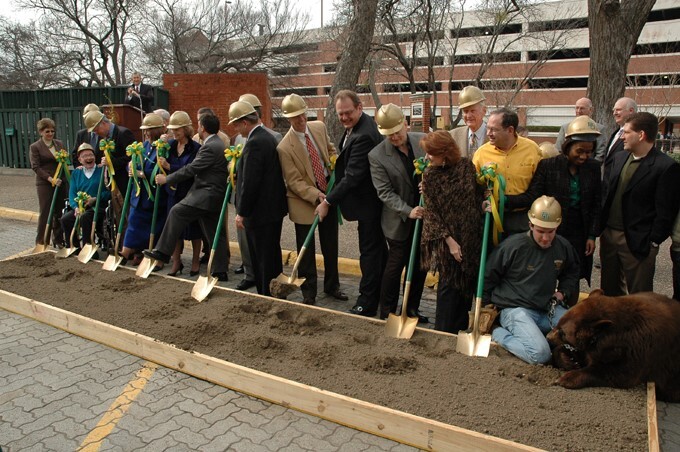
Groundbreaking
In 2005, Baylor University began work on a new and improved bear habitat. The university recommitted to providing the very best environment and care for the bear mascots after animal rights activists expressed concern over the mascots’ treatment. | Source: Image courtesy of Baylor University: Media and Public Relations, https://news.web.baylor.edu/news/story/2005/bear-habitat-groundbreaking-photo-feature#&gid=1&pid=12.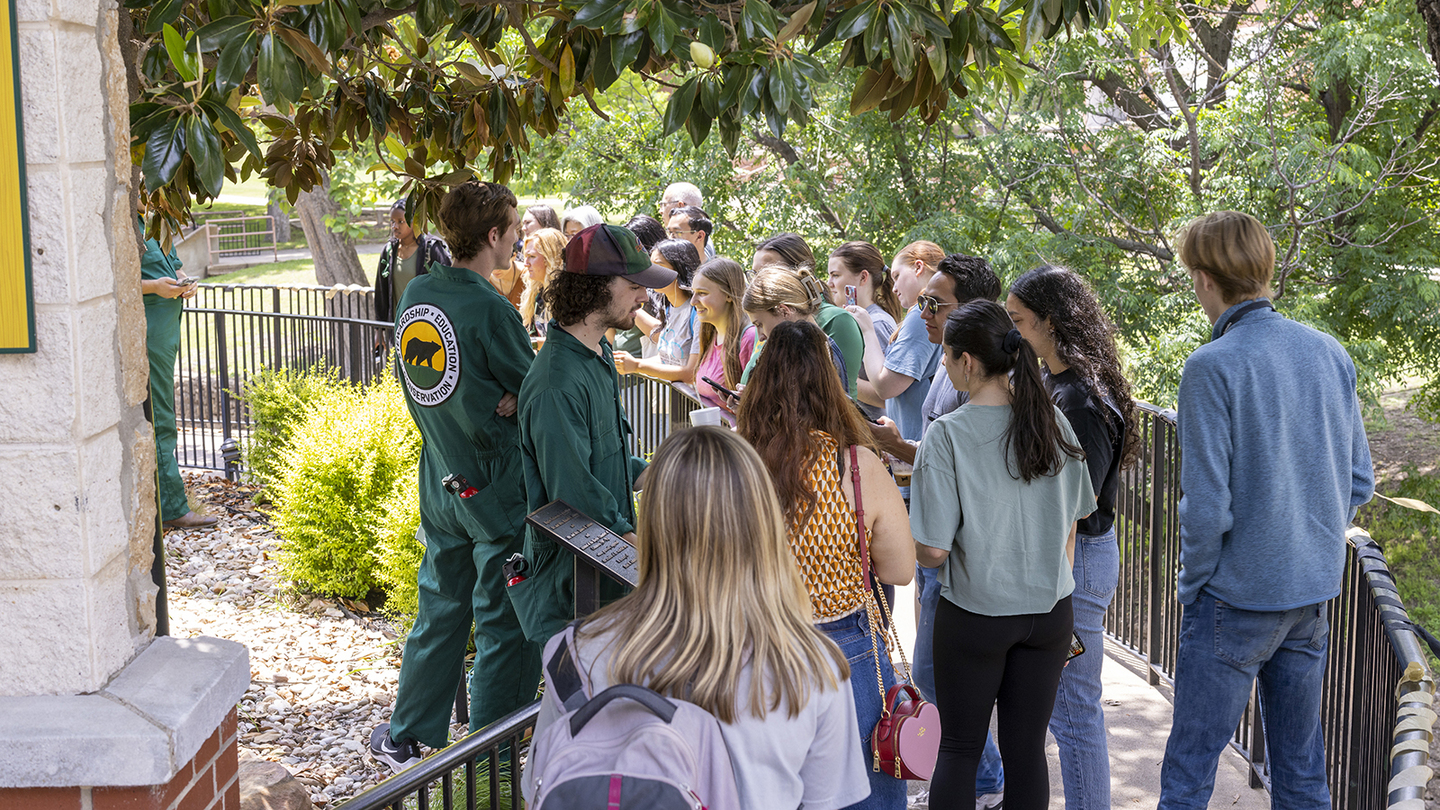
Bear Aware
One of the guiding pillars of the Baylor bear habitat is education. The Bear Program provides members of the university as well as the Waco community with information both about Baylor’s bears and black bears in general. | Source: Image courtesy of Baylor University: Baylor Bear Habitat, https://bearhabitat.web.baylor.edu/about/bill-eva-williams-bear-habitat.
High Visibility
Chamberman David Hornbeak was a member of the Bear Program Lead Team in 2013 and 2014. Hornbeak discusses the importance of the bear habitat as one of the most popular places to visit on campus. | Source: Hornbeak, David, interviewed by Clint Patterson, May 15, 2014, in Waco, Texas. Baylor University Institute for Oral History, Waco, Texas. Access full interview here.Plans for a New Habitat
Doctor Adam Ylitalo worked with the bear program as a trainer in the early 2000s. Ylitalo describes the process that came before the building of the Bill and Eva Williams Bear Habitat. | Source: Ylitalo, Adam, interviewed by Clint Patterson, August 7,2014, in Waco, Texas. Baylor University Institute for Oral History, Waco, Texas. Access full interview here.The Legend of the Stolen Mascots
Trainer Gordon Smith worked with the Bear Program in the late 1950s and was on the Baylor track team. Smith recalls a group of Baylor students fooling the rest of the university. | Source: Smith, Gordon, interviewed by Clint Patterson, November 29, 2014 in Waco, Texas. Baylor University Institute for Oral History, Waco, Texas. Access full interview here.