Lewis "Les" Ritcherson
Text
Lewis “Les” Ritcherson, born in Hillsboro, Texas in 1926, was the first African American to coach at the University of Wisconsin and the second African American football coach in the Big Ten. Ritcherson began his football career at A.J. Moore High School in Waco. As a senior, he earned All-District Defensive End as Moore High took home the 1942 district title. The team’s talent caught the eye of HBCUs around Texas, and Wiley College in Marshall offered Ritcherson a football scholarship.
Ritcherson attended Wiley from 1943-1946, playing football and basketball all four years and running track for two years. Wiley had an exceptional football program and won the Southwest Athletic Conference three out of Ritcherson’s four years as a player. Wiley’s coaches, Fred and Harry Long, were renowned among Black football coaches. In 1945, the football team went 10-0 and won the Orange Blossom Classic, the national championship game for HBCU football teams, against Florida A&M. Ritcherson’s performance that season and particularly in that game led to renowned sportswriter Fay Young naming him an end on his Black All-American team, an honor that came with a five-dollar prize.
After a short stint as football and debate coach in Midland, Texas, A.J. Moore High School hired Ritcherson in 1950 as head football coach. Moore High under Ritcherson went on to be state champion in 1952 and 1965 and state co-champion in 1951 and 1960. Ritcherson, at the urging of assistant coaches and players, started his son, Lewis Ritcherson Jr., at quarterback his last three years at Moore High. Coaching at Moore High was not without its struggles. The Black teams in the area played midweek games because the white schools played on weekends. This meant that the team often had to travel as far as Dallas or even Corpus Christi on school nights, and often the team bus got in so late that players and coaches would spend the rest of the night in the school gym.
In 1966, the University of Wisconsin-Madison (UW-Madison) sent assistant coach Deral Teteak to Texas to scout players. Teteak was impressed by Ritcherson’s coaching during his stop at Moore High, and soon after, Wisconsin Head Coach Milt Bruhn offered Ritcherson the position of receiver’s coach at the university. Although initially unsure about leaving Moore High, Ritcherson decided to take the job. He negotiated an unusual five-year contract with the university after hearing that administration might fire Bruhn the next year. Ritcherson was the first African American coach in any sport at the University of Wisconsin. At this time, Iowa’s Frank Gilliam was the only other Black football coach in the Big Ten.
As expected, the university replaced Bruhn after the 1966 season and hired John Coatta, a former Badger quarterback, to replace him. Coatta hired many of his former teammates as assistants. They greatly influenced his coaching decisions and upended the chain of command. These coaches were also extremely hard on their players, a tactic which Ritcherson felt to be unnecessary, especially when it was not improving the quality of the team.
In the sixties, considerable tension existed between Black and white students on campus, and this tension was prevalent between players and coaches on the football team. Many of the coaches treated the Black players poorly and would not pay attention to the players’ grievances. This led some of the Black players to boycott the team banquet. They also threatened to boycott a game against Minnesota, but Ritcherson felt that such an action could endanger their scholarships, and he talked them out of it. Despite the coldness of the coaching staff, the UW-Madison Athletic Board strove to help the Black players. The board even hired a psychiatrist to examine the players and coaches and suggest new ways to improve both their relationships and the team environment as a whole.
The prejudice of the other coaches affected Ritcherson as much as it affected the players. They often held meetings without him or ignored his opinion when making decisions. Ritcherson especially struggled with the lack of his peers on the staff. To remedy this, he organized the first meeting of Black coaches at predominantly white institutions at the 1970 American Football Coaches Association convention.
After he retired from coaching in 1970, Ritcherson took a job as an affirmative action officer first at UW-Extension, then back at UW-Madison. As an affirmative action officer, Ritcherson’s job was to encourage university departments to hire minorities. It was often difficult to convince departments to hire minorities because of what Ritcherson called the “old buddy system.” This meant that the departments only wanted to hire people they already knew. Despite this and other obstacles, Ritcherson made considerable progress in the university. One of his biggest successes was the program he set up with the nursing school to recruit from North Carolina A&T and Tuskegee Institute. Ritcherson was also instrumental in the creation of the Afro-American Studies Program and encouraged its administrators to hire a diverse staff.
Ritcherson retired from administration in 1990. He has since been inducted into the Texas Sports Hall of Champions and the Waco Independent School District Athletics Hall of Fame. When he passed away in 2019, Lewis Ritcherson had created a lasting impact both on the university and on his players. While he as an individual might not have much national renown, it was his effort and the efforts of all the Black coaches, players, and administrators that were willing to suffer injustice to set a precedent that broke the color line in college sports.
Files

Better Under Bruhn
Ritcherson enjoyed his first season at UW-Madison with Milt Bruhn as Head Coach. Bruhn welcomed Ritcherson with open arms, inviting him and his wife over for dinner often and introducing him to other Big Ten coaches. | Source: Image Courtesy of UW Archives, photograph. University of Wisconsin-Madison. https://reckoning.wisc.edu/athletics/#the-color-line-in-college-athletics.
Alma Mater
Lewis Ritcherson coached at A.J. Moore High School in Waco from 1950-1966. A teacher as well as a coach, Ritcherson always emphasized the importance of education for his players and would make sure they went to class even if they had been up to the wee hours of the morning because of a game. | Source: Image courtesy of Ritcherson, Rod. “Les Ritcherson,” photograph. Madison 365, 2018. https://madison365.com/uws-first-black-football-coach-knew-what-he-was-getting-into-and-came-anyway/.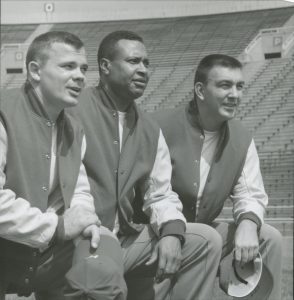
Job Security
The five-year contract Ritcherson insisted on when he was hired was unusual for an assistant coach, but it protected him during the overhaul of the coaching staff that took place after Bruhn was let go. Some of Bruhn’s other assistant coaches were displeased when they learned about this contract. | Source: Image Courtesy of UW Archives, “Members of the 1966 coaching staff,” photograph. University of Wisconsin-Madison. https://www.library.wisc.edu/archives/exhibits/african-american-athletes-at-uw-oral-history-project/.
Like Father, Like Son
Lewis Ritcherson Jr. enjoyed football as much as his father. The two would often watch film together, and Lewis Jr. knew his father’s playbook better than anyone else on the team. | Source: Image Courtesy of UW Archives. “Lew Ritcherson Jr.,” photograph. University of Wisconsin-Madison, 2019. https://diversity.wisc.edu/2019/12/remembering-uws-first-black-football-coach/.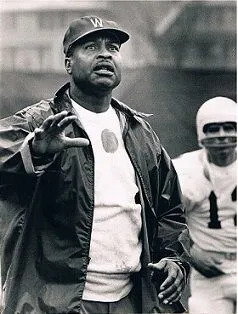
Father Figure
Despite his rocky relationships with the other coaches, Ritcherson had a good rapport with many of the players, who looked up to him as both coach and mentor. He often had out-of-state players over for holidays, and many of them kept in touch with him through the years. | Source: Image Courtesy of Rod Ritcherson, photograph. Madison 365, 2018. https://madison365.com/uws-first-black-football-coach-knew-what-he-was-getting-into-and-came-anyway/.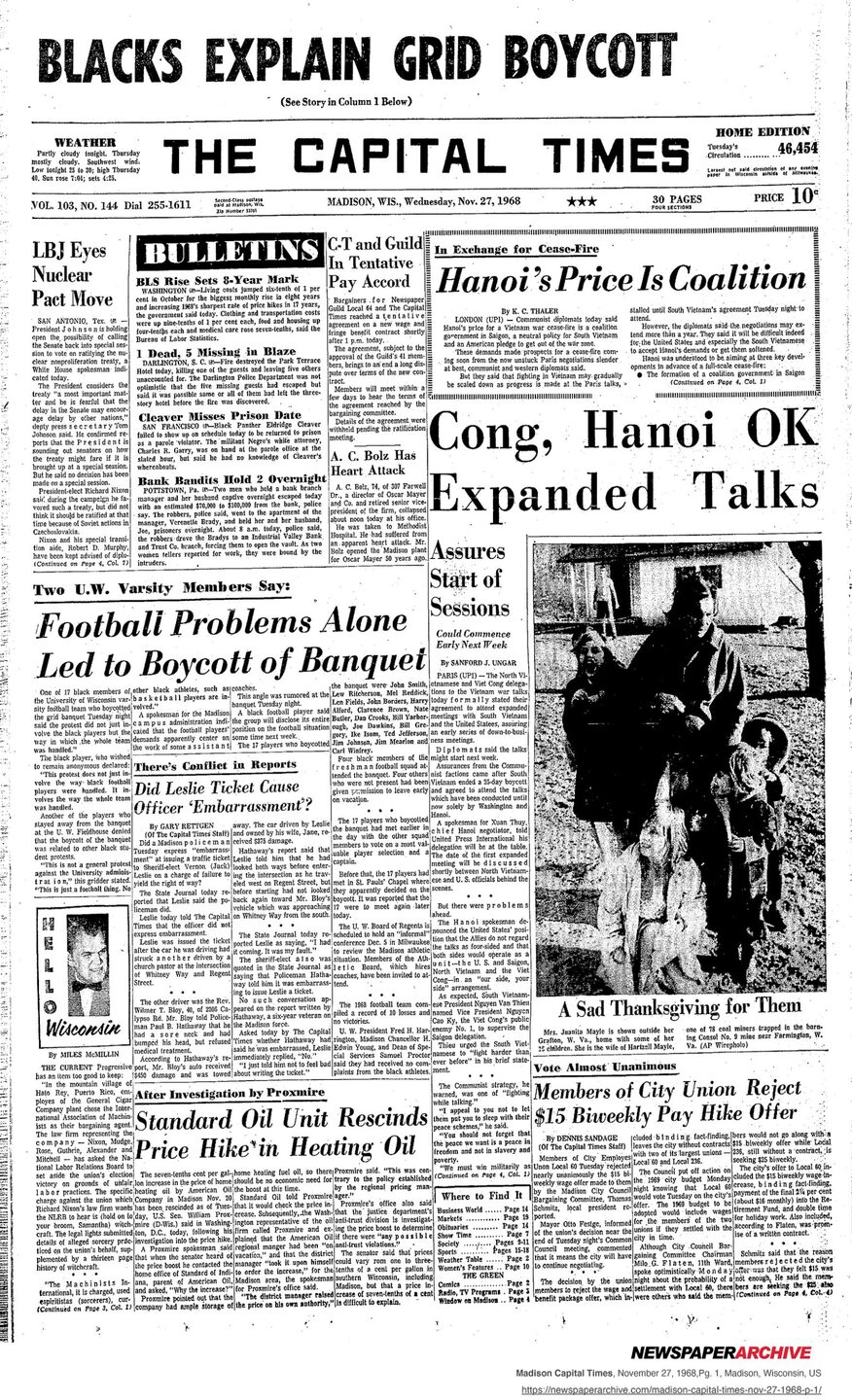
Making a Statement
In 1968, many of the Black football players boycotted the team banquet in an effort to bring attention to their poor treatment. Several of the coaches were harder on the Black players than the white players, forgave their mistakes less often, and employed a practice known as positional stacking, or putting all the Black players in the same few positions. | Source: Image Courtesy of UW Archives, photograph. University of Wisconsin-Madison. https://reckoning.wisc.edu/athletics/#the-color-line-in-college-athletics.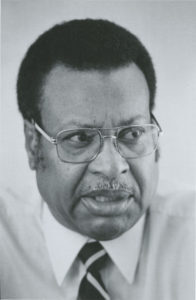
Advocate
After his five years coaching football at UW-Madison, Ritcherson became Assistant to the Chancellor for Affirmative Action. This was a good fit for him: his bachelor’s degree was in sociology, his master’s degree was in guidance and counseling, and he was passionate about advancing minorities on campus. | Source: Image Courtesy of UW Archives, “Lewis Ritcherson,” photograph. University of Wisconsin-Madison, 2018. https://diversity.wisc.edu/2018/02/history-in-their-own-words-uw-madisons-first-african-american-assistant-coach-lewis-ritcherson/.
A Strong Start
Lewis Ritcherson discusses how he got his start as a high school football player at A.J. Moore High School. | Source: Ritcherson, Lewis, interviewed by Greg Bond and Troy Reeves, April 25, 2012. UW-Madison Oral History Program, Madison, Wisconsin. Access full interview here.Love at First Sight
Lewis Ritcherson tells the story of how he met his wife, Velma, at Wiley College. | Source: Ritcherson, Lewis, interviewed by Greg Bond and Troy Reeves, April 25, 2012. UW-Madison Oral History Program, Madison, Wisconsin. Access full interview here.Building Lasting Relationships
Lewis Ritcherson recalls bonding with his players as head football coach at A.J. Moore High School. | Source: Ritcherson, Lewis, interviewed by Greg Bond and Troy Reeves, April 25, 2012. UW-Madison Oral History Program, Madison, Wisconsin. Access full interview here.All American
Lewis Ritcherson Jr., oldest son of Lewis and Velma Ritcherson, talks about winning the 1965 state championship at Moore High. | Source: Ritcherson, Lewis, Jr., interviewed by Greg Bond and Troy Reeves, October 8, 2012. UW-Madison Oral History Program, Madison, Wisconsin. Access full interview here.A Big To-Do
Reverend Marvin Griffin, former minister of New Hope Baptist Church in Waco, describes the celebration he organized for Coach Ritcherson after his 1965 State Championship win at Moore High. | Source: Griffin, Marvin, interviewed by Mark Firmin, August 12, 2008, in Waco, Texas. Baylor University Institute for Oral History, Waco, Texas. Access full interview here.Big 10 Beckoning
Lewis Ritcherson remembers his decision to take a coaching job at the University of Wisconsin-Madison. | Source: Ritcherson, Lewis, interviewed by Greg Bond and Troy Reeves, May 2, 2012. UW-Madison Oral History Program, Madison, Wisconsin. Access full interview here.Stuck in the Middle
Lewis Ritcherson Jr. recounts some of the issues his father faced while coaching at UW-Madison. | Source: Ritcherson, Lewis, Jr., interviewed by Greg Bond and Troy Reeves, October 8, 2012. UW-Madison Oral History Program, Madison, Wisconsin. Access full interview here.