St. James United Methodist Church
Text
St. James United Methodist Church, originally a Methodist Episcopal church, has existed almost as long as the city of Waco itself. Founded in 1874 by Anderson Brack, a formerly enslaved man, the congregation started with roughly fifty-three members. On the banks of the Brazos River, they worshipped, communed together, and worked to establish a permanent brick-and-mortar building that would serve as a central location for their Christian community. Along with the church, St. James also established a school that provided education to Black children in the Waco area. As they sought to secure a steady meeting place, though, they faced difficulty and discrimination.
Built in 1889, their original building at Second and Ross Streets was the first brick church for African Americans in Waco. St. James, established after Mt. Zion, was the second African American church in the city. After the city of Waco condemned their new building, they built a larger tabernacle in 1909 in the same location. They worshipped there until 1922. That year, the San Antonio and Aransas Pass Railroad Company purchased the property, citing eminent domain, and the St. James congregation built once more. This time, on Second and Clay Avenue.
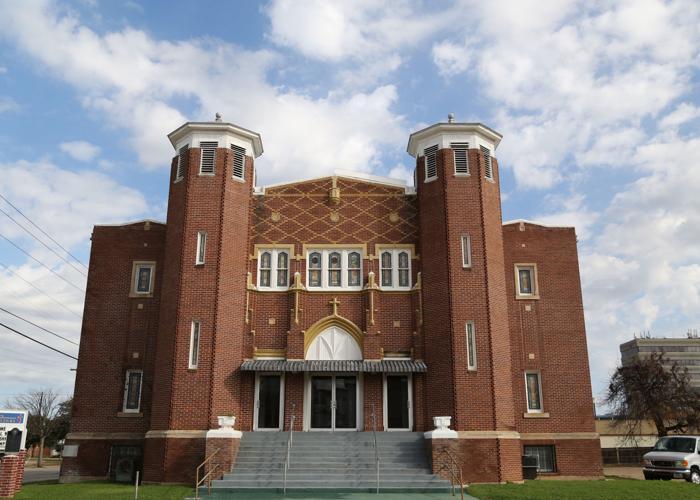
Under the leadership of Pastor C. S. Williams, the congregation broke ground on the church in March 1924. Utilizing bricks from their previous tabernacles inside the new structure, St. James memorialized and honored the history of their church. Architect Carleton Adams, who garnered statewide and national attention for his home and building designs in San Antonio, developed plans for the Tudor Gothic-style structure. While members were eager to meet in the new location, the congregation experienced financial strain in the years to come after accumulating $85,000 in debt to construct the building, which took thirty-two years to repay.
At Second and Clay, St. James committed themselves to racial justice initiatives in the community as well as interracial partnerships. During the Great Depression, they offered a daily soup kitchen to Wacoans in need. They also held meetings for the “Waco Forward” movement of the 1920s that launched as a local effort to assist those struggling amid economic stagnation. Waco Forward hoped to improve Waco’s economy and usher in an era of progress and stability. St. James also hosted other interracial events, including concerts and women’s groups, as well as a “Race Relations Sunday” service in February 1945. There, they called for attendees to “build a nation and a world where there shall be no discrimination on the basis of color, creed, or national origin.”
After its formation in 1936, the McLennan County chapter of the National Association for the Advancement of Colored People (NAACP) met multiple times at St. James. At an “NAACP Sunday” event in 1951, which occurred during the civil rights movement, the McLennan County chapter formed a plan that addressed local and national needs. They also hosted another notable meeting in 1955, where the organization expressed their support of the “Free by ‘63” campaign. This campaign effort raised funds for numerous legal cases taking place during the movement. Those a part of the NAACP and the church sought to address and end discrimination in Texas and across the country.
Important to Waco and St. James, multiple prominent members worked within and outside of the church. Robert L. Smith, one of the first Black Americans elected to the Texas House of Representatives in 1894, attended St. James. Prior to his arrival in Waco, Smith established the Farmers’ Improvement Society, which aided farmers who had fallen into extensive debt. Inescapable debt particularly impacted previously enslaved people who turned to sharecropping and tenant farming after emancipation. As Smith worked for these communities in Waco, he also served as a steward and legal adviser for the church. J. J. Flewellen and Professor J. S. Henry, principals at Carver High and Kirk Elementary, also attended St. James. Both schools offered educational opportunities to Black students in Waco. Lonnie Morris Belle Hodges, the church’s historian, strove to bring attention to the history of St. James. As the only living descendent of St. James’s charter members with continuing membership, Hodges worked to attain recognition for the history of the congregation and building. In 1986, the building received a Recorded Texas Historical Marker due to her efforts.
The congregation continued to grow over the years, exceeding over six hundred members during their strongest periods. Yet, by 2015, St. James had dwindled once more to fewer than sixty congregants. Deciding to focus more on fellowship and community rather than upkeep of an aging structure, they placed the historic building on the market. The church received a City of Waco Historic Landmark in 2017 and was placed on the National Register of Historic Places on September 12, 2019. St. James remains the only religious structure on the National Register of Historic Places in Waco. The building, purchased by local Wacoans Amy and Lane Murphy, remains a prominent historical landmark for the city. As they transition the church into a restaurant and event space, they plan to preserve the history of the congregation and the building. Members of St. James now meet in another location in Waco, joining with Wesley United Methodist Church each Sunday. There, they continue to commune and worship together. Through the remaining congregation and renovation efforts at Second and Clay, the long history of St. James United Methodist Church persists in Waco.
Files
Trials, Tribulations, and Towers
Though forced to relocate from their original location, St. James members looked forward to the construction of their church. The design, like inspired by the St. Paul United Methodist Church in San Antonio, contained architectural elements frequently utilized in Tudor Revival and Gothic Revival structures. The towers and Gothic arches above the entrance point to these influences. | Source: Associated Press. “Exterior of St. James,” photograph. Bismarck Tribune. 2015. https://bismarcktribune.com/st-james-methodist-church-building-in-waco-for-sale/article_2802fc28-92cc-50bf-9600-5b52163a282a.html.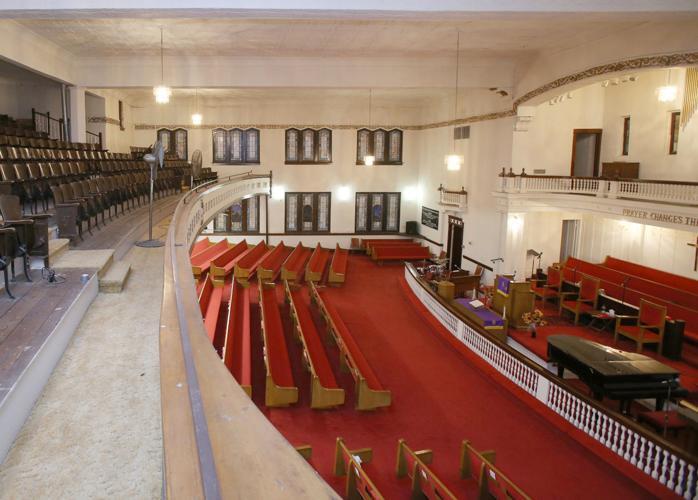
Sacred Space
On Sunday mornings, members of St. James gathered in the historic sanctuary at Second and Clay. Wooden pews, red carpeting, decorative millwork, and a large balcony formed the space, as well as stained glass windows, which offered beautiful depictions of biblical scenes. | Source: Larson, Jerry. “View of Sanctuary,” photograph. Waco Tribune-Herald. 2015. https://wacotrib.com/news/local/dwindling-flock-of-st-james-methodist-church-looks-to-sell-downtown-waco-landmark/article_e0997010-2c24-502a-9ae8-bfe610f29afb.html.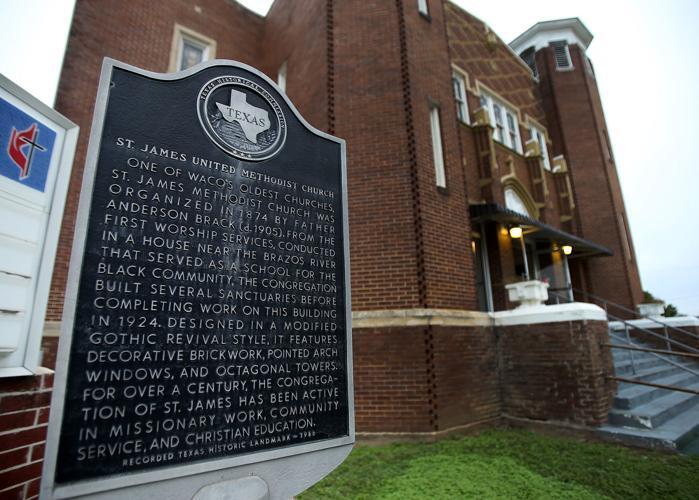
Making a Mark
Since acquiring approval for placement on the National Register of Historic Places, Second and Clay owners Lane and Amy Murphy qualify for federal tax credits for the building’s renovation. They plan to house an Italian-inspired restaurant, meeting space, and performance hall inside the building. | Source: Larson, Jerry. “Marker in front of church,” photograph. Waco Tribune-Herald. 2018. https://wacotrib.com/business/public-money-to-back-italian-restaurant-preservation-in-former-st-james-methodist-church/article_eb69758f-901c-50fc-a0be-895c4e9079d3.html#tracking-source=in-article.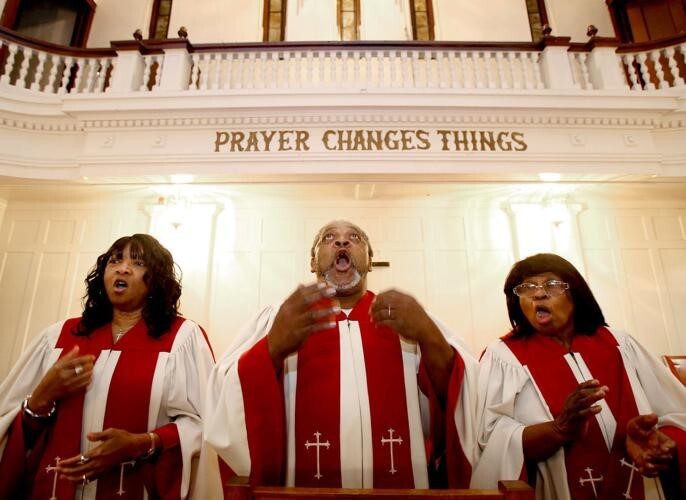
Prayer Changes Things
At the center of the sanctuary, St. James United Methodist Church inscribed the reminder that “Prayer Changes Things.” For nearly one hundred years, congregants read and reflected on that message. | Source: Larson, Jerry. “Choir in Sanctuary,” photograph. Waco Tribune-Herald. 2015. https://wacotrib.com/news/local/dwindling-flock-of-st-james-methodist-church-looks-to-sell-downtown-waco-landmark/article_e0997010-2c24-502a-9ae8-bfe610f29afb.html.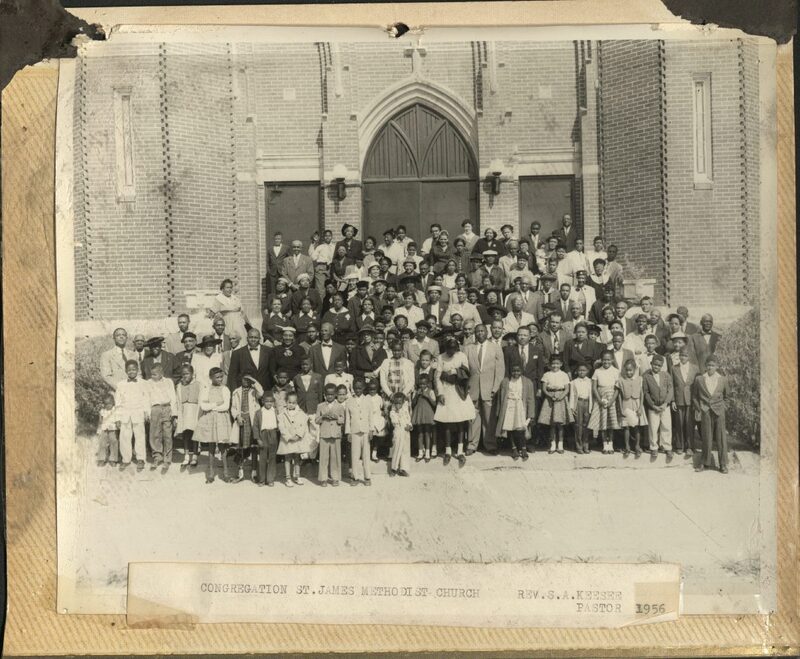
Gathering Together
At Second and Clay, the St. James congregation met together faithfully each Sunday for ninety-two years. Though now meeting in a smaller house of worship in Waco, the congregation continues to honor the traditions of the congregations who met before them. | Source: “Congregation St. James Methodist Church,” photograph. St. James United Methodist Church Archives, Facebook. 1956. https://www.facebook.com/wacostjameshistory/photos/a.2312466825647652/2468965573331109.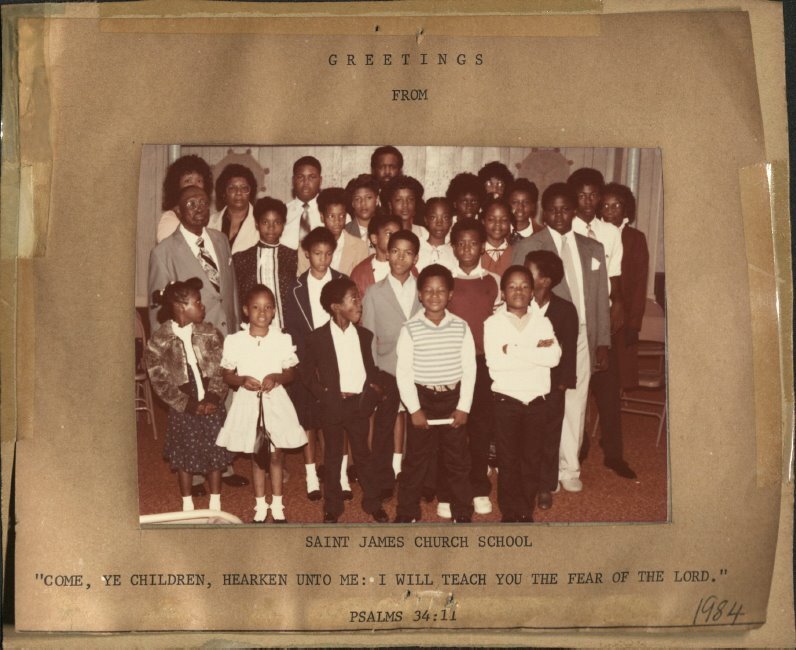
Education and Opportunity
At the time of its formation in 1874, St. James provided a school for Black children in the area. The school continued to function throughout the early-mid twentieth century as white, segregated schools in the area refused to accept Black students. A.J. Moore High School, Waco’s African American High School, held classes at St. James after their building burned down in 1921. | Source: “Saint James Church School,” photograph. St. James United Methodist Church Archives, Facebook. 1984. https://www.facebook.com/wacostjameshistory/photos/a.2312466825647652/2468966303331036.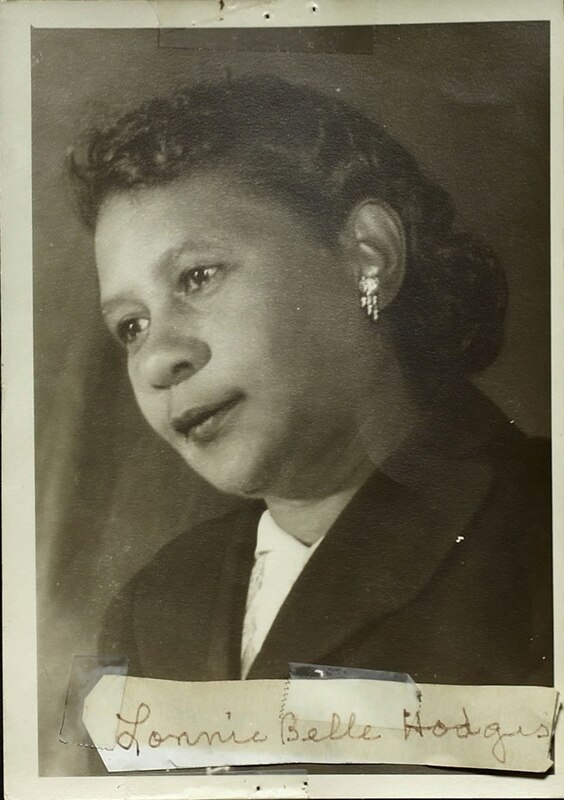
History Maker
As a historian, teacher, wife, mother, and dedicated member of St. James United Methodist, Mrs. Lonnie Belle Morris Belle Hodges worked and served in her community, home, and church. Throughout her life, she endeavored to “impart knowledge to children and to help mold them into Christian and morally upstanding individuals.” | Source: “Lonnie Belle Morris Hodges,” photograph. St. James United Methodist Church Archives, Facebook. https://www.facebook.com/wacostjameshistory/photos/a.2312466825647652/2312490818978586.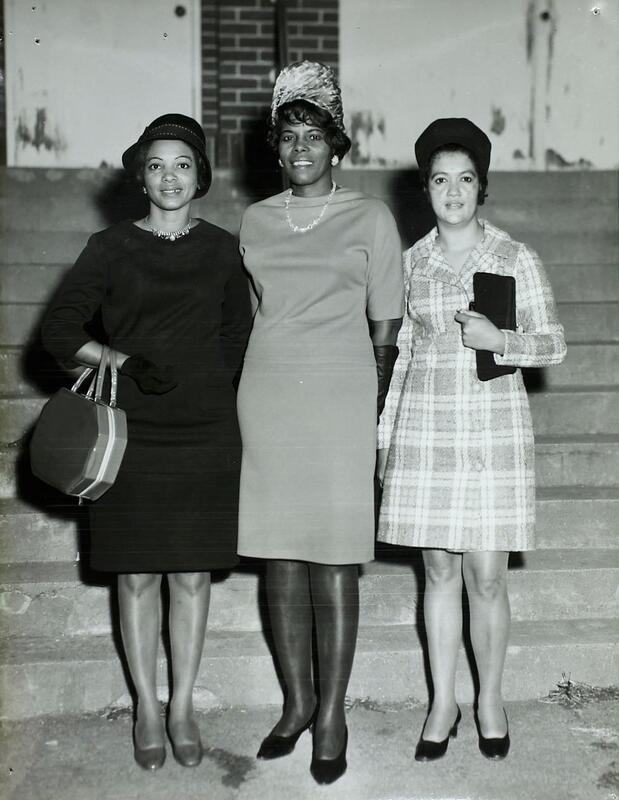
Sunday Best
Ella Mae Jones (left), Ethel Gooden (middle), and Mildred Ballou (right) pose in front of the church steps on a Sunday morning. | Source: “Members in front of church,” photograph. Saint James United Methodist Church Archives, Facebook. https://www.facebook.com/wacostjameshistory/photos/a.2312466825647652/2312490958978572
Sojourning Sanctuary:
Before St. James built at Second and Clay Avenue, the tabernacle they worshipped in was located a block over, on Second and Ross Street. Lonnie Belle Hodges notes that she was born in, baptized in, and joined the church in that original location. | Source: Hodges, Lonnie Belle. Interviewed by Vivienne Malone-Mayes. August 30, 1990, in Waco, TX. Baylor University Institute for Oral History, Waco, TX. Access full interview here.Documenting the Past:
As the church historian, Hodges emphasizes the importance of collecting stories and materials from previous church members. Her efforts to document the church’s history resulted in a historical marker to celebrate the congregation’s 100-year anniversary and a historical room inside the church that was named in her honor. | Source: Hodges, Lonnie Belle. Interviewed by Courtney Williams. February 17, 1993, in Waco, TX. Baylor University Institute for Oral History, Waco, TX. Access full interview here.Generational Ties:
Hodges recalls that her family was a part of the Methodist tradition since emancipation, and they joined St. James Episcopal Methodist upon moving to Waco. She also notes that New Hope Baptist and Mt. Zion Methodist worshipped together in North Waco throughout the late nineteenth century. | Source: Hodges, Lonnie Belle. Interviewed by Vivienne Malone-Mayes. August 30, 1990, in Waco, TX. Baylor University Institute for Oral History, Waco, TX. Access full interview here.Mother Methodist Church:
Though St. James was the first African American church with a brick building, Hodges explains that Mt. Zion Methodist Church was the first African American congregation in the city. | Source: Hodges, Lonnie Belle. Interviewed by Vivienne Malone-Mayes. August 30, 1990, in Waco, TX. Baylor University Institute for Oral History, Waco, TX. Access full interview here.Church Chronology:
Reflecting on St. James original location and its transition to Second and Clay, Hodges discusses the founding of the church and its movement over time. | Source: Hodges, Lonnie Belle. Interviewed by Courtney Williams. February 17, 1993, in Waco, TX. Baylor University Institute for Oral History, Waco, TX. Access full interview here.A Building’s Beginnings:
Clemmie Holloway Long tells of the church’s developments over time, describing when St. James began its move from the location on the Brazos River to the building on Second and Clay. | Source: Long, Clemmie Holloway and Willie Long Smith. Interviewed by Rebecca M. Sharpless. April 16, 1985. Baylor University Institute for Oral History, Waco, TX. Access full interview here.